ChatGPT vs Gemini: Which AI Assistant Is Better in 2026?

ChatGPT vs Gemini: compared across features, pricing, coding, and research. Discover their key differences and choose the right AI tool.
The choice between Gemini and ChatGPT has become quite challenging as the capabilities of both platforms expand beyond simple text-based conversations. From generating code and analyzing documents to writing blog posts, creating images, conducting research, and improving productivity, both platforms offer diverse capabilities.
However, the ChatGPT vs Gemini comparison is more than evaluating which platform generates the best answer. Their reasoning capabilities, subscription plans, features, integrations, and performance across diverse tasks can help determine which one provides greater value. Gemini benefits from Google’s support and ecosystem, while ChatGPT provides a more versatile AI workplace ecosystem. These advancements also highlight the growing role of AI chatbot development in creating more capable and interactive digital assistants.
So, which assistant is better to pick in 2026? Well, the answer depends on how you work, what are your workflows, and which tools you are already using. In this guide, we are going to explore the major Gemini vs ChatGPT differences, evaluate their performance across multiple use cases, and compare models and pricing to help you choose which one best fits your needs.
Quick Answer: ChatGPT vs Gemini: Which AI Assistant Is Better?
ChatGPT is a strong choice for coding, research, complex AI workflows, writing, and reasoning. On the other hand, Gemini is a better option for users working around Google’s Workspace such as Gmail, Drive, or Docs. In this ChatGPT vs Gemini 2026 comparison, neither can be titled as the best choice. The best assistant is the one that aligns with your workflows, requirements, preferred tools, and budget.
What Is ChatGPT?
Developed by OpenAI, ChatGPT is an AI assistant that helps with content generation, writing code, performing everyday tasks, solving problems, and analyzing information. Backed by OpenAI’s GPT model, it supports advanced reasoning, voice interactions, text conversations, image analysis, and document processing.
Based on available tools and plans, users can also depend on ChatGPT for Deep Research, image generation, web search, and data analysis. These capabilities make it a useful platform for students, businesses, individuals, and developers looking for a versatile AI workspace.
What Is Gemini?
Gemini is powered by Google’s model family, making it a suitable platform for coding, reasoning, content creation, research, and multimodal analysis. Depending on the feature and model available, Gemini also works across images, video, text, audio, and documents. Its integration with Google’s ecosystem is the main differentiator, which connects AI capabilities to streamline work across Google Docs, Drive, and Gmail.
In short: Gemini and ChatGPT both are designed with broad AI capabilities. ChatGPT is built within OpenAI’s assistant platform, while Gemini brings Google’s AI models along with its wider product ecosystem. Comparing their pricing, real-world use cases, and features can help get a clear understanding of major differences.
ChatGPT vs Gemini: Key Differences at a Glance
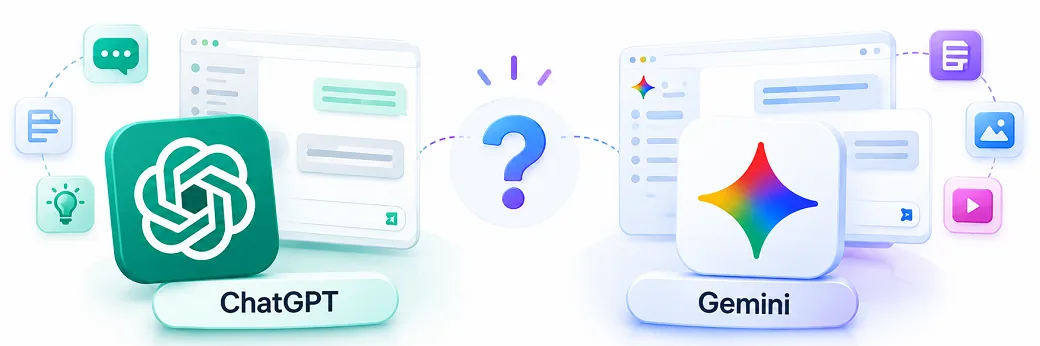
ChatGPT and Gemini may overlap across several functionalities and capabilities, but they still differ in tools, ecosystems, model families, and integrations. The table below offers a quick comparison of their capabilities.
| Category | ChatGPT | Gemini |
| Developer | OpenAI | |
| AI model family | GPT-5.6 family and GPT-6 Pro on eligible plans | Gemini 3.1 Pro and other Gemini models |
| Free access | Available with usage limits | Available with usage limits |
| Paid plans | Go, Plus, Pro, Business, Enterprise | Google AI Plus, Pro, Ultra and business offerings |
| Reasoning | Advanced reasoning with dedicated thinking options | Advanced reasoning with higher-tier Gemini models |
| Multimodal capabilities | Text, images, files, voice and other supported media | Text, images, audio, video, files and other supported media |
| Web/search capabilities | Web search and research tools | Google Search and AI-powered research capabilities |
| Coding | Code generation, debugging, analysis and development workflows | Code generation, analysis and Google-focused developer tools |
| Research | Deep Research and source-based research workflows | Deep Research and Google Search-powered research |
| Image generation | Image generation and editing | Image generation and editing |
| Video capabilities | Video-related capabilities vary by product and plan | Video generation through Google's AI tools and services |
| Productivity | Projects, connected tools, analysis and AI workflows | Strong integration with Google productivity applications |
| Integrations | Broad tools, apps and connected workflows | Deep integration with Google apps and services |
| Customization | Custom GPTs and configurable AI workflows | Gemini customization and Google AI workflows |
| Enterprise capabilities | Business and Enterprise plans with security, administration and advanced AI capabilities | Google Workspace and Gemini Enterprise with governance and Workspace integration |
| Best suited for | Versatile, general-purpose AI workflows | Google-centered productivity and multimodal workflows |
Build Smarter AI Solutions for Your Business
Turn your ideas into intelligent, scalable solutions with expert AI development services tailored to your business goals.
Consult AI ExpertsChatGPT vs Gemini: Features and Capabilities Compared
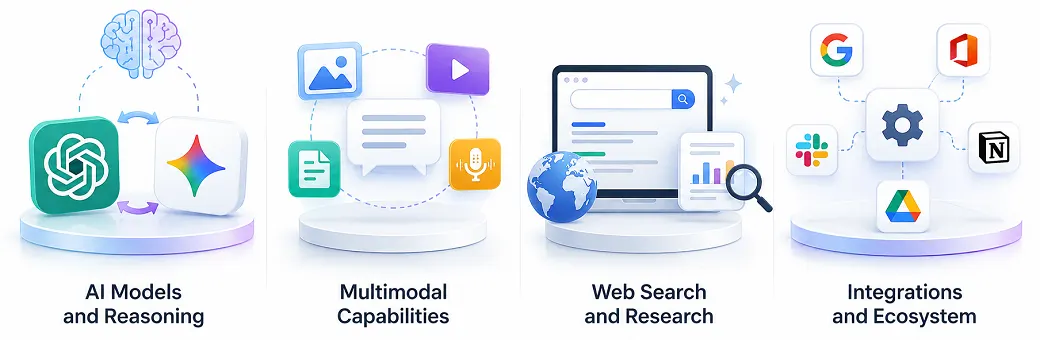
Gemini and ChatGPT have emerged as broad AI platforms rather than simple chatbots. Although both platforms support multimodal interactions, productivity tasks, reasoning, and research, their tools, ecosystems, and models differ.
AI Models and Reasoning
ChatGPT is backed by OpenAI’s model family along with various modes and other models also that simplify advanced reasoning, complex problem-solving, everyday tasks, and coding. Gemini leverages Google’s model family, which helps with more advanced reasoning as well as faster everyday assistance.
Both platforms are suited to solve complex problems, work across multiple content types, analyze information, and follow detailed instructions. The practical difference often comes down to the specific model, plan, and task rather than the platform name alone.
Multimodal Capabilities
Both platforms support multimodal AI, ensuring users can work more than just text-inputs. ChatGPT can easily process images, voice interactions, text, and documents as well as its image-generation capabilities extend simple analysis. Gemini also allows users to work with images, video, text, audio, and documents, making it a strong choice for users that depend on large-context inputs.
Web Search and Research
Both Gemini and ChatGPT can help with web searches, information synthesis, latest-information research, and source discovery. ChatGPT’s Deep Research functionality supports multi-step research to produce detailed reports along with citations. For research-oriented capabilities connected with Google’s search, Gemini is a suitable choice. For complex research, users must consider citation accuracy, ability to synthesize information, source quality, and depth instead of relying only on search speed.
Integrations and Ecosystem
One of the clearest differences between both is ecosystem integration. ChatGPT offers an extensive standalone AI environment involving connected services, business capabilities, tools, and custom workflows. Gemini is beneficial for users who work within Google's workspace. Therefore, Gemini integrations are naturally valuable for Google-centric organizations, while ChatGPT integrations are preferable for users seeking a flexible AI workspace.
ChatGPT vs Gemini: Which Is Better for Different Use Cases?
The choice between Gemini and ChatGPT will depend on specific tasks or workflows. Both AI assistants are capable enough to code, analyze information, write, research, and work with multimodal content. However, both actually differ in integrations, workflows, and how tasks are performed.
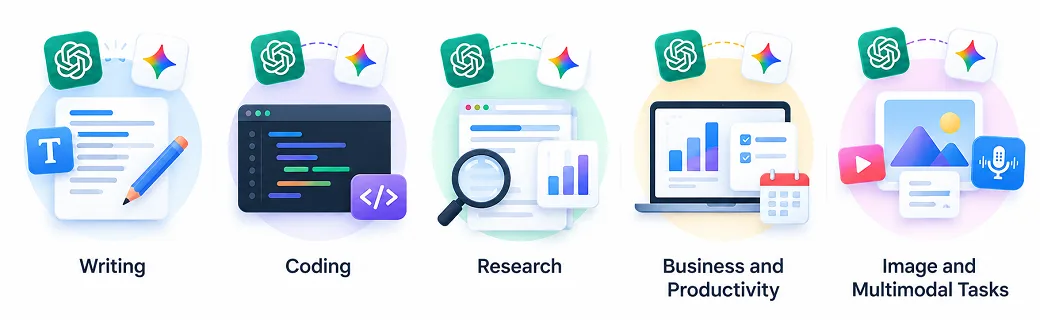
Writing
Winner: ChatGPT for most writing workflows
For copywriting, creative content, blog writing, editing, and tone adaptation, ChatGPT is the strongest choice. It is specifically useful for writers who work on refining drafts through multiple iterations, maintain a specific voice, or follow detailed instructions. Gemini can also be used for high-quality content generation and writing.
Best for: Writers, marketers, content teams, and professionals who need flexible content creation and editing.
Coding
Winner: ChatGPT for general development workflows
Both tools can explain programming concepts, assist with development tasks, generate code, and debug errors. For iterative debugging, problem-solving tasks, development, and code explanation, ChatGPT is an all-around coding assistant. Gemini is specifically preferred for Google-focused development workflows.
Best for: Developers who need an AI coding partner for generation, debugging, explanation, and iterative problem-solving.
Research
Winner: Depends on the research workflow
Gemini and ChatGPT are both suitable choices to synthesize multiple resources as well as for latest-information research. ChatGPT can easily plan and perform multi-step research through selected websites or files to produce detailed reports with citations. Gemini is usually preferred for extensive contextual information workflows.
Best for: Researchers, analysts, students, and professionals who need source-based research and information synthesis.
Business and Productivity
Winner: ChatGPT for broad AI workflows; Gemini for Google Workspace users
ChatGPT supports documents, brainstorming, coding, emails, data analysis, research, and advanced AI workflows. On the other hand, Gemini is beneficial for organizations who heavily rely on Google Workspace, as its capabilities go beyond just a chatbot.
Best for: ChatGPT for diverse AI workflows; Gemini for businesses deeply invested in Google Workspace.
Image and Multimodal Tasks
Winner: Depends on the task
Both platforms provide multimodal interactions including images, text, and other media. ChatGPT can be used to edit and generate images through natural-language instructions directly, while Gemini’s multimodal capabilities are more focused around Google’s AI ecosystem.
Gemini can be compelling for workflows that include Google’s broader ecosystem. For users working across image editing and creation, ChatGPT is a strong choice.
Best for: Creators, marketers, designers, and professionals working with mixed text, image, audio, or video inputs.
Ready to Turn Your AI Vision into Reality?
Partner with our experts to build custom AI solutions that streamline workflows and improve business efficiency.
Get in TouchChatGPT vs Gemini Pricing: Which Offers Better Value?
Both Gemini and ChatGPT offer free plans along with different tiers of paid subscriptions that differ in usage limits, bundled features, and pricing. The following table shows current prices as a reference. However, the actual pricing differs by plan, promotions, country, and taxes.
| Plan | ChatGPT | Gemini |
| Free | $0, with limited access to advanced features | $0, with limited access to advanced features |
| Entry paid | Go: $8/month | Google AI Plus: $4.99/month |
| Main paid plan | Plus: $20/month | Google AI Pro: $19.99/month |
| Higher-tier plans | Pro: $100, $200, or $500/month | Google AI Ultra: $99.99 or $199.99/month |
| Key benefits | Advanced reasoning, deep research, image creation, projects, custom GPTs, and expanded Codex access | Higher Gemini usage, Deep Research, Google Search features, Flow, Notebook, and Google app integration |
| Best for | Users seeking a broad standalone AI workspace | Users deeply invested in Google's ecosystem |
Current ChatGPT plans include Free, Go, Plus, as well as multiple Pro tiers along with enterprise plans that support advanced research, other capabilities, reasoning, and coding. For Gemini, the paid plans include free access, Google AI Plus, Pro, and Ultra, with high-tier plans that include access to Google’s productivity and AI ecosystem.
Well, price shouldn’t be considered the only factor to determine the best tool in a ChatGPT vs Gemini pricing comparison. A user who wants a standalone AI workspace can use ChatGPT. On the other hand, for workflows within Google’s ecosystem, Gemini is an ideal choice as its paid plans include AI features for services around Gmail, Drive, Google Search, Docs, and cloud storage. For heavy tasks, users should compare usage limits and included features, not just the monthly subscription cost.
ChatGPT vs Gemini: Pros and Cons
Both platforms offer strong functionalities and capabilities. However, the limitations and strengths may differ. Looking at the pros and cons of both assistants will help make a better decision in choosing the right tool.
ChatGPT Pros and Cons
Pros
- Versatile for writing, reasoning, coding, analysis, and general-purpose tasks
- Strong support for advanced AI workflows and productivity
- Broad range of tools and integrations
- Suitable for diverse professional and creative use cases
Cons
- Some advanced capabilities require paid access
- Usage limits can vary by plan and feature
- Its wide choice of tools may make the platform complex for users that need a simple chatbot.
Gemini Pros and Cons
Pros
- Deep integration with Google's ecosystem
- Convenient for Docs, Google Workspace, Gail, and Drive.
- Strong multimodal capabilities
- Preferred for complex AI tasks that have large contextual information
Cons
- Some advanced features will depend on subscription plan
- Capabilities and usage limits vary across plans
- Workflows outside Google’s ecosystem may not benefit from Gemini
Ultimately, the benefits of ChatGPT are focused around broad AI workflows and versatility, while Gemini’s capabilities are beneficial for connected productivity experiences and Google’s ecosystem.
ChatGPT vs Gemini: Which AI Assistant Should You Choose?
The choice between both assistants will eventually depend on your preferred ecosystem, operational workflows, and the task you want to perform. So, instead of assuming one tool as universally best, consider the one that fits your AI tasks.
Choose ChatGPT if...
As a general-purpose AI assistant, ChatGPT is best suited for coding, brainstorming, research, image generation, and complex AI workflows. Moreover, it is also ideally suitable for users who need multiple AI capabilities and features within one platform.
Choose Gemini if...
For workflows that revolve around Google Docs, Google Workspace, Gmail, and Google Drive, Gemini is a better fit. Its connection with Google’s ecosystem makes it a convenient choice for performing tasks across Google tools as well as large-context workflows.
Choose Both if...
Well, there is nothing like you only have to choose one. Most professionals use both Gemini and ChatGPT together, depending on the task. Using both is beneficial when one assistant can offer better results for specific workflows. This also helps compare results from both platforms.
Ultimately, the best AI assistant in 2026 is the one that fits your workflow most effectively.
Final Verdict: ChatGPT vs Gemini
Well, there is nothing like a single winner in this comparison, as the better assistant will depend on what your goals are and how you use it. ChatGPT is the strongest choice for writing, generating code for custom app development, and versatile AI workflows. Gemini is suitable for workflows with Google’s ecosystem such as Gmail, Drive, Google Search, and Docs.
For users who want a general-purpose assistant, ChatGPT is the suitable choice. On the other hand, Google-focused professionals prefer Gemini over ChatGPT. Ultimately, the choice is not about picking the best one; it’s about choosing the one that perfectly aligns with your business needs as well as operational workflows.