AI in Healthcare: Applications, Benefits, and Use Cases

Explore AI in healthcare, including key apps, benefits, real-world use cases, challenges, and implementation strategies for businesses.
Key Takeaways:
- AI in healthcare supports medical imaging, predictive analytics, clinical decision support, and administrative automation.
- AI-powered tools can help healthcare professionals analyze medical data, identify potential health risks, and prioritize patient care.
- Generative AI, conversational AI, and AI agents offer different ways to support clinical documentation, patient communication, and healthcare workflows.
- Key benefits of AI in healthcare include improved operational efficiency, data-driven insights, and more accessible patient services.
- Healthcare AI adoption requires careful attention to patient data privacy, algorithmic bias, system integration, and regulatory compliance.
- Successful AI implementation depends on reliable data, appropriate technology selection, clinical validation, and ongoing performance monitoring.
- Businesses developing Artificial Intelligence healthcare solutions should start with a clearly defined problem and ensure the solution meets user needs, security requirements, and operational goals.
Artificial intelligence is transforming healthcare operations by helping organizations to support clinical workflows, analyze medical data, and improve patient services. From automating administrative workflows to medical imaging, Artificial Intelligence is creating diverse opportunities for healthcare organizations to make better decisions.
Healthcare organizations are increasingly investing in AI capabilities, including AI chatbot development, machine learning, natural language processing, and more to address operational challenges such as administrative workloads. According to the ASTP hospital AI adoption report, about 71% of US hospitals have already been using AI integrated with electronic health records.
However, successful implementation will require more than just selecting an AI technology. Clinics and healthcare organizations must prioritize patient privacy, reliability, data quality, system integration, and appropriate human oversight.
In this guide, we are going to explore the key AI applications in healthcare, real-world use cases, implementation challenges, benefits, and emerging technologies. Moreover, this guide also examines how modern businesses can smoothly adopt and develop AI solutions in healthcare that can help address operational needs and challenges.
Quick Answer: How Is AI Used in Healthcare?
AI in healthcare supports clinical organization identify potential health risks, automating routine tasks, analyzing medical data, and supporting clinical decisions. Some of the most common applications of Artificial Intelligence in healthcare are predictive analytics, medical research, medical imaging, remote patient monitoring, and patient communication. The effectiveness of results still depends on appropriate validation, human oversight, reliable data, and secure integration.
What Is AI in Healthcare?
AI in healthcare refers to using intelligent technologies for analyzing operational and medical data to generate predictions, identify patterns, and automate repetitive healthcare tasks. Generally, these systems help healthcare organizations with research, patient services, and clinical decisions. Their core purpose is to support more efficient workflows and better-informed decisions.
How Does AI Work in Healthcare?
Artificial intelligence systems analyze and process information such as medical images, hospital operational data, electronic health records, and laboratory results. These systems learn from available large datasets to estimate risks, recommend actions, classify information, and generate summaries. The validation of outputs depends on the data quality and information.
Types of AI Used in Healthcare
Different types of AI applications in healthcare serve different purposes:
- Machine learning: Identifies patterns in data and predicts potential outcomes, such as patient risk.
- Deep learning: Depends on multilayered neural networks for completing tasks such as medical image analysis.
- Natural language processing (NLP): Interprets information from available medical documents and clinical notes.
- Computer vision: Examines medical images for identifying features that need immediate assistance.
- Generative AI: Generates or summarizes content related to medical information or clinical data.
- Conversational AI: For enabling communication between virtual assistants and chatbots.
All these technologies work separately as well as together within AI healthcare solutions. The actual requirement will depend on the available data, core problem being addressed, and level of reliability.
Also read: AI in Retail
Key Applications of AI in Healthcare
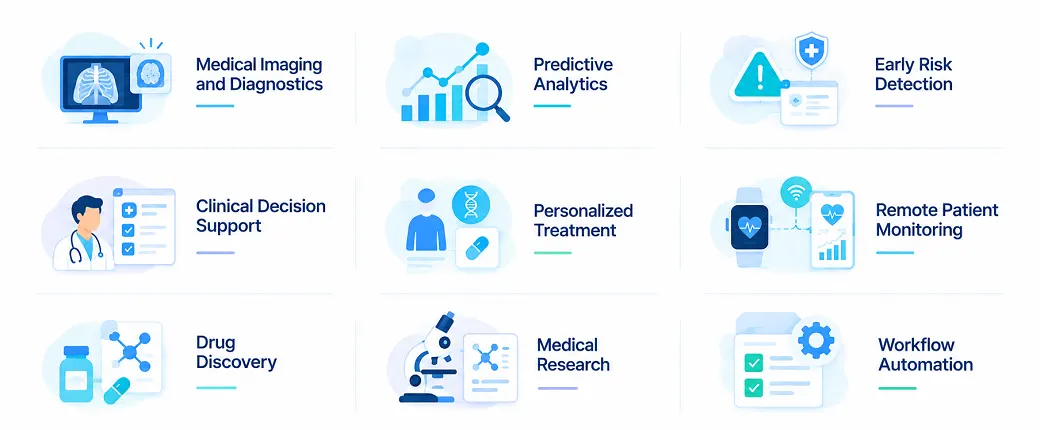
The use of AI in healthcare applications is expanding across treatment planning, medical research, diagnosis, patient monitoring, and administrative operations. Moreover, AI also helps healthcare organizations identify treatment patterns, analyze complex information, and manage repetitive tasks.
AI in Medical Imaging and Diagnostics
Computer vision helps analyze CT scans, medical images, X-rays, and MRIs to identify findings related to potential health abnormalities. These systems can also prioritize images for review, flag suspicious findings, and assist in interpreting diagnostic information. For example, AI-enabled tools are used in areas such as radiology, ophthalmology, and cardiology.
Predictive Analytics and Early Risk Detection
Using historical and current healthcare data, predictive analytics can help estimate particular outcomes. AI-powered health systems support clinics in estimating readmission risk, identifying patients at risk of deterioration, and examining health analysis. Using these insights, hospitals can allocate resources accordingly and prioritize assessment.
Clinical Decision Support and Personalized Treatment
AI clinical decision support systems can help review laboratory results, patient’s treatment history, medical literature, and other relevant information. These systems can identify potential risks, highlight treatment patterns, and evaluate treatment options. AI can also support personalized care by analyzing patient-specific information.
Remote Patient Monitoring and Virtual Care
AI analyzes the data collected through connected medical equipment, wearable devices, and remote monitoring platforms. For example, AI systems may identify changes in glucose readings, health indicators, heart rate, and activity levels that require immediate attention. For virtual patient care, these systems can support hospital staff monitor patients between appointments.
Drug Discovery and Medical Research
Medical researchers use AI to identify drug data, prioritize experiments, analyze biological data, and study molecular structures. AI can also help in organizing research literature and identifying patterns across large datasets. Although these capabilities can support initial stages of research planning, for accurate computational results still require appropriate clinical testing and laboratory investigation.
Healthcare Workflow and Administrative Automation
Artificial intelligence integration in healthcare organizations can help with medical coding, insurance claim processing, clinical documentation, appointment scheduling, and information retrieval. Automation tools can organize administrative tasks and route requests to hospital staff, while NLP can be used to extract patient data or information from clinical notes.
Expert Insight:
When evaluating AI applications in healthcare, organizations should begin with the problem they need to solve rather than the technology they want to adopt. A suitable solution should demonstrate reliable performance in its intended setting, integrate with existing workflows, protect patient information, and include clear procedures for human review and ongoing monitoring.
DD Agarwal - Project Leader / Tech Lead, Web, Open-source
Real-World AI Use Cases in Healthcare
AI use cases in healthcare goes far beyond treatment and diagnosis. Healthcare organizations depend on AI capabilities to support diagnostic workflows, develop digital health products, improve hospital operations, and simplify patient communication. Below are some of the most common use cases of AI in healthcare industry:
AI-Powered Hospital Operations
Hospitals use artificial intelligence for staff scheduling, resource allocation planning, patient demand forecasting, and bed availability monitoring. Predictive analytics help healthcare providers identify potential bottlenecks and anticipate high demands. With AI, administrative processing and appointment management can be automated, enabling internal staff to focus on tasks that require human attention.
AI for Diagnostic Centers and Radiology Providers
Diagnostic centers use AI to flag potentially abnormal findings, analyze medical images, and prioritize emergency conditions for professional review. For example, the US Food and Drug Administration has a list of applicable AI-powered medical devices and products to support diagnostic workflows and medical imaging.
Source: FDA
AI-Powered Patient Engagement Platforms
With conversational AI, healthcare solutions can automate answering routine queries, collect patient information, remind patients about appointments, and also help schedule hospital appointments. These solutions also provide general health-related knowledge to patients. However, a clear escalation procedure is crucial for sensitive questions, urgent symptoms, and emergency situations that require clinical judgement.
AI for Healthcare Startups and Digital Health Products
Healthcare-based startups have already integrated AI capabilities into health data analysis tools, remote patient monitoring platforms, and personalized wellness applications. For example, an application can summarize health data for users or may analyze wearable data to identify health patterns. General wellness products must avoid unsupported treatment claims, while clinical applications require regulatory assessment.
For businesses thinking about investing in AI-powered healthcare mobile app development services, beginning with a clearly defined problem is the initial step. The most reliable AI solutions in healthcare can help address patient needs, integrate with existing business systems, and provide appropriate performance.
Build Smarter Healthcare Solutions
Turn your healthcare AI ideas into secure, scalable, and practical digital solutions.
Benefits of AI in Healthcare
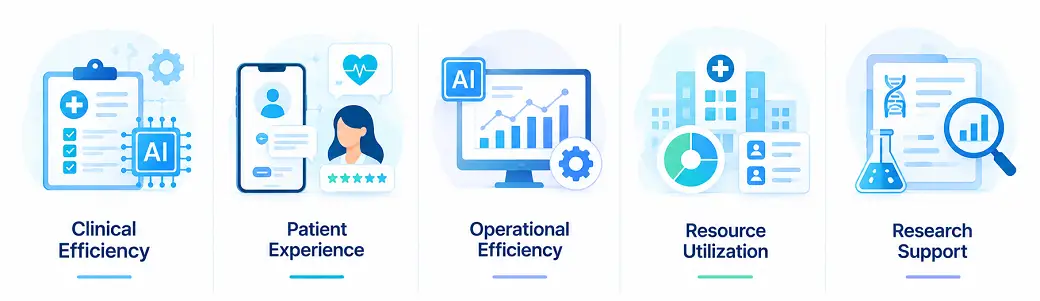
The benefits of using AI in the healthcare industry extend beyond clinical applications. When implemented responsibly, AI can support healthcare organizations in improving efficiency, making better clinical decisions, and enhancing patient services.
| Benefit | AI application | Measurable indicator |
| Clinical efficiency | Documentation assistance | Time spent on documentation |
| Patient experience | Healthcare chatbots | Patient response time |
| Operational efficiency | Appointment automation | Scheduling completion time |
| Resource utilization | Predictive analytics | Resource utilization rate |
| Research support | Medical data analysis | Time required for data analysis |
Improved Clinical Efficiency and Decision Support
With AI, healthcare institutions can identify patterns, analyze medical information, and prioritize cases that require immediate attention. Moreover, it can also automate internal operations such as data processing or documentation. AI-powered recommendations must be used to support clinical judgements rather than completely replacing actual healthcare professionals.
Better Patient Experience and Access to Care
AI-driven chatbots as well as virtual assistants can access general health information, help patients with appointment scheduling, and handle support tasks outside working hours. These solutions generally improve service accessibility and communication when a patient needs answers to common health related questions.
Operational Efficiency and Resource Utilization
AI automation in healthcare simplifies administrative processes such as medical coding, resource planning, appointment scheduling, and billing. Also, predictive systems help healthcare organizations utilize equipment more effectively and estimate patient demand. However, actual improvements will depend on integration, system performance, and workflow design.
Data-Driven Insights and Research Support
As healthcare organizations generate and depend on large amounts of operational and clinical data, artificial intelligence can help identify patterns, analyze datasets, and support medical research. With appropriate regulations and reliable data, these insights can help improve research workflows and healthcare planning.
Although these benefits make custom AI development capabilities relevant for healthcare solutions, businesses still have to carefully evaluate the pros and cons of AI in healthcare against their specific business requirements. Maintaining reliable data, clear performance indicators, and ongoing monitoring can help determine whether the AI implementation is delivering meaningful growth or not.
Also read: AI in Sports
Generative AI, Conversational AI, and AI Agents in Healthcare
Integration of advanced technologies within healthcare applications is creating new ways for organizations to communicate with patients, coordinate routine tasks, and manage patient information. Conversational AI, generative AI, and AI agents serve different purposes; still, they can work together in healthcare solutions.
Generative AI Applications in Healthcare
With generative AI integration in healthcare solutions, it becomes easy to create and summarize the available content. Healthcare organizations use it to summarize medical literature, prepare patient education materials, draft clinical documents, and retrieve relevant information. Although these applications can automate repetitive documentation work, reviewing the generated content for accuracy and potential errors is crucial.
Conversational AI and Healthcare Chatbots
With conversational AI, digital healthcare solutions can interact or communicate with users through voice or text. Healthcare AI chatbots can assist with appointment scheduling, send follow-up reminders, answer routine questions, and collect patient information. They also direct user queries to appropriate staff in case of emergency.
AI Agents in Healthcare
AI agents within healthcare solutions can help coordinate and perform multi-step tasks. For example, AI agents can check appointment availability, retrieve authorized information, and prepare a scheduling request to submit it for approval. However, these systems still require clear permissions, safeguards, controlled access, and activity monitoring against unauthorized actions.
Choosing the Right AI Approach
The best approach depends on the problem, users, data, and required level of automation.
| Technology | Typical role | Healthcare example |
| Generative AI | Creates or summarizes content | Drafting clinical documentation |
| Conversational AI | Manages user interactions | Patient appointment assistance |
| AI agents | Coordinates multistep tasks | Preparing an administrative workflow for staff review |
Please note, these technologies are not mutually exclusive. Healthcare platforms use generative AI for summarizing relevant information, conversational AI to answer patient queries, and AI agents to perform multi-step tasks.
Businesses looking for generative AI use cases in healthcare should prioritize choosing a technology stack that best fits their operational workflows. Secure data handling, human oversight, proper permissions, and appropriate validation are crucial for building reliable healthcare AI solutions.
Also read: AI in Transportation
Challenges and Risks of AI in Healthcare
Although AI offers several opportunities to improve healthcare services, its adoption also introduces technical, ethical, and operational challenges. Understanding the pros and cons of AI in healthcare helps organizations identify risks early and develop solutions that prioritize patient safety, data protection, and reliability.
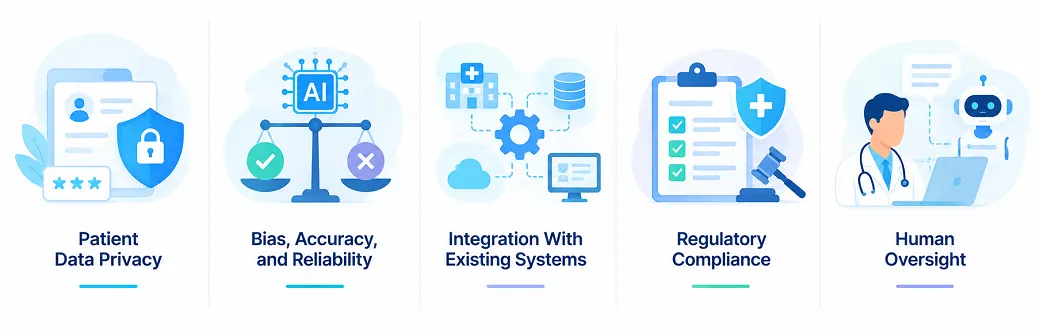
Patient Data Privacy and Security
AI healthcare solutions have to process sensitive information such as diagnostic reports, patient records, and medical histories. Data breaches, unauthorized access, or improper data sharing may therefore result in confidential data exposure. Healthcare organizations must focus on implementing access controls, appropriate data handling procedures, encryption, and secure data storage. Moreover, they must also comply with applicable regulations and privacy laws, where relevant.
Source: Health and Human Services (HSS)
Bias, Accuracy, and Reliability
If the training data reflects existing inequalities or underrepresents certain populations, AI bias in healthcare may occur. As a result, the model may produce incorrect recommendations or perform differently for each patient. Unreliable outputs or poor data quality will also affect clinical decision making. So, organizations must prioritize evaluating AI models through performance testing, representative datasets, and maintaining professional oversight.
Integration With Existing Healthcare Systems
Integrating AI within diagnostic platforms, hospital management systems, and electric health records is quite challenging. Legacy infrastructure, inconsistent records, or unlabelled data formats may prevent effective information exchange between systems. Healthcare organizations have to assess data quality, interoperability, and workflow compatibility while developing the healthcare application. Apart from this, rigorous testing can help ensure AI integration can support existing processes effectively.
Regulatory Compliance and Human Oversight
Regulatory and compliance requirements will depend on the jurisdiction, whether the solution qualifies as a regulated medical device, and the intended use. For example, the US Food and Drug Administration compliance regulates AI-powered medical equipment or devices based on applicable requirements.
Source: FDA
Healthcare organizations have to document system limitations, establish proper human oversight, and determine which rules should be applied. Addressing these AI in healthcare challenges during development and deployment will help build trustworthy solutions.
Also read: AI in Real Estate
How to Implement AI in Healthcare?
Implementing AI in healthcare requires a suitable technology stack, continuous evaluation, careful planning, and reliable data. Healthcare organizations should prioritize operational goals, system integration, clinical requirements, and privacy before integrating AI capabilities. Following a well-structured approach will help transform the concept into a scalable, production-ready AI solution tailored to business goals.
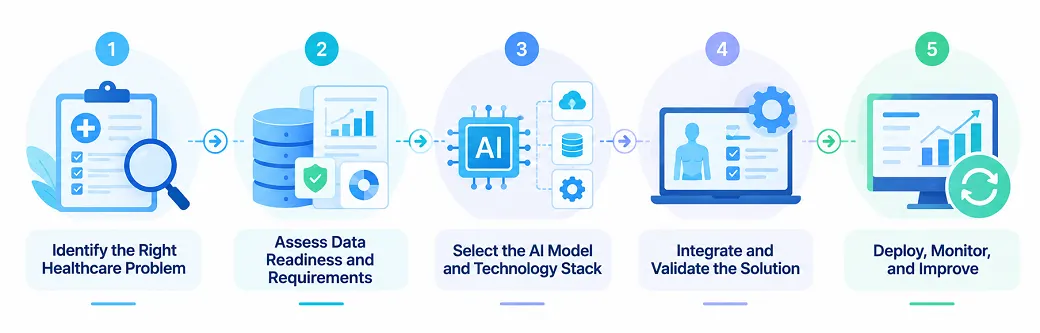
Identify the Right Healthcare Problem
The process starts with identification of existing operational or clinical challenges. Evaluate who will be using the application, what the expected outcomes are, and which workflows need improvement. Then define core objectives such as improving appointment management or automating administrative workflows. A clearly defined problem will help choose the appropriate technologies as well as evaluate effectiveness.
Assess Data Readiness and Requirements
AI systems heavily depend on reliable, relevant, and representative data. Make sure to assess available clinical notes, operational datasets, medical records, and images for data accuracy and consistency. Verify privacy requirements, data access permissions, and security controls of the AI solution. Addressing whether properly labelled data is available can help reduce development risks.
Select the AI Model and Technology Stack
Finalize the tech stack depending on the core use case. For example, computer vision can analyze medical images and graphs, machine learning offers predictive analytics, and large language models help with information retrieval and documentation. Some solutions may require all these approaches together. Make sure to evaluate scalability, security, hosting, interoperability, and maintenance requirements before finalizing the development technology stack.
Integrate and Validate the Solution
The next step is to integrate AI solutions with existing business systems such as appointment scheduling platforms, electronic health records, and diagnostic software. Test access controls, usability, interoperability, security, and the performance under various real-world conditions. Depending on the jurisdiction and intended use, healthcare applications may also require regulatory review and clinical validation.
Deploy, Monitor, and Improve
Start with a limited and controlled deployment, establish procedures, and train users to handle unexpected outputs or errors. Regular monitoring of data quality, user feedback, system performance, and security is also crucial post-launch. Ensuring human approvals and managing model updates within controlled testing can help maintain the functionality of the solution. As per WHO’s AI governance, businesses must focus on accountability and safety of patient data throughout the development cycle.
AI Healthcare Implementation Checklist
- Define the problem and measurable objectives.
- Assess data quality, access, and privacy requirements.
- Select suitable AI technology and infrastructure.
- Complete security testing and system integration.
- Validate performance and clinical safety where applicable.
- Establish monitoring, human oversight, and maintenance procedures.
Businesses planning to invest in AI-powered healthcare app development must address these challenges beforehand for building scalable, secure, and practical solutions.
Expert Insight:
A healthcare AI prototype demonstrates technical feasibility, but production readiness requires much more. Businesses must validate performance in the intended environment, integrate the system into existing workflows, and establish clear processes for monitoring, security, and accountability".
Yogendra Gupta - Tech Lead, Mobile, Cloud
Future Trends in AI Healthcare Solutions
The future of AI integration in healthcare industry will depend on how effectively the organization can combine futuristic technologies with clinical expertise, responsible implementation, and reliable data. There are several AI trends in healthcare that are influencing how modern healthcare institutions manage everyday operations and deliver care to patients.
Multimodal AI for Healthcare Data
Multimodal AI is used to process diverse data types such as clinical notes, patient records, and medical images. For analyzing all these inputs together, AI may support healthcare organizations to maintain a clearer understanding about a patient's health condition. However, the outputs will still require human validation.
Source: World Health Organization
More Personalized and Proactive Care
AI can help in delivering more personalized care by analyzing health indicators, patient histories, and relevant clinical information to identify potential risks. If integrated with remote patient monitoring workflows, AI can also support in identifying patient health vital changes that require immediate attention. However, these capabilities will depend on model reliability, data quality, and clinical oversight.
AI Agents for Healthcare Workflows
The demand of AI agent development for healthcare solutions is also emerging for retrieving information, coordinating multistep tasks, and supporting administrative healthcare workflows. Future implementations may include handling complex tasks, ensuring sensitive actions require appropriate monitoring, permissions, and human approval is also important.
Source: ScienceDirect
Greater Focus on AI Governance and Evaluation
As healthcare organizations are increasingly adopting advanced AI systems, governance and compliance has become equally important. Organizations have to now focus more on monitoring performance after deployment, maintain clear accountability, evaluate accuracy, and document system limitations. Through lifecycle oversight and strong data governance, businesses can build reliable AI solutions in healthcare.
Source: World Health Organization
Bring Your Healthcare AI Idea to Life
Partner with AI experts to develop healthcare applications tailored to your business needs.
Conclusion
AI in healthcare is transforming how modern healthcare organizations approach clinical decision-making, daily operations, patient care, and medical research. From predicting health-related risks and supporting patient communication to analyzing medical images and automating administrative tasks, artificial intelligence offers diverse opportunities to enhance healthcare operations.
However, successful adoption is more than just picking the right technology stack. Before making any investment, businesses must prepare reliable data, validate AI performance before deployment, identify suitable use cases, and ensure secure integration with existing business systems. Regular monitoring, appropriate compliance safeguards, and human oversight are also equally important for protecting patient information.
For healthcare organizations, successful AI adoption starts with a clear understanding of existing business challenges and then defining clear objectives before starting the development process. Moreover, hiring an experienced AI healthcare app development company can help transform product concepts into scalable and practical AI solutions in healthcare.
If you are planning to build an AI-powered healthcare solution, hire AI engineers to learn how we can help develop a custom AI healthcare application.