Generative AI Statistics 2026: Market Size, Growth, and Forecasts

Explore generative AI statistics for 2026, including market size, growth forecasts, enterprise adoption, trends, and industry insights.
Key Takeaways
- The global generative AI market is projected to reach $29.6 billion in 2026, according to Grand View Research.
- Generative AI market forecasts indicate substantial growth through 2033, although estimates vary by research methodology.
- Around 70% of surveyed organizations used generative AI in at least one business function in 2025.
- Generative AI adoption is expanding across healthcare, finance, retail, manufacturing, education, and media.
- Global generative AI venture capital funding reached $35.3 billion in 2025, according to the OECD.
- Worldwide AI spending is forecast to reach $2.7 trillion in 2026, including technologies beyond generative AI.
- North America accounted for approximately 40.8% of global generative AI market revenue in 2025.
- Future market growth will depend on business adoption, investment, infrastructure, data security, and measurable outcomes.
Generative AI has become a major force for businesses planning to accelerate their digital transformation journey in 2026. With artificial intelligence integration, businesses are now focusing on automating content creation and operational workflows, accelerating digital solution development, and improving customer experiences. As demand and adoption increase, organizations are heavily investing in AI models, customized solutions, and infrastructure to gain competitive advantage.
This generative AI market report 2026 covers market growth, investment trends, latest statistics, enterprise adoption, and long-term forecasts. As per Grand View Research’s June 2026 report, the current market valuation stands at $29.6 billion in 2026. Meanwhile, Stanford HAI’s AI index states that around 70% of organizations have already been using generative AI capabilities within at least one business function in 2025. Additionally, the OECD’s February 2026 analysis also highlights that about $35.3 billion in venture capital funding was invested in generative AI firms in the year 2025.
Generative AI Market Report 2026: Key Findings
The generative AI market report points to rapid expansion, rising enterprise adoption, and growing investment. Key findings include:
- Market size: $29.6 billion projected in 2026, rising to $324.7 billion by 2033, according to Grand View Research, June 2026.
- Market forecast: A projected 40.8% CAGR from 2026 to 2033, according to the same report.
- Adoption: 70% of surveyed organizations used generative AI in at least one business function in 2025, according to Stanford HAI's 2026 AI Index.
- Spending: Global spending on generative AI models is forecast to grow 117% in 2026, according to Gartner, July 2026.
Together, these generative AI statistics for 2026 highlight expanding commercial use and continued market growth.
Generative AI Statistics at a Glance
The table below highlights global generative AI market statistics based on adoption, spending, projected growth, and investment trends. Each figure is backed by its reporting period as well as source for quick reference.
| Metric | Statistic | Source and reporting year |
| Market size | $29.6 billion projected for 2026 | Grand View Research, 2026 |
| Market growth | 40.8% CAGR projected for 2026–2033 | Grand View Research, 2026 |
| Future market value | $324.7 billion projected by 2033 | Grand View Research, 2026 |
| Enterprise adoption | 70% of surveyed organizations used generative AI in at least one business function in 2025 | Stanford HAI, 2026 AI Index |
| Population adoption | 53% adoption within three years of mass-market introduction | Stanford HAI, 2026 AI Index |
| Generative AI investment | $35.3 billion in global venture capital funding in 2025 | OECD, 2026 |
| AI spending | $2.7 trillion forecast for worldwide AI spending in 2026 | Gartner, September 2026 |
| Generative AI model spending growth | 117% projected growth in 2026 | Gartner, July 2026 |
| Regional market share | North America held 40.8% of market revenue in 2025 | Grand View Research, 2026 |
Note: Market-size estimates and spending forecasts use different definitions.
Expert Insight:
"Market size alone does not determine the business value of generative AI. Differences in research methodology, market definitions, and forecast periods can produce significantly different estimates. Businesses should evaluate adoption trends, implementation costs, scalability, and measurable ROI alongside market forecasts before making investment decisions".DD Agarwal - Tech Lead, Web, Open-source
What Is the Generative AI Market?
The generative AI market is vast and covers platforms, services, technologies, and infrastructure to build and deploy AI systems that can generate content based on learning patterns. These AI systems can generate images, audio, synthetic data, text, videos, and software code across multiple industries.
Key Segments of the Generative AI Market
The market includes several interconnected categories:
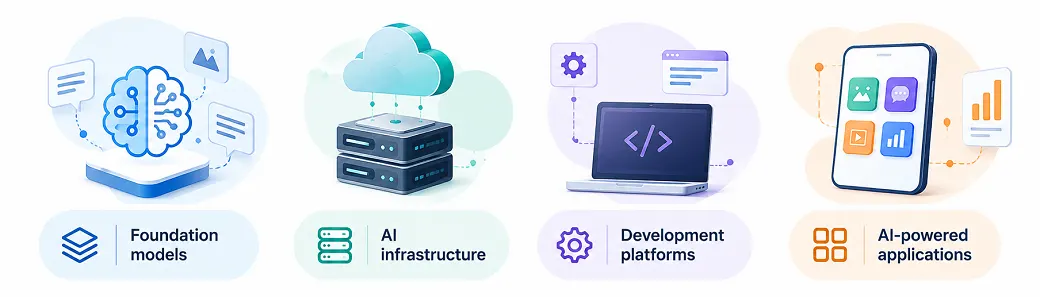
- Foundation models: Multimodal and large language models to generate or interpret different kinds of content.
- AI infrastructure: Cloud services, data infrastructure, and computing hardware to train and run generative AI systems.
- Development platforms: Services and tools to integrate, customize, and deploy tailored generative AI models in business architecture.
- AI-powered applications: Solutions for custom software development, research, customer support, content creation, and workflow automation.
How Is Generative AI Different From the Broader AI Market?
Traditional AI solutions are used for classification, decision making, prediction, and recommendation. Generative AI, meanwhile, focuses on creating outputs or new content aligned with the learning patterns. These markets may overlap; still, they are not interchangeable.
What Is Shaping the Market in 2026?
Current generative AI market statistics and trends include multimodal capabilities, demand for scalable AI solutions, enterprise integration, and specialized models. Apart from this, market segmentation also differs across research reports, as some are based on model services and software, platforms, applications, and infrastructure. Understanding these differences is essential for comparing market estimates.
Generative AI Market Size, Growth, and Forecasts
The global generative AI market is expanding rapidly as both startups and large-scale enterprises are heavily investing in AI-powered business transformation, computing infrastructure, and foundation model integration within business operations. However, the market estimates differ comparatively, as research firms’ reports may vary in measurement methods, forecast periods, and market definitions.
Global Generative AI Market Size in 2026
Research firms estimate substantial market growth in upcoming years. Grand View Research forecasts that the global generative AI market is valued at $29.6 billion as of 2026 and is projected to grow with a CAGR of 40.8% from 2026 to 2033. On the other hand, MarketsandMarkets estimates the current market valuation is about $185.45 billion. Please note, CAGR is an average annual growth rate for a specific time period, not the growth recorded individually for each year.
Generative AI Market Forecast Through 2030 and Beyond
Different research providers project varying market values for the next decade. The following estimates illustrate the range of published forecasts.
| Research provider | 2026 market estimate | Forecast market value | CAGR |
| Grand View Research | $29.6B | $324.7B by 2033 | 40.8% |
| MarketsandMarkets | $185.45B | $1.66T by 2033 | 36.8% |
| Fortune Business Insights | $161B | $1.26T by 2034 | 29.3% |
Why Generative AI Market Estimates Differ
These differences show the actual variations within the market scope including revenue measurement, services and products, and forecasting assumptions. For example, Statista’s global generative AI report shows the market is currently valued at $399.73 billion and is expected to reach $1.34 trillion by 2032. This report defines the market differently compared to other reports.
So, businesses must first verify generative AI market statistics from multiple sources depending on base year, forecast period, and provider’s methodology.
Generative AI Adoption Statistics in 2026
Generative AI usage is rapidly growing across workplaces, consumer-facing applications, and businesses. However, the actual adoption rates vary based on organizational implementation, individual usage, and deployment across business workflows. Having a clear understanding of these differences can help identify the areas where generative AI consulting and implementation can actually drive results and growth.
Enterprise Generative AI Adoption
According to Stanford HAI’s 2026 AI Index Report, about 70% of overall surveyed organizations were already using generative AI in business operations. Overall, artificial intelligence adoption has reached about 88% in global enterprises, demonstrating the importance of differences between generative AI usage compared to broader AI implementation.
Employee and Consumer Usage Statistics
Generative AI is also being increasingly used by individuals for research, everyday tasks, writing, and learning. Stanford HAI’s 2026 AI Index stated that generative AI reached about 53% of global population-level adoption within three years after it was introduced. However, the actual adoption rate varies by country.
Adoption Across Business Functions
Businesses have already started implementing generative AI within internal operations for information processing, content creation, and knowledge access to improve workflows. McKinsey’s 2025 State of AI report states some of the most common use cases of generative AI are product and service development, software engineering, marketing and sales, service operations, and IT.
However, higher adoption doesn’t simply mean measurable productivity gains. Organizations must evaluate employee training, performance measurement, appropriate data structure, and governance to turn generative AI investments into profitable business solutions. Tracking these factors along with generative AI statistics will help get a clear image of long-term business impact and enterprise readiness.
Turn Generative AI Insights Into Action
Build scalable AI solutions that align with your business goals and emerging market opportunities.
Explore AI Development ServicesGenerative AI Market Statistics by Industry
Generative AI adoption demand varies across different business sectors depending on operational requirements, potential business value, data availability, and regulatory constraints. Various industries such as fintech, manufacturing, education, healthcare, retail, and media are already working on exploring the benefits of generative AI for workflow automation. These differences within industries have created multiple opportunities for industry specific solutions.

Healthcare and Life Sciences
Telemedicine as well as healthcare service providers have already started using generative AI for medical research, administrative automation, clinical documentation, and patient communication. McKinsey’s 2025 healthcare analysis showed about 85% of surveyed healthcare organizations had already been using generative AI capabilities in late 2024. Clinical accuracy, data privacy, and regulatory compliance still remain crucial implementation considerations.
Banking and Financial Services
For document processing, internal workflow management, customer support, and fraud investigation, financial institutions are heavily investing in generative AI development. Global AI financial service report by the Cambridge Centre for Alternative Finance highlights that about 81% of surveyed financial firms have already adopted AI at some level. However, this figure is about broader AI adoption, not just generative AI.
Retail and Ecommerce
Ecommerce companies are applying AI to tailor product suggestions, anticipate customer demand, generate product listings, and handle customer inquiries more efficiently. Generative AI helps automate customer interactions and enhance operational efficiency. However, the actual outcome will still depend on integration with existing systems as well as implementation quality.
Manufacturing
For engineering assistance, product design, technical documentation, and maintenance knowledge retrieval, manufacturing businesses are heavily investing in generative AI capabilities. However, the actual adoption still depends on the integration with systems, appropriate human oversight, and availability of operational AI data.
Media, Entertainment, and Education
Educational institutions are focusing on implementing tutoring assistants, personalized learning materials, and administrative support, while media companies are using generative AI capabilities for content localization, development, editing, and creating workflows. For both sectors, the central concerns are intellectual property, content accuracy, and responsible AI usage.
Overall, the growth of the generative AI market depends on business-specific needs instead of a uniform adoption pattern. Comparing industries separately will require differentiating general AI adoption, production deployment, and generative AI usage.
Generative AI Investment, Spending, and Revenue Statistics
Enterprise spending, revenue generation, and investment highlight the rapid evolution of the generative AI market. Business spending reflects the demand for AI capabilities, funding shows innovation and infrastructure development, and revenue generation indicates how generative AI service providers monetize their services. A clear understanding of these metrics will help get a clearer picture of commercial opportunities and market growth.
Generative AI Investment and Funding
Investment in generative AI capabilities includes computing infrastructure, AI-powered products, and model development. According to OECD’s AI venture capital investment in 2025, generative AI firms globally received about $35.3 billion in venture capital funding. This figure represents investment activity, not market revenue or enterprise spending.
Enterprise Spending on Generative AI
As organizations increasingly focus on integrating AI models into workflows, custom applications and software, enterprise spending is also increasing. Gartner’s September 2026 report forecasts that global AI spending will reach 2.7 trillion by the end of 2026, an increase of 49.5% year over year. However, this figure is about the broader AI market, not generative AI alone.
Generative AI Revenue and Monetization
Generative AI service providers generate revenue through various ways such as API usage, cloud services, subscriptions, enterprise licenses, and AI-driven applications. According to Gartner’s July 2026 forecast, the overall spending on generative AI models will grow to 117% by the end of 2026. However, this is just a spending forecast, not an accurate measurement of revenue. It is important to evaluate revenue separately from total funding and spending while accessing long-term profitability and market value.
Key Players in the Generative AI Market
The global generative AI development market is ruled by various cloud infrastructure providers, foundation-model developers, and enterprise AI platforms. Major leaders in this field are Google, Anthropic, Meta, OpenAI, Microsoft, AWS, and NVIDIA. Each one contributes to different sectors of the ecosystem, including enterprise deployment, model development, and computing infrastructure.
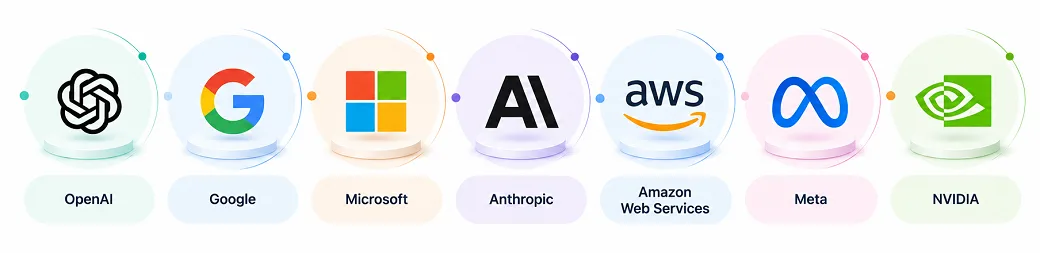
- OpenAI: Builds enterprise AI solutions and generative AI models tailored to specific business workflows.
- Google: Offers Gemini models as well as generative AI development capabilities backed by Google Cloud Vertex AI.
- Microsoft: Provides enterprise AI model deployment capabilities through Microsoft Foundry along with support for models from multiple providers.
- Anthropic: Builds Claude models for AI analysis, reasoning, and enterprise applications.
- Amazon Web Services: Provides access to foundation models through Amazon Bedrock.
- Meta and NVIDIA: NVIDIA offers computing software and platform for AI integration and development, while Meta focuses more on building generative AI models.
What Shapes Market Competition?
The market competition extends beyond model capabilities to pricing, scalability, enterprise integrations, infrastructure access, and security. As the companies mentioned above work across various market and industry segments, they shouldn’t be considered as a single source or market share statistics without validation from comparable resources.
Ready to Build with Generative AI?
Partner with AI experts to transform your ideas into secure, production-ready generative AI applications.
Talk to Our AI ExpertsConclusion
The generative AI market is transforming beyond early experimentation to wider enterprise adoption while creating new opportunities for businesses within different industries. Market demand also indicates continued adoption, while enterprise spending and investment highlight the growing importance of generative AI implementation in business operations.
As per Stanford HAI’s 2026 AI Index Report, global generative AI adoption in enterprises has reached approximately 53% in the last three years. The report also highlights that about 70% of surveyed organizations were already using generative AI in at least one business operation. These details demonstrate the increasing demand for artificial intelligence as well as its adoption.
In future, the generative AI market will depend on several factors such as implementation costs, ability to drive measurable business outcomes, infrastructure, and governance. Apart from this, market estimates also vary by research approach and methodology, making source verification a crucial factor for evaluating future investments in generative AI.
For businesses, the priority is to turn generative AI experimentation into scalable, business-focused solutions. A managed investment in data security, appropriate architecture, integration, and model evaluation can help build and implement growth-driven generative AI capabilities. Hiring an experienced generative AI development company can help move from initial MVP to production-ready systems aligned with business requirements.