AI Web Development Trends in 2027: 10 Innovations Shaping the Future

Explore 10 AI web development trends for 2027, from generative UI and semantic search to AI agents, personalization, and intelligent testing.
The Key Takeaways
- AI in web development is enabling websites to interpret user intent, retrieve relevant information, and support more contextual interactions.
- Semantic search, generative UI, and AI personalization are making web experiences more responsive to user needs.
- AI agents can assist with multi-step tasks through authorized tools and APIs, provided appropriate safeguards are in place.
- Agent-ready websites may use structured content, machine-readable information, and well-defined APIs to support interactions with compatible AI agents.
- Multimodal AI and predictive analytics are expanding how web applications process information and deliver relevant recommendations.
- AI coding agents and AI-driven testing tools can support development workflows, but human review and conventional quality checks remain essential.
- Secure architecture, reliable data, privacy controls, and continuous evaluation are necessary for building dependable AI-powered web applications.
- Businesses should evaluate AI web development trends based on user needs, technical feasibility, security requirements, and measurable objectives.
Websites are moving beyond static pages and predefined interactions. With AI in web development, applications can interpret natural-language requests, retrieve relevant information, adapt selected interface elements, and assist users with specific tasks. These capabilities are creating new ways for businesses to deliver digital services, support customers, and simplify complex workflows.
For businesses planning to build their digital presence in 2027, the opportunities go far beyond simply integrating a chatbot on their existing websites. AI is already influencing how websites respond to user queries, how users discover information, and how developers build and perform quality assurance testing on websites.
This article explores the top 10 AI web development trends that will shape the future of digital web experiences. From adaptive interfaces and AI-assisted engineering to intelligent search and agentic web applications, these advancements in the web development market will help businesses offer personalized recommendations and drive long-term growth.
Quick Answer: What Are the Key AI Web Development Trends in 2027?
AI web development trends in 2027 focus on making websites more intelligent, adaptive, and capable of assisting users with complex tasks. Key developments include conversational and semantic search, generative user interfaces, AI-powered personalization, multimodal AI, predictive analytics, agentic AI, agent-ready websites, retrieval-augmented generation (RAG), AI coding agents, and AI-driven software testing.
From Traditional Websites to AI-Native Web Applications
Traditional websites primarily include predefined navigation, workflows, and pages. On the other hand, AI-powered websites have extended capabilities such as conversational interactions, AI-assisted task execution, semantic search, and adaptive interfaces. However, AI integration in websites doesn’t completely eliminate the need for conventional engineering.
| Comparison Factor | Traditional Websites | AI-Enabled Web Applications |
| User interaction | Primarily uses predefined navigation, forms, and workflows | Can support natural-language and context-aware interactions |
| Search | Often relies on keyword matching, categories, and filters | Can interpret query intent and retrieve semantically relevant results |
| Personalization | May use predefined rules and user preferences | Can adapt experiences using relevant context and behavioral signals |
| Task execution | Follows predefined workflows and application logic | Can assist with or execute approved multi-step tasks |
| User interface | Primarily uses predefined layouts and interactions | Can adapt selected interface elements to user requests or context |
| Development workflow | Uses conventional development, debugging, and testing tools | Can incorporate AI coding and testing tools alongside conventional methods |
These differences highlight potential capabilities not universal distinctions. Traditional websites may also support personalization and advanced search, while AI-powered websites may implement only selected AI capabilities.
Having a clear understanding of these differences can help set a solid foundation for choosing the right AI web development trend that aligns with the business requirements.
The Rise of Intelligent Web Experiences
AI in web development is changing how users generally interact with interfaces, discover information or products, and make decisions online. Instead of depending only on predefined rules or static layouts, AI-powered web development makes online experiences more personalized depending on user preferences, intent, and context. From generative interfaces and predictive recommendations to conversational search, personalization, and multimodal interactions, these trends highlight how AI in custom website development can enhance usability and relevance.
1. Conversational and Semantic Search
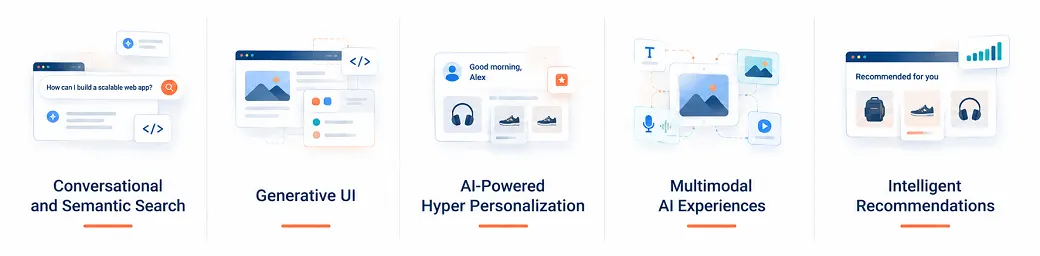
Traditional websites’ search functionality relies mostly on matching keywords along with the terms in the indexed content. But semantic search extends this through understanding of intent and meaning behind a search query to ensure users can find relevant information even without exact keyword match inputs. This makes AI-powered search functionality a practical factor of AI web application development.
With conversational AI, businesses can extend user experiences through follow-up questions, exploring results though natural language inputs, and refining the requirements.
However, the search results don’t depend only on the AI models. Developers have to maintain accurate content for indexing, enforce access permissions, evaluate retrieval relevance, and manage response latency to ensure users can only view the authorized information.
Using conversational search will not simply replace every category page, navigation menu, or filter. Using semantic search capabilities with browsing controls offer greater flexibility while ensuring information is easily discoverable.
2. Generative UI and Adaptive Web Interfaces
Generative UI design is the approach where artificial intelligence adapts or assembles the interface components depending on the user's context, request, or task. Instead of using the same layout for every user, AI-driven websites can display relevant information, controls, and workflows whenever needed.
Two approaches must be distinguished. AI can also select validated and predefined components from existing designs, or it can also help generate design code dynamically. Choosing the available components offers greater control over both design behavior and consistency. However, the dynamically generated design code may incur complexity, so it must be tested, validated, and safely rendered.
Generative UI/UX design approaches are emerging, but its actual reliability depends on the application architecture and models. Developers have to preserve responsive layouts, design-system consistency, accessibility, and predictable interactions. Integrating security safeguards is also crucial to prevent generated outputs from exposing confidential or sensitive data.
3. AI-Powered Hyper Personalization
Through AI personalization, websites can adapt recommendations, content, and workflows to user’s needs. With proper access controls and consent, AI-powered web development can use stated preferences, permitted user data, behavioral signals, and session context to deliver personalized web experiences.
Traditional personalization relies on predefined workflows and rules that may include showing a promotional advertisement to users within a particular country or region. AI-driven hyper personalization can interpret combinations of various signals and adjust content more dynamically. However, the actual effectiveness will depend on the quality of available data.
More personalization is not always automatically better. Biased data can produce incorrect outcomes, while inaccurate signals may result in unfair recommendations. Businesses must minimize unnecessary data collection, monitor how personalization decisions can affect the users, prioritize user consent, and protect sensitive information. The goal is to enhance system usability and relevance.
4. Multimodal AI Experiences
Multimodal AI enables systems to process or combine different types of information, including text, images, audio, and, where supported, video. In generative AI in web development, this creates opportunities for interfaces that understand more than typed questions and respond in formats suited to a user's task.
Implementation of multimodal AI goes far beyond simply connecting a model to a website. Development teams have to confirm whether the input and output types are supported by model, ensure security of uploaded files, and also consider processing latency, infrastructure costs, and browser compatibility. Interfaces should also offer accessible alternative options such as keyboard controls or text descriptions whenever visual or audio interactions are involved.
As the uploaded media may contain confidential business or personal information, data protection is equally important. Multimodal AI websites must ensure file type validation, define retention policies, and restrict access to provided content. However, the actual capabilities will vary depending on model and implementation methodology. So, businesses must verify the modalities instead of assuming the system can support every type of file format.
5. Predictive Analytics and Intelligent Recommendations
Predictive analytics depends on historical data as well as current signals to estimate model outcomes or identify repetitive patterns. In AI web development, these capabilities can help highlight relevant options, make more informed decisions, and anticipate user needs.
Predictive analytics as well as generative AI development both serve different purposes. Predictive models can help estimate model outcomes such as likelihood of a particular event. Intelligent recommendation systems can use ranking methods and available signals to prioritize relevant content, actions, or products. While generative AI generates outputs such as summaries, text, or interface content.
Reliable implementation requires appropriate model selection, up-to-date data, and evaluation under real-world conditions. Developers must detect performance issues, monitor prediction quality, and establish proper feedback loops to improve recommendations. Businesses should explain these recommendations if needed and shouldn’t treat model predictions as accurate outcomes.
Expert Insight:
"The most effective AI web development strategy starts with a specific user problem, not a technology trend. Businesses should identify where users struggle to find information, complete workflows, or make decisions before selecting an AI capability. Semantic search, personalization, and predictive recommendations serve different purposes, so implementation should depend on the use case, data availability, and measurable objectives. "
DD Agarwal- Tech Lead, Web, Open-Source
The Agentic Web: Websites That AI Can Understand and Use
Web development has been evolving beyond AI, primarily answering questions for intelligent systems that can use approved tools, complete defined tasks, and plan steps. With custom AI web development services, the demand for agent-ready websites, AI-driven web applications, and agent AI solutions is also increasing. However, reliable AI integration will depend on secure integrations, user control safeguards, appropriate permissions, and validated actions.
6. Agentic AI in Web Applications
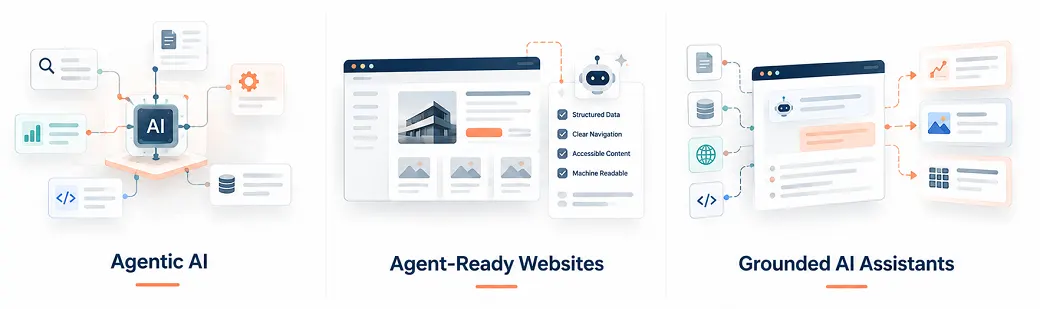
With agentic AI, websites can perform more than answering questions. They can also complete multi-step tasks using authorized APIs, tools, and functions. Instead of answering only with text based outputs, agents can also evaluate results, plan actions, and operate based on granted permissions.
One of the key differences between agentic AI workflows and conventional chatbots is the ability to perform actions. A traditional chatbot requires explanation to change the ongoing processing, while an AI agent could automatically initiate some changes using an authorized API.
For greater autonomy, stronger safeguards are needed. Developers must validate actions, implement both recovery and error handling mechanisms, enforce scoped permissions, and maintain audit logs. Moreover, consequential actions such as account charges or payments must require user permissions. Human oversight remains equally important whenever the agents encounter unexpected inputs.
7. Agent-Ready Websites and the Emerging Agentic Web
As AI agents are becoming capable of performing multi-step tasks with minimum human intervention, websites have to ensure the functionalities and information is easily understandable for these agents. Agent-powered websites require clear service descriptions, well-defined APIs, structured content, and machine-readable information to help agents access available features.
One emerging trend is WebMCP, a proposed web development standard that allows websites to expose structured tools AI agents can use and discover. As of October 2026, WebMCP is still under development, while a Chrome origin trail is available for experimentation. However, it is not an established web standard yet.
Businesses must consider WebMCP as an emerging capability instead of a universal requirement. Regardless of the development approach, secure agent interactions still require validated actions, controlled permissions, and conformation for performing consequential actions.
8. Grounded AI Assistants Using Business Data
Retrieval-augmented generation (RAG) allows AI assistants to retrieve required information or data from available sources before providing an output. Instead of depending only on learned knowledge, RAG in AI-powered websites can connect the responses to product information, authorized data, business documentation, or internal knowledge bases.
The process includes retrieving correct information, sending the content to an AI model, output generation, and evaluating the response. Based on the implementation, AI assistants can also offer source citations to help users verify important details.
However, accuracy of results doesn’t solely depend on the retrieval alone. Businesses must enforce document-level permissions, prevent unauthorized access to sensitive information, maintain updated source material, and evaluate retrieval accuracy. Outdated content or poorly indexed documents may lead to inaccurate or misleading responses.
Although RAG can help reduce dependency on a model's stored knowledge, it doesn’t guarantee factual accuracy or completely eliminates hallucinations. Scalable AI-powered websites include retrieval with monitoring, validation, and appropriate developer oversight.
These agentic AI capabilities and intelligent experiences must follow well-structured engineering practices to ensure websites remain reliable, secure, and maintainable.
AI Is Changing How Web Applications Are Engineered
AI is not only influencing the functionalities and capabilities of web applications as well as websites, but it also helps developers build, test, and maintain them. AI-powered testing tools and AI coding agents can support engineering tasks and identify potential issues. However, human insight and testing is still crucial for website security, quality, and architectural decisions.
9. AI Coding Agents and Autonomous Development Workflows
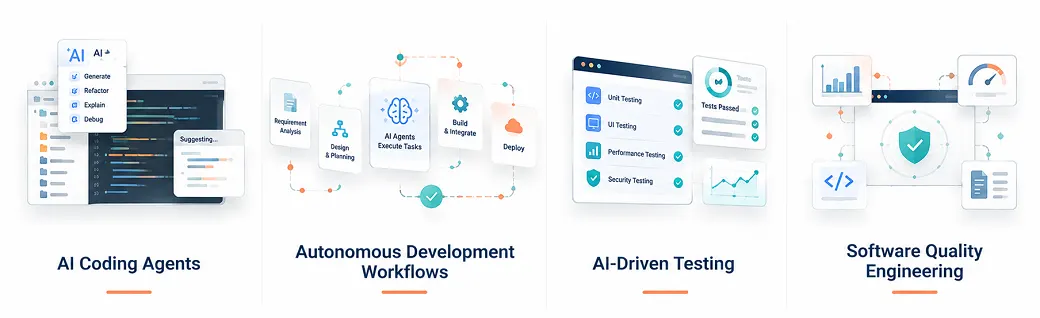
AI coding agents provide more than basic code completion by helping development teams generate code, refactor components, analyze repositories, debug errors, and document software. Based on required permissions and capabilities, AI development tools and coding agents can also help execute multi-step tasks across testing tools, version-control workflows, and development environments.
For building AI-powered websites, AI agents can help in identifying dependencies, implementing interface components, or providing fixes for existing issues. These capabilities may reduce the repetitive work to help developers explore implementation approaches more efficiently.
The generated code may still introduce incompatible dependencies, contain vulnerabilities, or misunderstand application requirements. Making changes can also affect the established website functionality if the agent doesn’t have sufficient project context.
Therefore, development teams must use AI-assisted development along with automated checks, version controls, code reviews, and secure development practices. Making sensitive changes must require proper human approval. Although AI coding agents can help with engineering workflows, they do not completely eliminate the need of experienced developers for production coding and architectural decisions.
10. AI-Driven Testing and Software Quality Engineering
Using AI software testing tools, developers can prioritize test execution, maintain tests when websites scale, generate test cases, and analyze defects. For web application development, potential use cases cover testing form validation, evaluating conversational interfaces, identifying regression risks, and analyzing browser behavior.
With AI, development teams can also examine recurring failures by analyzing test logs, application behavior, and results. However, these capabilities will depend on the quality of available data as well as the system's configuration.
AI-assisted testing doesn’t guarantee the website is fully secure, accessible, and functions correctly. Developers must perform manual regressions tests for human-reviewed test coverage, security assessments, predictable behavior, and performance testing. Moreover, real-user testing and accessibility checks are crucial for identifying potential usability issues that may not be visible during automated testing.
Once the website is deployed, regression testing and monitoring are crucial to detect potential issues and bugs as AI models and website dependencies evolve over time. Using AI capabilities alongside quality engineering approaches ensures more systematic website maintenance.
The actual business value of these engineering development practices will depend on how smoothly they fit into existing business workflows. Organizations must evaluate these capabilities along with the intelligent features they are planning to deliver to users.
Build Smarter Web Experiences
Discover practical AI opportunities to create intelligent, adaptive, and user-focused web applications.
Where Can Businesses Apply These AI Web Development Trends?
Some of the most valuable AI web development use cases are focused on addressing business challenges instead of just adding AI because of market popularity. The actual requirement and right implementation approach will depend on available business data, operational constraints, customer needs, and technical constraints. The below examples show how businesses can benefit from building AI-powered web applications.
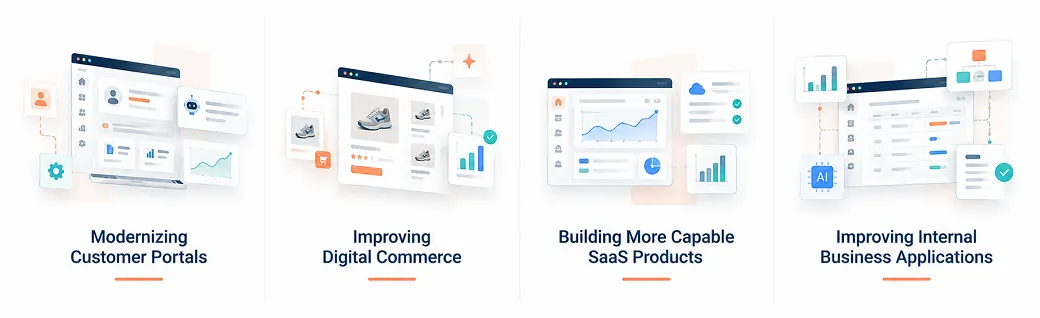
Modernizing Customer Portals
Customer portals can benefit from AI agent development to answer common user queries through approved documentation, guide users through their requests, and retrieve relevant information. For example, within an insurance portal, customers can easily locate policy details. However, document-level permissions, reliable source retrieval, and identity verification are necessary for protecting sensitive business information.
Improving Digital Commerce
In eCommerce websites or web apps, AI can help with conversational shopping assistance, natural-language product discovery, visual product search, and personalized recommendations. For example, users can upload a photo to search for similar products online or describe the requirements in the search bar. Moreover, AI agents can help with purchasing workflows depending on user confirmation or appropriate authorization.
Building More Capable SaaS Products
Software-as-a-Service (SaaS) solutions incorporate contextual-assistance, AI agents, natural language analytics, and intelligent dashboards to complete routine tasks. For example, a project management application can help users locate any overdue assignments or summarize task updates. Data accuracy, user control, and workflow reliability still remain essential.
Improving Internal Business Applications
Organizations can integrate AI within business websites for document analysis, reporting, internal knowledge search, and workflow assistance. For example, an employee portal can help the staff in finding relevant policies for approved documents. Data governance, limiting automated actions, and human review can help maintain control.
For successful enterprise web app development, business must begin with a suitable data foundation, defined need, and measurable evaluation. They must also test the web solutions against real business workflows before expanding the functionalities.
Also read: AI-Powered Mobile App Development Trends
What Does an AI-Ready Web Architecture Need?
Developing an AI-powered website includes more than just integrating or connecting an AI model API. A reliable web development architecture must support secure integrations, ongoing evaluation, data retrieval, and user interactions. All these components work together to provide useful AI capabilities while maintaining application security, maintainability, and performance.
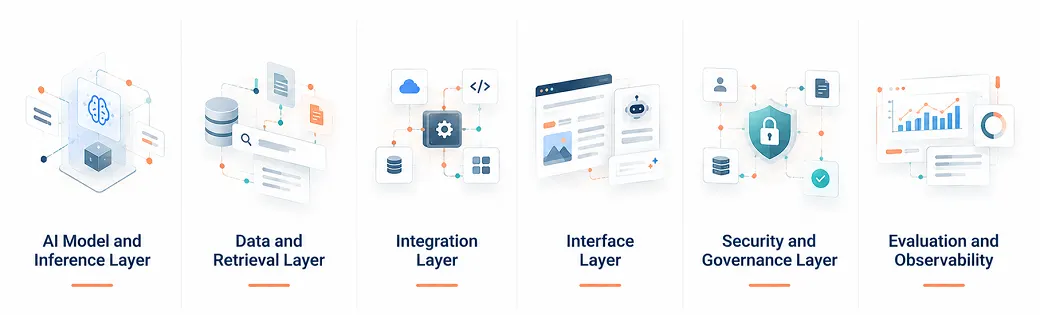
AI Model and Inference Layer
The inference and model layer generates outputs and handles AI requests. Development teams must evaluate inference APIs, deployment options, model capabilities, and response latency along with locally deployed or hosted cloud models. The choice depends on data sensitivity, application requirements, and operational constraints.
Data and Retrieval Layer
The data layer prepares the information for AI websites through data indexing, cleaning, and retrieval. Within the RAG architecture, the response quality may be influenced by information freshness, access permissions, metadata, and retrieval relevance. Reliable data governance is crucial to ensure AI systems focus on retrieving correct or required information without exposing restricted content.
Integration Layer
The integration layer connects AI functionalities with databases, business systems, APIs, and application services. Through controlled interfaces, businesses can ensure AI components collect or access information and request approved actions without any unrestricted system access. Authorization, error handling, authentication, and input validation helps protect the website’s functionality.
Interface Layer
The interface layer helps connect the AI capabilities with the user experiences through search, conventional navigation, chat, and adaptive components. Accessible controls, useful error messages, clear feedback, and predictable interactions allow users to understand system behavior. Moreover, users must also maintain control over crucial actions and decisions.
Security and Governance Layer
AI governance and security must span the entire application. With proper authorization, prompt-injection defences, audit logs, authentication, data protection, and restricted tool permissions, data exposure can be reduced. Some consequential actions may also require human approval and explicit user confirmation depending on the website’s intended purpose.
Evaluation and Observability
These help developers monitor retrieval accuracy, failure rates, response quality, latency, and operating costs. Repeatable tests and production feedback can help reveal potential issues as models, data, and application behavior change over time. Through continuous monitoring, businesses can maintain reliable AI functionality and make timely improvements.
Although these architectural components offer a solid foundation for building dependable AI-powered web solutions, they cannot eliminate every risk. Development teams must carefully address changing model behavior, usability changes, security vulnerabilities, and performance constraints during development and after deployment too.
Risks and Engineering Challenges of AI-Powered Websites
Although AI-powered websites can help improve digital user experiences, they may also introduce risks beyond those found in traditional web development. So, businesses should evaluate AI web apps’ reliability, operating costs, security, data privacy, and usability throughout the development as well as deployment process to ensure proper user trust.
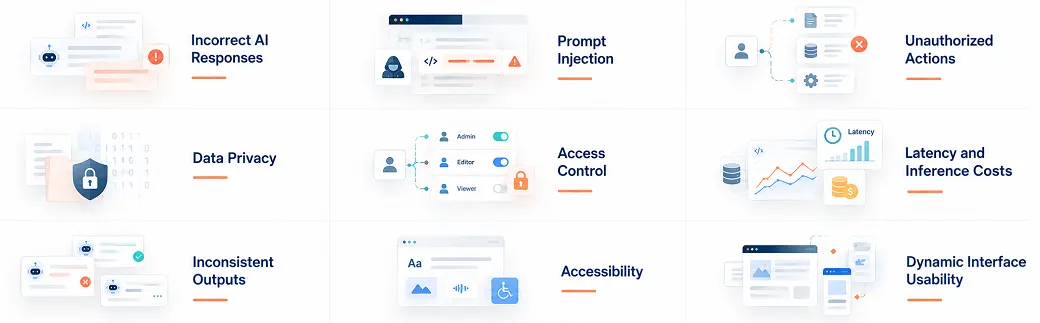
Incorrect or Unsupported AI Responses
Sometimes, AI systems may retrieve irrelevant information or generate inaccurate answers that may potentially mislead users. Validating retrieved information, evaluating output quality, and grounding responses through reliable sources can help eliminate these risks. Moreover, applications must also communicate uncertainty clearly if reliable outputs are unavailable.
Prompt Injection and Unauthorized Actions
Whenever unexpected or malicious instructions attempt to manipulate AI systems into misusing connected tools or ignoring intended constraints, prompt injection happens. Developers must restrict tool permissions, ensure human confirmation is required for consequential actions, enforce server-side authorization, and validate inputs and outputs.
Data Privacy and Access Control
If AI-powered websites have inadequate access controls, poorly configured retrieval systems, or collect excessive data, this may result in exposure or sensitive business information. Organizations must enforce role-based permissions, comply with applicable privacy requirements, apply data minimization, and define clear retention policies to safeguard business and user data.
Latency and Inference Costs
Information retrieval, model calls, and multi-step agent workflows can increase operating expenses as well as response times. Teams must use caching where needed, monitor performance, optimize model selection, and apply request limits to balance functionality, cost, and responsiveness.
Inconsistent Outputs and Evaluation
AI responses vary across model versions, continuously changing data, and requests. With continuous evaluations, representative test datasets, and regression testing can help resolve performance issues. Moreover, high-risk operational workflows must be reviewed by humans manually and should have clearly defined criteria for outputs.
Accessibility and Dynamic Interface Usability
AI-generated adaptive interfaces and content can be used to ensure accessibility barriers if components omit accessible markup or behave unexpectedly. Developers must implement screen readers, clear feedback, keyboard navigation, and semantic HTML to test experiences under real-world scenarios.
Businesses can overcome these AI challenges and risks in web development by implementing capabilities that help apply appropriate security measures and address genuine user needs. Careful integration also supports innovation along with usability, operational reliability, and security.
Turn Ideas Into AI-Powered Solutions
Develop secure, scalable web applications with AI capabilities tailored to your business goals.
Conclusion: Building for the Next Generation of the Web
The emerging AI web development trends that will shape 2027 point towards more adaptive, interactive, and intelligent web solutions. From agentic workflows and personalized user experiences to AI-assisted testing and coding, these trends will change how modern businesses deliver digital products.
However, adopting any emerging technology without a defined goal is not a profitable strategy. Businesses must build a web solution depending on technical feasibility, security requirements, customer needs, data readiness, and measurable objectives. The future of artificial intelligence in custom web development will not only depend on new capabilities but how responsibly organizations will implement them.
Building a successful AI-powered web solution requires reliable integrations, human oversight, robust architecture and continuous evaluation to maintain trust and quality.
At Konstant Infosolutions, we help businesses plan, assess, and build AI-powered web apps and websites aligned with their goals and growth. Hire AI engineers to transform your ideas into AI-driven, scalable, and useful digital experiences.