AI-Powered Mobile App Development Trends in 2027

Explore 12 AI mobile app development trends shaping mobile apps in 2027, from agentic AI to personalization, security, and implementation.
Key Takeaways
- AI is making mobile app workflows more intelligent, contextual, and automated.
- On-device and cloud AI offer different benefits for speed, privacy, and scalability.
- Personalization can help apps deliver more relevant user experiences.
- Responsible AI deployment requires data protection, accuracy, and human oversight.
- Businesses should validate AI features before investing in full-scale implementation.
- AI integration must align with user needs and existing app architecture.
- Measure outcomes through engagement, task completion, and operational efficiency.
Mobile applications have been evolving beyond static interfaces to intelligent user experiences that can adapt to user behavior, understand natural language, and assist with complex business workflows. As the demand for personalization and convenience increases, organizations are exploring how AI can help build responsive and efficient mobile applications.
This shift is already visible in modern user demands and behavior. According to Sensor Tower’s State of Mobile 2026 report, people spent about 48 billion hours using applications that include generative AI capabilities, which is approximately 3.6 times more as compared to the year 2024. This report covers Google Play and iOS (only for China) data.
Businesses looking to develop a mobile application must understand these AI trends to identify potential opportunities that can help enhance user experiences and build an app that stands out in the market. In this guide, we will look at the top 12 trends that will shape AI-powered mobile app development in 2027 and beyond.
Some of the most talked about trends are generative AI development, personalization, privacy, AI agents, on-device intelligence, predictive capabilities, and AI-assisted development. We will also look at implementation challenges, industry use cases, and tips to choose the right trend for your mobile app.
Quick Answer: What Are the Top AI Mobile App Development Trends in 2027?
The top AI mobile app development trends for 2027 include generative AI for interactive experiences, on-device intelligence, agentic AI for task automation, multimodal AI, and personalized recommendations. AI-powered security can help detect suspicious or fraudulent activities, while predictive analytics enable proactive assistance. Moreover, hybrid as well as privacy-aware architectures are also gaining traction as organizations are increasingly investing in data protection, reliability, and performance.
Why Is AI Reshaping Mobile App Development in 2027?
Mobile applications are transforming from predefined workflows and fixed screens to intelligent experiences that can anticipate user needs, understand requests, and can help users complete tasks. This shift is accelerated by increased demand for more personalized recommendations, natural interactions, and automation that help businesses reduce manual, repetitive efforts. For businesses, AI is creating new opportunities to streamline services, improve customer experiences, and streamline app functionalities aligned with user needs.
Market demands forecast that this change is already underway. As per Sensor Tower’s State of Mobile 2026 report, the global user in-app purchases spending reached $167 billion in the year 2025. Alongside this, the total time spent on generative AI apps also climbed to 48 billion hours. These figures highlight the growing demand for AI-powered mobile experiences. However, this doesn’t mean that every app is adopting AI at the same pace.
The capabilities of mobile platforms are also advancing with artificial intelligence. Android supports cloud-based, on-device, as well as hybrid AI integrations, while Apple offers frameworks for visual intelligence and on-device language model integration.
Together, these trends will shape the future of AI in mobile app development. In 2027 and beyond, businesses must assess personalization, conversational AI, and automation against technical constraints, measure business goals, real user needs, and privacy requirements instead of adopting any trend without a clear purpose.
AI-Powered Mobile App Development Trends Shaping Mobile Apps in 2027
Artificial intelligence is transforming mobile applications from simple digital tools into adaptive, intelligent experiences. In 2027, emerging AI capabilities such as generative AI integration, predictive analytics, AI agent development, and on-device models will create new opportunities for businesses to automate tasks, personalize interactions, and simplify user journeys. For organizations, clearly understanding these AI mobile app development trends will become important for improving app functionality, identifying practical opportunities, and building solutions that align with modern user expectations.
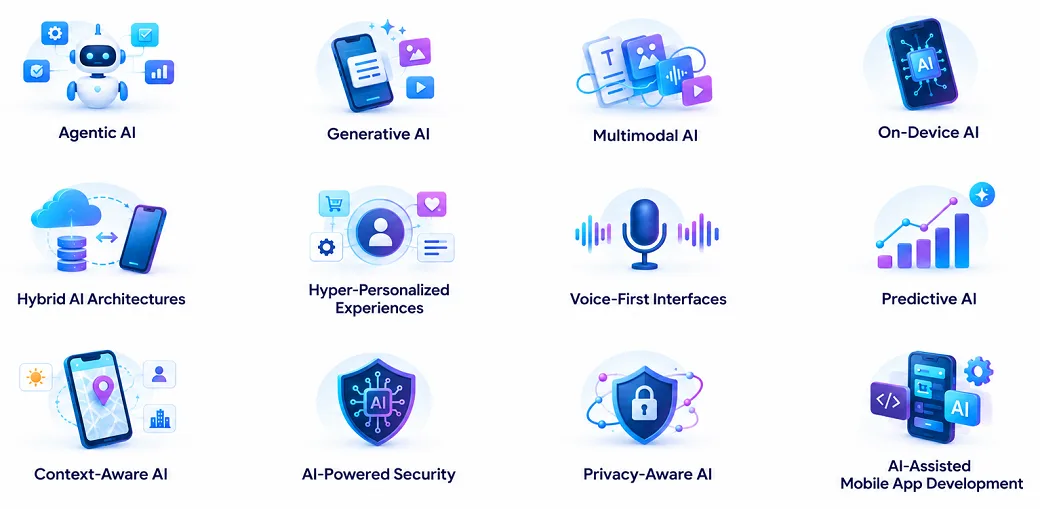
Agentic AI for Autonomous In-App Tasks
Agentic AI enables mobile apps to complete multistep tasks instead of simply answering questions. AI agents can interpret goals, plan actions, and use authorized tools, APIs, and app functions to execute workflows. For example, travel apps can organize itineraries, appointment apps can find available slots, and retail apps can manage orders.
Integrating AI agents in mobile applications can help reduce manual effort by automating repetitive tasks across connected services. Android's AppFunctions initiative is an emerging example of exposing app capabilities to AI agents and assistants, although platform support varies.
Reliable implementation depends on clear permissions and requires confirmation before performing any consequential tasks such as bookings or payments, recovery mechanisms, and progress updates. Users must be able to intervene or review the action if necessary.
Generative AI Embedded Into Core App Experiences
Generative AI can enhance mobile app workflows through content creation, contextual answers, summarization, and rewriting. eCommerce platforms can help compare multiple products, eLearning apps can explain complex lessons, and fitness apps can offer personalized activities based on user goals.
Instead of relying solely on standalone chatbots, businesses must integrate AI into relevant screens. For example, writing applications can help with instant text revisions, while shopping apps can provide answers to common user queries.
Developing successful AI-powered mobile applications requires evaluating response time, operating costs, output quality, and privacy. Users must be able to easily edit, review, or reject the generated responses.
Multimodal AI for Text, Images, Voice, and Video
Multimodal AI helps in processing different types of input, including images, video, text, and audio. This makes interaction more flexible by reducing the need to navigate through multiple screens or providing detailed descriptions.
For example, retail or shopping applications can identify products from photos, and troubleshooting applications can help analyze images with written descriptions. Similarly, document apps can help extract information from scanned pages and eLearning mobile apps can provide visual learning data.
These AI-powered features can help reduce input friction, but the performance will still depend on supported formats, model capabilities, and processing requirements. So, businesses must consider accessibility, test real inputs, and establish strong privacy controls for uploaded media.
On-Device AI and Small Language Models
On-device AI executes tasks and processes information offline directly on the user's device instead of depending on cloud servers. Smaller language models make summarization, lightweight personalization, smart replies, and document extraction more practical for mobile hardware.
Android’s ML Kit GenAI provides features such as proofreading, summarization, and rewriting. Apple’s Foundation Models framework also supports summarization, text generation, and entity extractions on compatible devices. Based on the implementation requirements, these capabilities can support offline use, enhance responsiveness, and reduce dependency on cloud processing.
However, local inference is limited by battery consumption, device compatibility, memory, and processing speed. Developers must run rigorous tests across supported devices and offer alternatives in local models that cannot handle a user input. Using on-device AI is most useful if speed, privacy, or offline benefits justify these limitations.
Hybrid AI Architectures Combining On-Device and Cloud Models
Hybrid AI architectures include both cloud and on-device processing to balance performance, computing needs, and privacy. Local models can easily handle or execute lightweight tasks, while cloud models can be used for larger workloads or complex reasoning.
For example, an app can summarize offline or locally stored data and can use cloud models for complex tasks or queries if connectivity is available. Successful AI integration in mobile applications requires routing rules based on privacy, response time, task complexity, network availability, and cost. Development teams must monitor local resource usage along with cloud usage and implement fallbacks for connection failures.
Hyper-Personalized Experiences Driven by AI
With hyper-personalization, AI can adapt mobile app content, interactions, and recommendations using authorized behavior data, relevant user preferences, and context. For example, eCommerce applications can use AI-powered personalization to recommend products based on user’s preferences or browsing patterns, educational platforms provide learning assessments based on progress, and fitness apps can offer tailored activities to users.
The effectiveness of personalization will depend on model performance and data quality. Businesses must obtain proper use consent, collect only required information, and ensure users have control over the preferences. Data minimization can help personalize user experiences.
Instead of assuming that personalization can help increase user engagement, businesses must monitor user feedback, recommendation relevance, and fairness. The end goal is to offer useful as well as relevant experiences without compromising on privacy or security.
Voice-First Interfaces and Speech Reasoning
Voice-driven interfaces allow users to interact or perform tasks through spoked requests. Integrating conversational AI can help interpret requests, support multistep tasks, and ask clarifying questions. Some of the most common use cases are custom support, field service assistance, hands-free navigation, and accessibility.
Android’s speech recognition and Apple’s Speech framework APIs offer several tools for integrating voice-enabled features. However, conversational reasoning still requires additional AI models. Accents, response delays, background noise, and recognition errors may affect the app’s usability. So, applications must confirm required important details before performing any action and clearly communicate how the audio will be processed. Voice AI is most successful when it offers genuine accessibility benefits and convenience.
Predictive AI and Proactive Assistance
Predictive AI uses current signals as well as historical data to anticipate outcomes, helping mobile apps deliver timely reminders, alerts, and recommendations to users. Travel apps can mark potential disruptions, retail applications can forecast inventory stockouts, and maintenance applications can help identify potential equipment failure.
However, these AI app development use cases still require reliable models and relevant data. False alerts can frustrate users, accurate predictions are not guaranteed, and missed events may result in risks. So, businesses must detect changes in data patterns, regularly monitor model performance, and evaluate recall, precision, and alert usefulness. The goal should be providing reliable and actionable assistance without overwhelming users with unnecessary updates.
Context-Aware AI and Retrieval-Augmented Generation
Context-aware AI uses authorized information and user inputs to deliver relevant outputs. Retrieval-augmented generation (RAG) helps in this by retrieving relevant information from various trusted sources before the model produces any answer.
For example, enterprise mobile applications can help answer common employee questions based on internal documentation, while support applications can offer troubleshooting guides. However, RAG doesn’t guarantee accurate responses.
Seamless AI integration in mobile applications requires updated information sources, access controls during retrieval, and manual testing for answer reliability and retrieval accuracy. If sufficient data is not available, the AI solution must acknowledge the limitations instead of generating unsupported answers. Citing responses can also help in verifying the generated outputs.
AI-Powered Security and Fraud Detection
With AI-powered mobile app security, businesses can detect suspicious activities by analyzing login behavior, unusual account actions, transaction patterns, and device signals. Digital wallets, banking apps, and eCommerce platforms can use anomaly detection to report account abuse or potential frauds.
Risk-based automation may require additional consent of verification in case of unusual activities. However, legitimate behavior could trigger alerts, resulting in false positives that may disrupt user experiences.
AI integration should support existing security controls including strong authentication, secure APIs, encryption, and access restrictions. Businesses have to monitor false-positive rates, detection accuracy, and changing fraud patterns. Alerts also help security teams in investigating suspicious activities as well as make informed decisions.
Privacy-Aware AI and Responsible Model Governance
Responsible AI governance and privacy must be integrated in the mobile app architecture from the initial stage. AI features also process sensitive and personal information, making informed consent, access controls, data minimization, and secure processing for secure AI mobile app development.
Businesses must assess on-device processing options, access permissions while using cloud models, collect required data only, and review data retention. The NIST AI Risk Management Framework offers detailed guidance for managing and evaluating AI risks throughout the development lifecycle. Audit logs, human oversight, model testing, and documented limitations are also crucial for finance, healthcare, and enterprise applications.
Ensuring privacy in AI mobile applications is an ongoing requirement, not a single final compliance check.
AI-Assisted Mobile App Development and Testing
With AI-assisted mobile app development, the engineering team can automate prototyping, debugging, coding, test generation, and code review. These AI development tools can help developers reduce repetitive work, generate test cases, explore UI logic, and understand unfamiliar codes. However, actual productivity gain will depend on the development context.
As per a 2026 Management Science study about 4,867 developers, AI assisted coding can help accelerate development, although results vary.
AI-generated code and testing may contain insecure patterns, errors, or missed edge cases. So, developers must manually run regression tests, conduct security checks, review outputs, and validate dependencies before deploying the app. Manual judgement remains crucial for accessibility, production readiness, compatibility, and performance.
Expert Insight
"Successful AI-powered mobile apps are not built by adopting every emerging technology. They are built by identifying specific user needs, selecting the right AI capabilities, and integrating them with clear performance, privacy, and reliability requirements. Businesses should prioritize practical use cases, validate AI outputs, and measure real user outcomes before expanding AI features across the application."
DD Agarwal . Tech Lead, Web, Open-source
How AI Mobile App Trends Apply Across Industries?
AI-powered mobile application development benefits several industries depending on user expectations, requirements, and data availability. From intelligent assistance to personalized shopping assistance, businesses can use AI capabilities to enhance and automate specific workflows while ensuring accuracy, operational risks, and privacy.
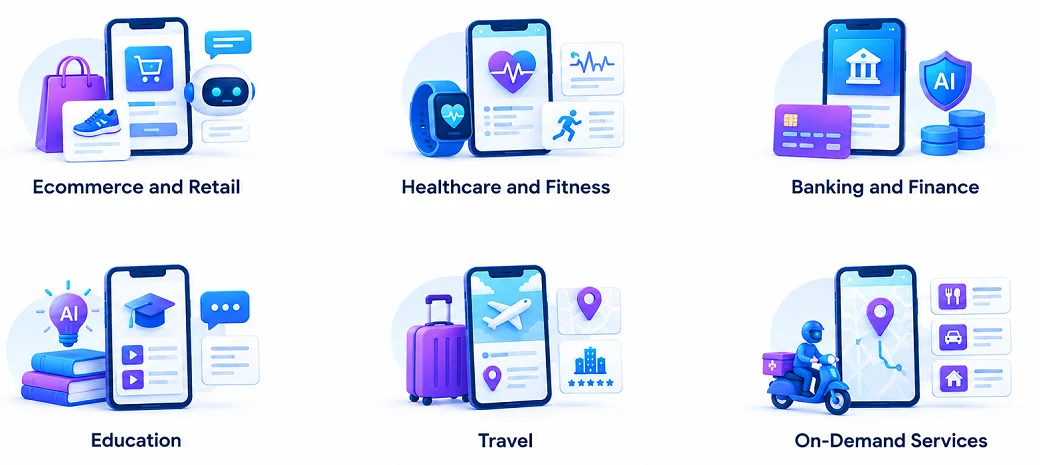
Ecommerce and Retail
The implementation of AI in retail and eCommerce industry streamlines personalized product recommendations, visual search, and conversational shopping assistants to help shoppers discover relevant products online. Moreover, AI-powered search and purchase assistance can also help with general product questions as well as guide shoppers throughout their buying journey.
Healthcare and Fitness
AI in healthcare and fitness applications support appointment scheduling, patient care, wellness guidance, and personalized fitness recommendations. Applications that handle medical information and personal patient data must follow appropriate privacy safeguards as well as clinician oversight if necessary.
Banking and Finance
Financial mobile apps use AI to identify unusual spending patterns, detect suspicious transactions, and offer personalized financial insights to users. Data protection, strong authentication, and human review for important decisions are still essential.
Education
AI-powered digital learning applications can explain difficult concepts, offer personalized exercises to learners, and support interactive learning through voice, images, and text. However, educational effectiveness with AI I should be carefully evaluated rather than being assumed.
Travel and On-Demand Services
Travel mobile applications use AI capabilities for streamlining booking queries, itinerary planning, and personalized recommendations. While on-demand platforms use predictive analytics to coordinate deliveries, estimate user demand, and send push notifications.
These AI mobile app development use cases demonstrate potential capabilities instead of guaranteed outcomes. Businesses must carefully evaluate opportunities against technical feasibility, user needs, and future performance goals before implementing AI.
Build Smarter Mobile Apps With AI
Turn your AI app idea into an intelligent mobile experience with the right development partner.
How AI Is Changing the Mobile App Development Process?
AI mobile app development is transforming how modern developers plan, test, write, and maintain applications. Instead of completely replacing mobile app developers, these tools help explore design options, automate repetitive tasks, and accelerate development activities. Their effectiveness still depends on codebase context, quality of human review, and task complexity.
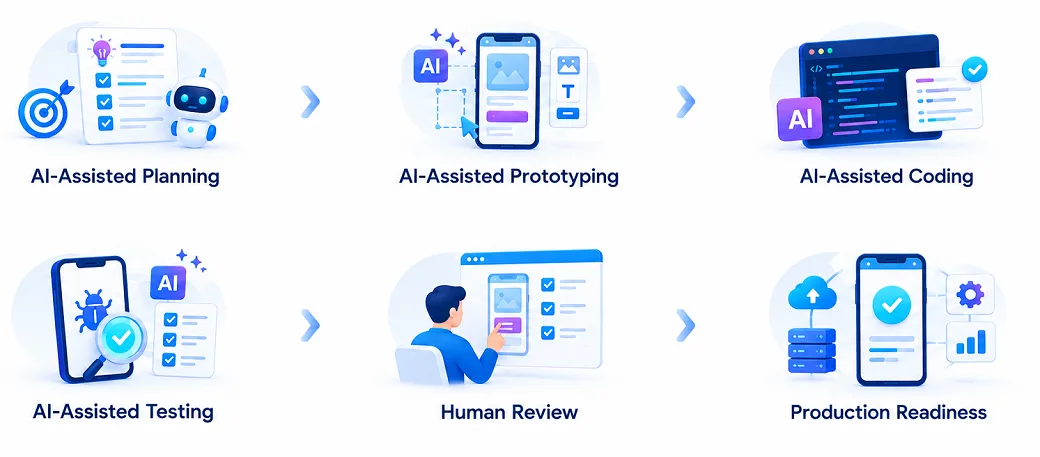
AI-Assisted Planning and Prototyping
AI development tools help developers with generating interface concepts, building mobile app prototypes, exploring requirements, and drafting user flows. Developers can depend on these outputs to compare the design options, but production decisions still require accessibility, user research, and technical constraints.
AI-Assisted Coding and Testing
Coding agents can explain errors, support code debugging, suggest code, and generate unit tests. A 2025 field survey involving 4,867 developers across three different organizations found an increase in tasks completed when developers used AI coding assistants. However, the results varied across settings and outputs. Although this ensures potential productivity benefits, it doesn’t guarantee improvements in every project.
Human Review and Production Readiness
AI-generated code and tests still require human engineering validation. Development companies must run regression and security tests, monitor application performance after launch, review architecture, and verify all the edge cases. This helps ensure AI-based development workflows do not compromise maintainability, reliability, and user safety.
Challenges of Adopting AI in Mobile App Development
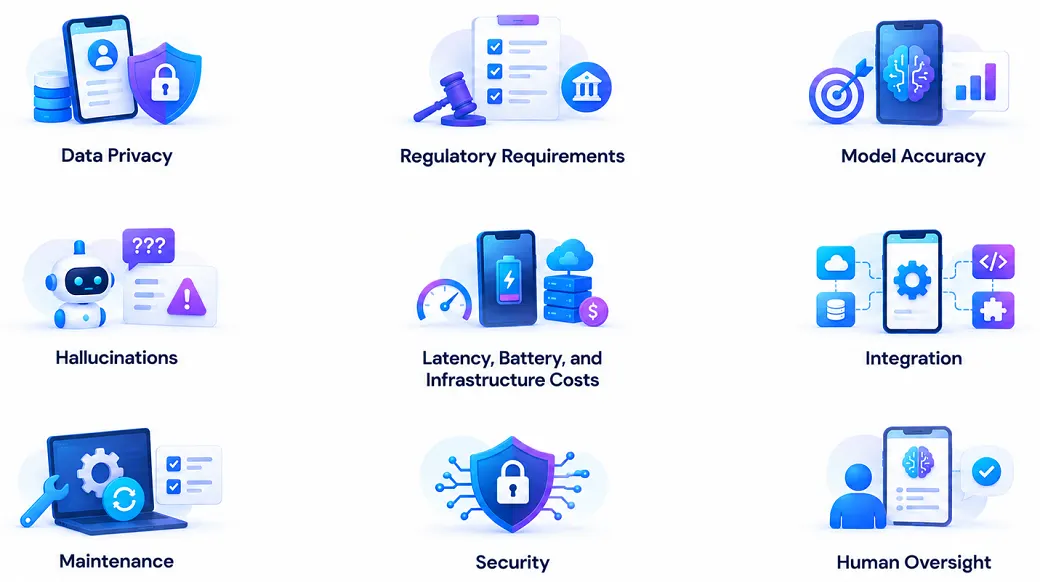
Integrating artificial intelligence capabilities within mobile app development introduces several challenges that go beyond model selection. Businesses must address output reliability, system compatibility, data protection, device performance, and security before adding AI features. Carefully planning these requirements can help reduce potential operational risks and build a more reliable AI-powered mobile application.
Data Privacy and Regulatory Requirements
AI features may also process images, conversations, personal information, or location data. Businesses should minimize data collection, explain how the personal information is shared or processed, obtain appropriate user consent, and define retention periods. Apple’s developer guidance recommends clearly communicating data usage as well as minimizing the amount of data sent to servers. However, required privacy obligations will depend on the users, data, and jurisdictions involved.
Model Accuracy and Hallucinations
Generative AI solutions may produce misleading or incorrect responses. Developers must test AI models against datasets, provide human escalation or fallback responses for unverified outputs, and ground answers from trusted sources if possible.
Latency, Battery, and Infrastructure Costs
Complex AI models can increase network usage, response times, and cloud inference expenses. With on-device AI processing, businesses can reduce network dependencies, but they must operate within device processing, memory, and battery constraints. Developers should consider benchmarking real-world performance and compare cloud, local, hybrid solution architectures before choosing an approach.
Integration and Maintenance
Connecting AI models within existing APIs, databases, and application workflows requires careful integration. Development teams must monitor errors, output quality, latency, and errors post deployment. Regular version management and regression testing can help identify possible problems when dependencies, models, or application requirements change.
Security and Human Oversight
AI integration may introduce several risks such as unauthorized tool use, exposure of sensitive business information, and prompt injection. Validate inputs, maintain audit logs, apply least-privilege permissions, and protect credentials. Retain human oversight for actions where mistakes may cause harm and set proper user confirmation for consequential actions. NIST recommends integrating proper risk management approaches throughout the AI solution lifecycle.
Bring AI Innovation to Your Mobile App
Integrate AI capabilities into your mobile app to deliver smarter features and more personalized user experiences.
How to Choose the Right AI Trends for Your Mobile App?
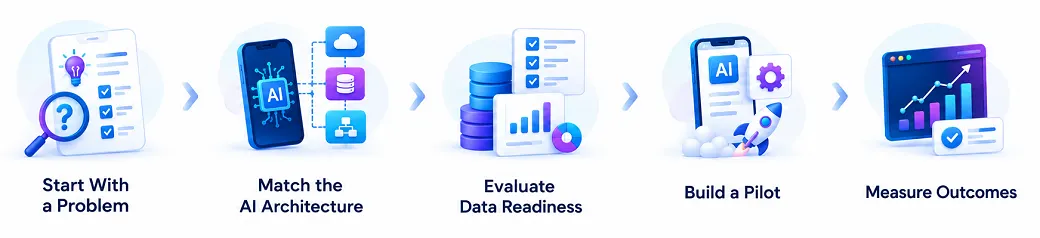
Choosing the right AI capabilities for any mobile application includes understanding business objectives, acceptable level of risk, users, and technical constraints. Instead of integrating every emerging technology, prioritize features that can actually deliver measurable value and solve specific problems.
Start With a User or Business Problem
Evaluate where users are experiencing friction or where existing workflows require manual effort or excessive time. Also define success metrics such as response accuracy, support resolution time, and task completion rate before choosing an AI solution.
Match the AI Architecture to the Use Case
Using on-device AI, businesses can run processes locally and reduce dependency on networks. On the other hand, cloud-based models are suitable for computationally demanding tasks. Applications requiring hybrid architectures can combine both approaches. Make sure to compare model capabilities, privacy, latency, connectivity, and operating costs.
Evaluate Data Readiness and Risk
Assess whether the data is accessible, legally usable, accurate, and relevant. Consider potential model errors, the consequences of incorrect outputs, and privacy requirements for financial and healthcare applications.
Build a Pilot and Measure Outcomes
Start by testing a limited set of features before expanding the functionalities. Evaluate model performance under multiple real-world conditions, establish baseline metrics, monitor costs, and make sure to define rollback processes in case any feature fails.
Match Business Requirements to AI Capabilities
| Business Requirement | AI capabilities to Consider |
| Automate multistep tasks | Agentic AI |
| Improve recommendations | AI personalization |
| Support offline experiences | On-device AI |
| Identify suspicious activity | Predictive AI and anomaly detection |
| Accelerate development workflows | AI-assisted coding and testing |
Evaluate the Development Partner
Hire a partner with AI integration experience, production monitoring capabilities, mobile engineering expertise, and robust testing practices. Also assess scalability, security, maintenance, and the capability of the development team to estimate app development cost based on business requirements.
Conclusion: Preparing Your Mobile App for the Next Phase of AI
Artificial intelligence is changing how mobile apps are built and how they deliver value. As the demand for generative AI, personalized experiences, agentic workflows, and on-device intelligence is evolving, businesses must look beyond emerging trends to identify which technologies can help address technical business challenges.
Building a successful AI-powered mobile app requires more than just integrating AI models or capabilities. It also includes preparing reliable and structured data, protecting user privacy, selecting the right cloud architecture, evaluating model performance, and monitoring the solution after deployment. Businesses must prioritize technical feasibility, measurable outcomes, and responsible AI practices instead of just adopting any technology only because of market popularity.
As the demand for AI in mobile app development is evolving, a well-strategized implementation strategy can help businesses build adaptable, scalable, and reliable applications.
At Konstant Infosolutions, we support startups as well as large-scale enterprises transform AI opportunities into business-driven AI solutions. Talk to our experts to explore our AI capabilities that align with your mobile app development goals.