The Ultimate Tech Guide to Grocery Delivery App Development

Complete guide to grocery delivery app development covering AI features, costs, delivery models, and future-ready business growth strategy.
Who Should Read this Guide:
- Startup founders planning to launch a grocery delivery business
- Retail businesses looking to digitize grocery operations
- Entrepreneurs exploring AI-powered delivery app solutions
- Product managers building on-demand delivery platforms
- Businesses wanting to improve customer experience through mobile apps
- Enterprises searching for scalable grocery delivery app development strategies
Grocery delivery industry is going through rapid digital transformation, and in 2026 we expect even bigger shifts in this industry. Today, grocery delivery mobile apps have become a crucial part of our everyday shopping routines. These apps offer high level convenience and efficiency as compared to traditional shopping methods.
With this increased demand of online grocery shopping and doorstep deliveries, almost every grocery storekeeper is now shifting to setting up the online presence of their business through custom on demand grocery delivery app development services. As modern customers now demand seamless payments, access to groceries on mobile apps, and quick doorstep deliveries, grocery business retailers, entrepreneurs, and supermarket chains are also planning to enter this on-demand commerce market.
This overall shift has made investing in grocery delivery application development a crucial strategy for modern businesses. Whether you are a growing startup or a well-established grocery business owner, this guide will walk you through all the ins and outs of custom grocery delivery app development.
In this guide we will talk about core features, benefits, cost, process, and top grocery delivery mobile apps dominating the market.
Why Should Businesses Invest in Grocery Delivery App Development?
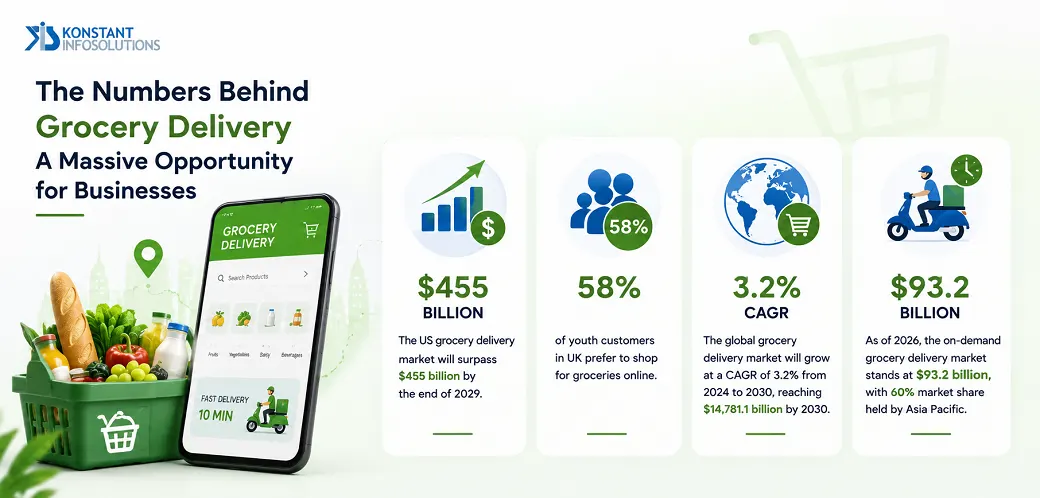
The demand and popularity of on-demand grocery delivery apps is growing rapidly as more and more users now prefer online shopping of groceries and get them delivered to their home at their preferred times. Furthermore, the rise of 10-minute delivery apps, quick-commerce, and last-minute hyperlocal deliveries has brought a revolution in the on demand delivery market by allowing customers to order anything they need instantly. Here are some of the top market stats that will hopefully convince you to invent in developing a grocery delivery mobile app:
- The US grocery delivery market will surpass the estimated mark of $455 billion by the end of 2029. This clearly shows the opportunity why present is the right time to invest in this market.
- As per Statista, more than 58% of youth customers in the UK prefer to shop for groceries online.
- The global grocery delivery market will grow with a CAGR of 3.2% from 2024 to 2030 and is expected to reach a staggering $14,781.1 billion by the end of 2030.
- As of 2026, the current on demand grocery delivery market stands at $93.2 billion, with about 60% of market share held by the Asia Pacific region.
What is a Grocery Delivery App?
After the COVID pandemic, the new normal has shifted to a few taps on mobile apps and getting every service delivered to the user's doorstep. The grocery industry is also witnessing the same as more and more customers are now shifting to order groceries online and get them delivered to their preferred location at any time and anywhere. But what actually a grocery delivery app is. In simple words, a custom grocery delivery mobile app is an online platform that allows customers to order groceries from their smartphones or tablets, make online payments, track orders in real-time and get orders delivered wherever they want.
Compared to other eCommerce or retail stores that sell a wide range of products, a grocery delivery mobile app only serves and delivers a limited range of products such as dairy, fresh produce, staples, and meat. However, these items demand seamless inventory and stock management along with instant or same-day delivery services.
Whether you are a startup or a well-established business, investing in grocery delivery mobile app development services will help with increased customer loyalty as well as remain competitive in today’s competitive landscape. As large scale grocery chains leverage grocery apps to set-up a consistent revenue generation stream, startups follow the aggregator model to save higher upfront infrastructure and inventory costs.
In simple words, grocery delivery mobile apps bring various parties together to ensure a smooth and seamless delivery flow including:
- Users: End users prefer grocery delivery apps to compare prices, choose preferred delivery times, track orders in real-time, browse products, place orders, and make online payments through a simple app interface.
- Grocery Storekeepers: The grocery store owners work as fulfilment centers responsible for management of inventory, discounts, product listings, pricing, and orders.
- Delivery Partners: Drivers are informed about upcoming and new orders, get details about delivery addresses, optimize delivery routes, and track overall earnings and commissions.
- Admins: The admins are responsible for managing overall grocery delivery operations, registered users, vendors, drivers, promotions, pricing rules, logistics workflows, analytics, and more.
Business Models of Grocery Delivery Mobile Apps
Now as you have an idea about what grocery delivery apps, you must be wondering about developing one for your business. However, before getting into grocery delivery app development, there are some important models you have to consider. To ensure the success of your mobile app, you must choose the model that aligns with your business goals, fits within your budget, and will help you in generating constant revenue over a longer run.
Revenue Models
One major concern that you can’t overlook while developing grocery delivery mobile apps is monetization. You have developed an app, but how will you earn money from it? To help you out, here are some of the ways you can follow to make your app a steady revenue generation platform:
- Freemium: This model allows users to have free access to the app, which results in broad adoption. But later on, customers can upgrade to a paid account and get access to some of the advanced features of the app. This approach may limit the chances of revenue generation as the majority of the users will prefer the free model, making it a complex monetization approach.
- Per-order Revenue: With this model, you can charge a fixed fee for every order transaction or delivery. This approach is easy to implement and aligns the usage with cost. On the other side, the fees may result in loss of potential customers, making it an unpredictable revenue model.
- Subscription Based: For free delivery or access to premium features of the app, you may charge a fixed subscription fee from users for monthly, quarterly, weekly, or yearly basis. For example, consider the HelloFresh app’s meal kit subscription. Overall, this model will drive long-term loyalty and steady revenue. However, you must focus on delivering consistent value to users to avoid churn.
Inventory Model vs Aggregator Model
If you are a well-established grocery delivery business and thinking about digitizing your store to enhance online presence and drive more customers, the inventory model will work best for you. Under this model, you will solely manage your own inventory/store, just like Walmart.
But if you are starting as a new business, this model will require hefty investment for logistics and warehouse space.
So, as a startup, you can consider going with the aggregator model. With this model you can work as a middleman for connecting customers with local grocery stores. The examples of this model are Shipt and Instacart. The aggregator model saves you from higher upfront costs of infrastructure management, but the successes heavily depend on reliability of partnered grocery stores.
White-Label vs Custom Solutions
Now, you have to decide whether you want to develop a custom grocery app from scratch or you will be going with a white-label app for quick app launch and faster time-to-market. A white-label grocery delivery mobile app may offer some degree of customization and help you in reducing development costs, but there are chances you may have to operate with some limitations that may not align with your business goals.
On the other hand, investing in custom grocery delivery app development services comes with higher costs. Either you can work with your in-house development team or you can outsource the project to a trusted grocery delivery app development company like Konstant Infosolutions. While developing a custom mobile app could cost more and require longer time for implementation, it ensures that you will enjoy greater flexibility with customization. Over time, this will potentially result in higher revenue and ROI.
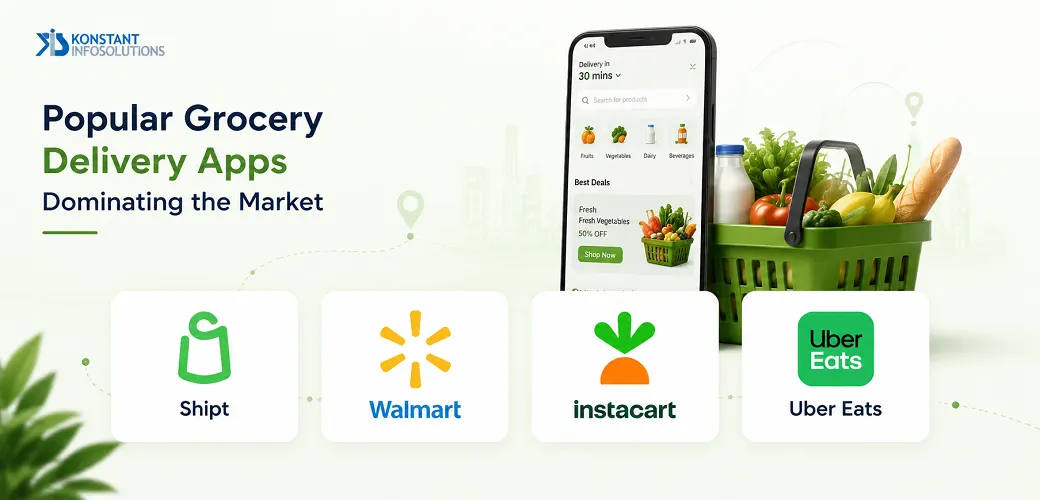
Popular Grocery Delivery Apps Dominating the Market
Before developing a custom grocery delivery mobile app, you must get familiar with the top competitors who are dominating the on demand grocery delivery industry. By carefully analyzing the features, functionalities, fee, and other factors of these apps, you can develop an app that will not only succeed in the market but will ensure users will prefer your app over your competitors.
Shipt
Shipt is one of the major contenders in the USA online grocery delivery market. In some ways the app is mostly similar to Instacart including the aggregator model, connecting customers with personal shoppers by partnering with various stores across the United States. From a fleet of more than 300,000 contractors who work on the behalf of the company, the app allows customers to get groceries delivered at their preferred location. Moreover, users can also set personalized diet preferences to easily navigate through the product catalogue, add special requests, and select their favorite shoppers.
Walmart
The app is a titan of the grocery delivery industry, and is packed with top-notch features that streamline the overall process of ordering groceries online. Customers get the option to order household appliances, food, groceries, clothes, and even furniture from an infinite product catalogue separated into multiple categories. Moreover, to make the shopping process more convenient, users can also create favorites lists, get personalized product suggestions, and easily add most-purchased items to the cart. After successfully placing the order, customers can track the order directly from the app’s home screen.
Instacart
Instacart has been ruling the grocery industry for over a decade now. This aggregator-style app has partnership with more than 40,000 grocery stores across the United States and lists over 500 million products online that users can shop. After the user places an order, the app connects the users with a personal in-house shopper who shops the groceries for them and gets the items delivered on the same day. Customers can also apply advanced search filters to quickly find the preferred product, directly connect with the shoppers, and track the order in real-time from the app.
Uber Eats
During the initial days, Uber Eats used to trade as a HoReCa app which allowed users to order meals from restaurants and get them delivered at their preferred location. But it's not the same anymore. The latest version of Uber Eats allows users to buy and order groceries online to ditch store-pick up hassles. Moreover, the app also allows users to track orders in real-time, buy monthly/yearly subscriptions to enjoy unlimited $0 delivery fees.
Benefits of Custom Grocery Delivery App Development
A custom grocery delivery mobile app benefits modern grocery businesses by allowing them to expand their market reach beyond physical locations restrictions for increasing sales, unlocking data-driven business insights, and streamlining inventory and stock management through hyper-personalized marketing. For users, grocery delivery apps help them to skip the long queues at physical stores and get groceries at their doorstep and at any time. On the other hand, grocery businesses can benefit from grocery delivery app development in various ways such as:
Boosting Loyalty Programs
By developing a grocery app, you can not only attract new users, but also retain existing one through personalized deals and reward programs such as:
- Cashback on every purchase
- Loyalty programs
- Free grocery delivery
- Special promo codes
- Regular Sales
- And so, on
Attracting Customers
In today’s digital world, most of the customers prefer to shop everything online. Instead of physically going to the store and dedicating a few hours to shop some groceries, they prefer using online grocery delivery mobile apps to get groceries delivered at their doorstep. If you invest in custom grocery delivery app development, it will not only help in attracting customers, but will also increase revenue generation.
Building Better Relationships
Getting conversion from a new customer is about 10x harder than retaining an existing customer. But with a scalable grocery delivery mobile app, you can not only connect with a wider audience base, but also achieve higher conversion rates. By investing in grocery mobile app development services, you can focus on offering personalized shopping experiences to users based on their shopping preferences, send timely push notifications about special discounts, and alert them about upcoming sales. Overall, this will eventually lead to increased conversions and profits.
Better Insights
By developing a custom grocery delivery mobile app, you can get detailed information as well as insights that you couldn’t get while operating offline. Here is a list of the of the data that a grocery delivery app delivers to streamline operations and drive long-term growth:
- User preferences
- Past purchasing patterns
- Preferred shopping time
- Best-selling products
- Product that are causing loss
- And more
Based on this data that you will get from in-app dashboard and analytics, you can focus on delivering personalized recommendations and shopping experiences to users based on their preferences and behavior.
Must Have Features for Grocery Delivery Mobile Apps
Now as you know the major reasons, how investing in custom grocery delivery app development services could benefit your business, let’s have a look at another crucial stage of app development process. The features and functionalities of the grocery app play a major role in deciding whether your user will love the app or not. Since, developing an MVP could help you with reducing development costs as well as speed up the whole development process, you can integrate the core features that most users expect. An on-demand grocery delivery mobile app has three panels, let's have a look at core features of each.
Customer App
A customer app is the core module of grocery delivery apps that allow users to place online orders and get groceries delivered at their doorstep. The must have features of user panel are:
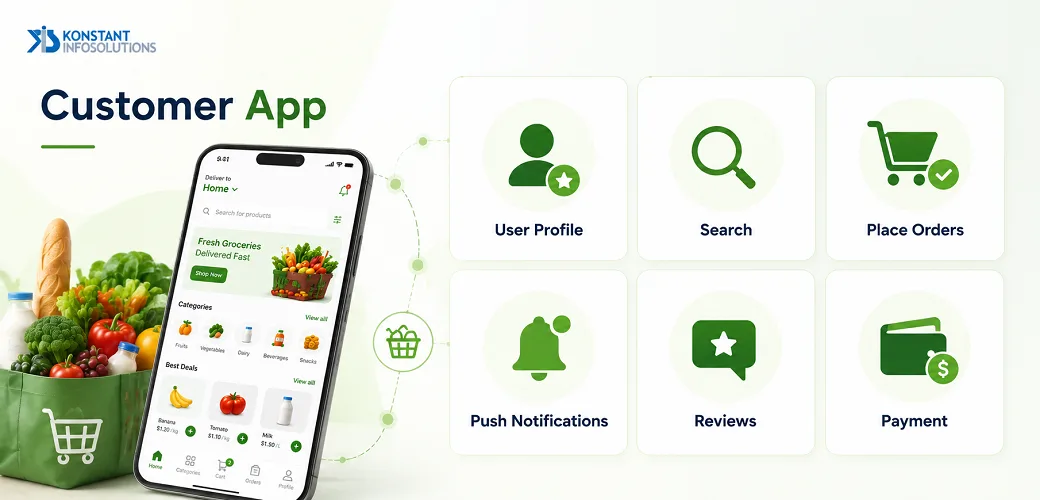
- User Profile: To use the app and place orders, users can create an account on the app through mobile number, email, or social media accounts.
- Search: With in-app search, users can easily search for the preferred product and apply different filters such as location, price range, and more.
- Place Orders: Within the app, users can add selected items in cart, make payments to place orders, and also track the deliveries in real-time.
- Push Notifications: Users are updated about order status, new offers and promotions, and when an item is restocked through in-app push notifications.
- Reviews: Based on service and deliveries, users can leave a review or feedback about the store as well as delivery agents.
- Payment: For seamless ordering, users can either make online payment through net banking, credit/debit cards, or they can make offline payments after the order is delivered.
Store App:
By developing a customized store module for grocery delivery apps, you can help storekeepers to automate operational workflows, manage their online presence, and connect with a wider audience base. Here is a list of core features for store panel:
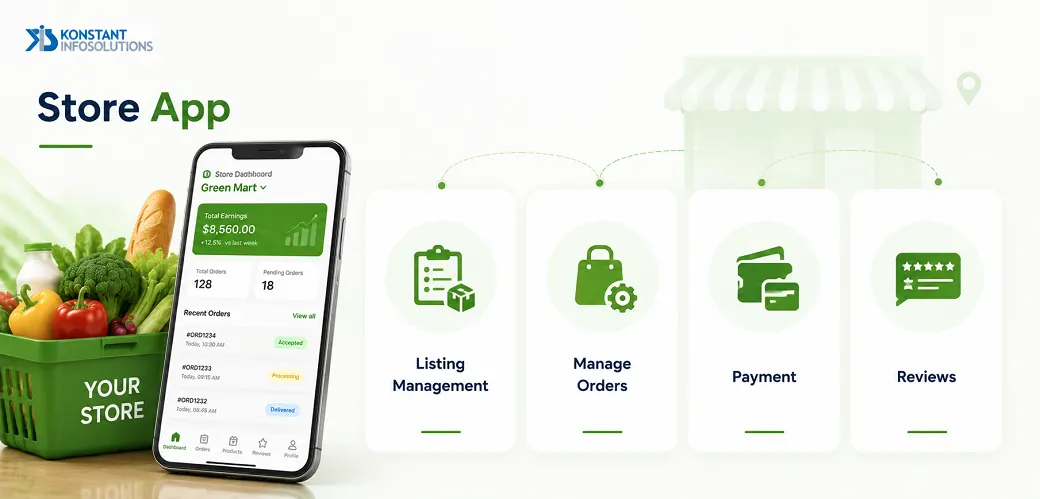
- Listing Management: Based on product availability and market demand, storekeepers can add, modify, or delete a specific product from the app, as well as adjust the pricing too.
- Manage Orders: With this in-app feature, store owners can accept or reject upcoming orders, process them, and notify users about the status of orders.
- Payment: Storekeepers can accept payment from users through various options including cash on delivery, credit/debit cards, pay later, or UPI modes.
- Reviews: To streamline and offer better services to customers, storekeepers can receive reviews and feedback from customers.
Courier App
The delivery person also needs a specific app with best-in-class features that can help with timely pickup and delivery of orders. The essential features of delivery person app are:
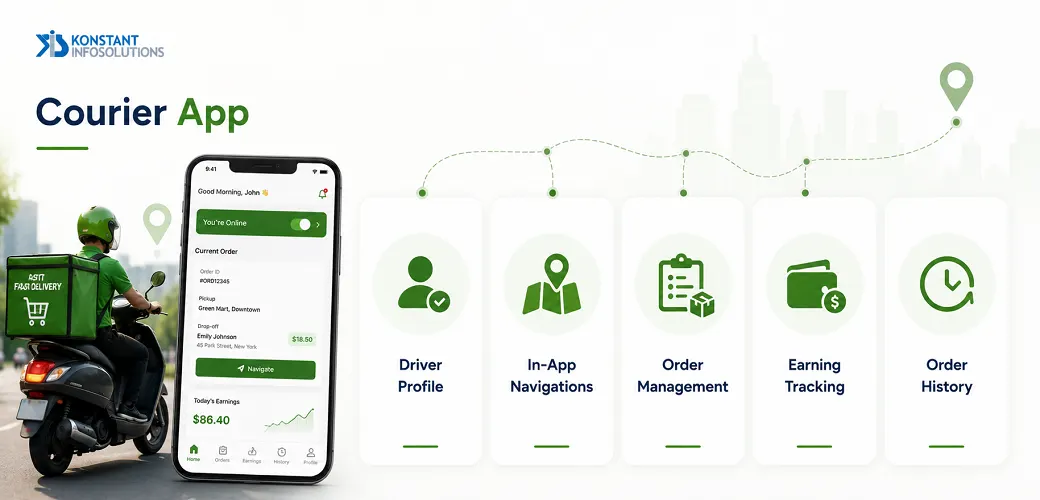
- Driver Profile: Just like users, drivers can also create an account on the app easily for quick registration through mobile number or email.
- In-App Navigations: This feature helps drivers to facilitate and deliver the order with ease and on-time. With navigation drivers can also optimize the delivery route to ensure quick order deliveries.
- Order Management: Within the app, drivers can get complete details about upcoming and new orders along with delivery location, expected earnings, and commissions before accepting any order.
- Earning Tracking: For completed deliveries and past orders, drivers can see total earnings, commissions and tips to maintain a track of their earnings and expenses.
- Order History: This feature enables drivers to view detailed history and information of completed orders as well as total payments/earnings.
Please note, this is not a list of all the features and functionalities that a grocery delivery mobile app should have. These are just the core features that you shouldn’t miss while developing a grocery delivery app. Based on your business needs and goals, you can adjust the features of the app to ensure the success of your app.
Steps to Develop a Grocery Delivery App
Thinking about developing a custom grocery delivery app to streamline operational workflows and drive consistent growth? In this section, we will talk about the detailed process of developing a grocery delivery app solution, from initial planning and development to launch and post maintenance and support.
Market Planning & Research
The initial step of grocery delivery app development begins with thorough market research that includes budget selection, understanding current market trends, and making a blueprint of the overall app development journey. Moreover, it is also important to get a clear understanding about modern user demand and industry needs, target audience, and future business goals to develop an app that will drive long-term success.
Hire Development Team
To develop a successful grocery delivery mobile app, you need a partner with proven experience and expertise in this field. By hiring an experienced grocery delivery app development company that has a team of professional and skilled mobile app developers, backend engineers, QA and testers, and project managers, you can develop a customized app tailored to unique needs and goals of your business. Additionally, make sure they follow agile development methodology to speed up AI-powered grocery delivery app development process and achieve faster time-to-market.
Build User Interface
Now, you should consider building clickable wireframes and mock-ups with core features and functionalities to visualize how the final product will look and perform at end user’s devices. Through modern designing tools such as Figma and Adobe XD, you can design smooth app navigations, user flows, and icons of the app as per your business requirements. With a strong and seamless user experience, you can ensure that users will love the app.
Integrate Cloud & APIs
This is one of the most crucial phases of grocery delivery app development as it involves integration of dynamic APIs, databases, and cloud computing to ensure seamless responsiveness and support. These integrations offer several services such as in-app chatting, real-time notification and order tracking, and complex data storage facilities. Moreover, at this phase, you can also think about integrating secure payment gateways to ensure users can easily make in-app payments.
QA and Security
Once the app has been developed completely, you do not directly launch it. Make sure to get it checked and analyzed by a team of expert QA and testers. Through various automated and manual testing approaches such as user acceptance tests, performance tests, and usability tests, you can ensure the app is free from bugs and issues. If there are any errors within the app, users may find it difficult to use.
Launch & Maintenance
Now the app is ready for launch on Apple App Store or Play Store, to ensure the users can easily download and use the app. However, once the app is live, the work is not finished. You must consider rolling out regular app updates to ensure your app stays up to date and offers seamless performance at all times. From quick bug fixing, feature enhancement, performance optimization, and security patch updates, mobile app support and maintenance services ensure the app scales seamlessly as your business expands over time.
How Much Does It Cost to Develop a Grocery Delivery App?
Budget is one of the most crucial factors for any businesses thinking about investing in grocery delivery mobile app development. Being a startup or a well-established business, you must consider spending in the right way for developing a custom grocery app that can drive long-term success and business growth. For your knowledge, there are three different categories to divide the on demand apps based on complexity and size. i.e.:
- Simple App: $20,000-$50,000
- Medium App: $50,000-$150,000
- Complex App: $150,000-$250,000.
For grocery delivery mobile apps, there are numerous features that must be considered to ensure the success of the app in the market. With a wide and different user base, the features and functionalities of the grocery app could increase, which will eventually result in higher development costs.
To cut development costs while ensuring your app can reach a wider user base, consider developing a cross-platform mobile app. By writing a single codebase for both iOS as well as Android, you can simply eliminate the need of developing separate apps for various platforms. Overall, this will save a heft of money, time, as well as resources for your business.
What Future Holds for Grocery Delivery App Development?
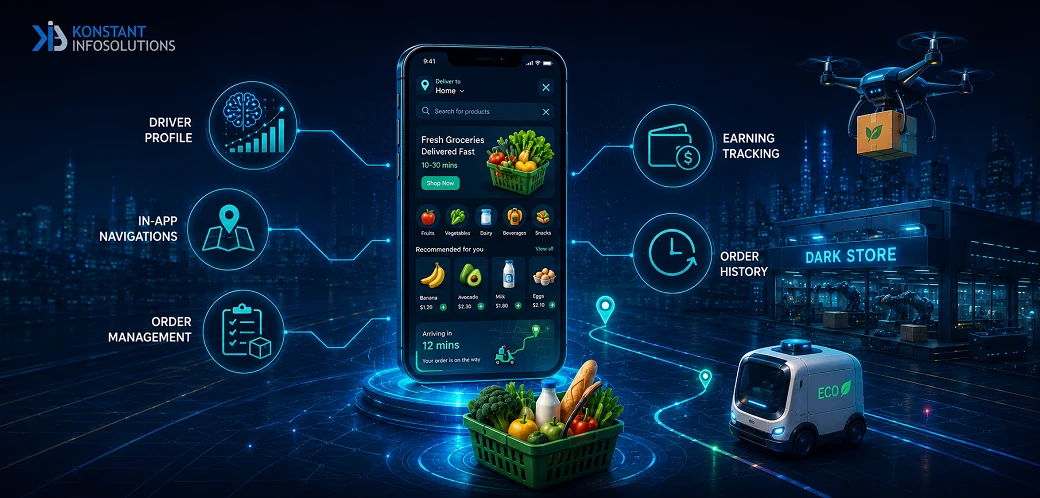
With the emergence of artificial intelligence and other future-driven technologies in grocery delivery mobile apps, businesses are now focusing more on automating operational workflows, offer quicker deliveries, track orders in real-time, and deliver personalized recommendations to users. Here are some of the key trends that will affect the future of grocery delivery industry:
Customer Support and Chatbots
For quick and faster customer support, grocery delivery mobile apps leverage AI-powered chatbots that eliminate the need of manual support from teams to solve common user queries, handle compliant tickets, and help users navigate through the app.
Another NLP-related trend emerging in custom grocery delivery app development is voice assistant integration including Google Assistant and Alexa that simplify overall shopping experiences.
Quick Commerce
Modern users demand everything at their fingertips. They do not want to wait when they have the option to choose from various grocery delivery apps. With the average delivery time ranging from 10-30 minutes, storekeepers have now started to operate from strategically placed warehouses also called “dark stores” for quicker deliveries and route optimization. The leaders in industry who are following this approach are Getir and Gorillas who have already established micro-fulfilment stores in the US and Europe for ultra-fast grocery delivery.
Personalised Shopping Experiences
Using machine learning and AI, businesses can focus on enhancing the overall grocery delivery app development process. With integration of these technologies, grocery apps can analyze customer data to offer personalized product recommendation, offers and discounts, shopping lists, and promotions. For example, Instacart leverages AI to analyze customer preferences and previous purchases for recommending items they are likely to purchase again. On the other hand, Amazon Fresh offers personalized promotional discounts to enhance customer retention and engagement.
Businesses must recognize that every customer has different requirements and preferences for purchasing grocery items. So, by offering customized subscription-based models, businesses can increase user retention through additional perks such as faster delivery windows and exclusive discounts for a fixed annual, monthly, or quarterly fee.
AR for Product Visualisation
With augmented reality technology, grocery delivery apps allow users to get a 3D view of products within their pantry or kitchen before purchasing. This feature is specifically useful for special grocery products such as meal kits. As IKEA uses AR to help users visualize furniture in their homes in a 3D view, similarly grocery apps can also leverage AR capabilities for showing detailed nutritional information and food packaging details.
Sustainability and Inventory management
As sustainability is becoming top priority for modern customers, grocery businesses are moving towards eco-friendly practices such as reduced carbon footprints and plastic wastage. Consider Ocado, a UK-based grocery delivery business that leverages electric delivery vehicles and also allows users to return back plastic bags for recycling.
Machine learning models and artificial intelligence also help in reducing overstocking and spoilage, and prevent stockouts. For example, FreshDirect apps allow businesses to predict market demands based on seasonal trends, weather patterns, and customer shopping preferences.
AI-Powered Demand Forecasting
The emergence of custom AI development within grocery delivery mobile apps helps with accurate demand forecasting and predict market trends by analyzing user purchasing patterns and preferences. This not only prevents stock shortages and optimizes supply chain operations, but also helps in reducing inventory waste for improving operational efficiency.
Why Choose Konstant for AI-Powered Grocery Delivery App Development?
Nowadays, most of the customers prefer to order groceries online as it saves time and is convenient as well as fast. This is the reason why the demand for AI-driven grocery delivery apps is becoming quite popular among modern grocery businesses. By integrating artificial intelligence capabilities with grocery delivery applications, businesses can focus on automating overall operational workflows, enhance customer experiences, and make inventory management more efficient.
A successful grocery delivery mobile app not only has essential features such as push notifications, advanced search secure payment gateways, and login systems, but is also integrated with advanced AI-driven capabilities including smart search results, demand forecasting, product recommendations, automated customer support, and intelligent delivery route optimization.
Developing a custom mobile app from scratch could be complex without the right technical expertise and knowledge. At Konstant Infosolutions, we have a team of skilled and experienced developers who bring hand-on expertise and proven knowledge in AI grocery delivery app development tailored to your unique business needs and goals. We support grocery storekeepers integrating modern technologies that not only improve operational efficiency but also enhance customer engagement.
With over two decades of industry experience, our experts understand the continuously evolving needs of the grocery delivery industry. From user-friendly interfaces to AI-driven automation, we support growing startups as well as large scale grocery chains to develop and deploy grocery delivery solutions that enhance customer satisfaction and also helps to stay competitive in today’s digital landscape.
The Key Takeaway
As the demand for quick and convenient grocery delivery at doorstep is rapidly growing, storekeepers are focusing more on investing in white label grocery delivery app development to optimize operations and connect with a wider audience base. Moreover, AI tools and technologies are driving the future of the grocery industry, and there’s no time like the present to grab the benefits of custom grocery delivery mobile apps.
For businesses, these apps unlock new opportunities for driving constant revenue and profit. On the other hand, grocery delivery apps allow customers to order groceries online to get them delivered at their doorstep at any time and from anywhere. Whether you are thinking about developing a custom mobile app tailored to your business needs, or thinking about choosing a white label grocery delivery app, the success will depend on smooth execution, smart planning, and strong features.
Hopefully, this blog has helped you to gain a detailed understanding of on demand grocery delivery app development. By following the steps mentioned in this blog, you can develop a customized grocery delivery app tailored to your unique business goals and needs.
Best of luck with your next grocery delivery app!