Wearable App Development Cost in 2026: Complete Pricing Guide

Discover wearable app development cost in 2026 with pricing factors, features, stages, and budget ranges to help you plan your project.
Wearable solutions are transforming the way people monitor their health, interact with digital experiences, and improve productivity. Modern devices such as fitness trackers, smart rings, hearables, and smartwatches depend on wearable applications to collect and analyze user data to offer personalized insights and help with their everyday activities.
As wearable technology continues to evolve at a rapid pace, several technology trends in wearable app development such as machine learning, artificial intelligence, connected devices, and cloud computing are driving digital transformation in wearable solutions. Startups as well as enterprises across fitness, consumer markets, and healthcare are increasingly investing in developing wearable mobile apps to enhance user engagement and operational workflows. As per a report from FnF Research, the global wearable technology market is expected to reach about $380 billion by 2028, with a CAGR of 18.5%.
But before investing in wearable app development, one common question that most businesses get stuck with is: How much does wearable app development cost?
The answer directly depends on several factors including project size and complexity, feature and functionalities, security measures, wearable platform choice, backend infrastructure, and regulatory compliance. In 2026, the average wearable development cost will range from $20,000 to $300,000+.
This guide talks about major key drivers including platform considerations, development stages, and budgeting factors that influence overall wearable app development costs in 2026.
Quick Answer: What Is the Average Cost of Wearable App Development in 2026?
The average wearable app development cost in 2026 ranges from $20,000 to $300,000+, depending on app complexity, platform selection, integrations, compliance requirements, and custom feature development. Basic wearable applications generally cost less, while enterprise-grade healthcare, fitness, and AI-powered wearable solutions require significantly larger investments.
How Much Does Wearable App Development Cost in 2026?
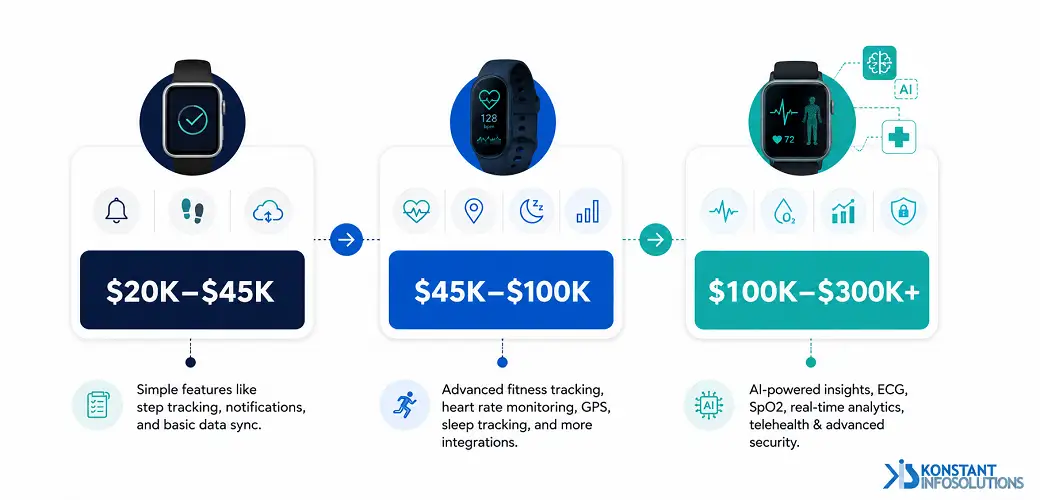
The final cost of developing wearable apps usually depends on several factors such as feature set, compliance requirements, location of mobile app development company, project size and complexity, supported devices, and more. Developing a simple wearable app with limited feature set will cost less compared to a more complex wearable app integrated with AI, real-time analytics, and healthcare compliance standards.
| App Complexity | Estimated Cost | Timeline |
| Basic | $20,000–$45,000 | 2-4 Months |
| Medium | $45,000–$100,000 | 4-7 Months |
| Advanced | $100,000–$300,000+ | 7-12+ Months |
Basic Wearable Apps
These apps are best for businesses and startups looking to validate an idea in the market through a Minimum Viable Product. Basic wearable apps have minimal integrations, simple backend infrastructure, and are focused on core functionality. Common features are:
- User registration
- Step tracking
- Calorie tracking
- Basic activity dashboard
- Push notifications
- Simple device synchronization
Estimated Cost: $20,000–$45,000
Why This Range Exists: Developing these types of wearable apps usually costs less because of fewer integrations, limited features and functionalities, as well as simple user experiences. These apps are built for quick market launch and validate market demand.
Mid-Level Wearable Apps
For businesses thinking about developing and launching a commercial-grade product with enhanced user experiences, enhanced functionality, and greater scalability, mid-level wearable apps are best suited. Moreover, these apps also support advanced data management capabilities and multiple integrations. Most common features are:
- Real-time tracking
- Historical data analysis
- Multi-device synchronization
- Third-party integrations
- Personalized workout plans
- Cloud data backup
Estimated Cost: $45,000–$100,000
Why This Range Exists: Costs rise because of cloud infrastructure requirements, stronger security approach, sophisticated features, additional third-party integrations, and rigorous testing across multiple digital touchpoints.
Advanced Wearable Apps
Complex or advanced wearable apps are usually built for healthcare, premium consumer user cases, enterprise, and sports performance. Backed by advanced analytics, extensive integrations, and highly complex backend structures, these apps demand high development costs. Common features of these apps are:
- AI-powered insights
- Real-time data streaming
- Advanced analytics
- Multi-role dashboards
- Custom API integrations
- Role-based access control
- Regulatory compliance workflows
Estimated Cost: $100,000–$300,000+
Why This Range Exists: Developing advanced wearable applications includes large-scale backend infrastructure, adherence to healthcare compliance standards, complex development processes, machine learning and AI integration, and high-level security measures. Together, these factors significantly increase the overall development efforts and cost.
For most businesses, the cost of developing wearable apps ranges between $45,000 to $100,000. Wearable apps built under this budget offer scalability, functionality, and seamless user experience needed to make the app a successful market product.
How Long Does It Take to Develop a Wearable App?Developing a wearable app typically ranges from 2 to 12 months, depending on project size and complexity, number of features, compliance needs, and supported devices. A basic wearable app will take about 2 to 4 months, mid-level solutions require 4 to 7 months, and advanced wearable applications with additional features such as AI-powered features and real-time data processing will take about 7 to 12 months. |
Key Factors Affecting Wearable App Development Cost
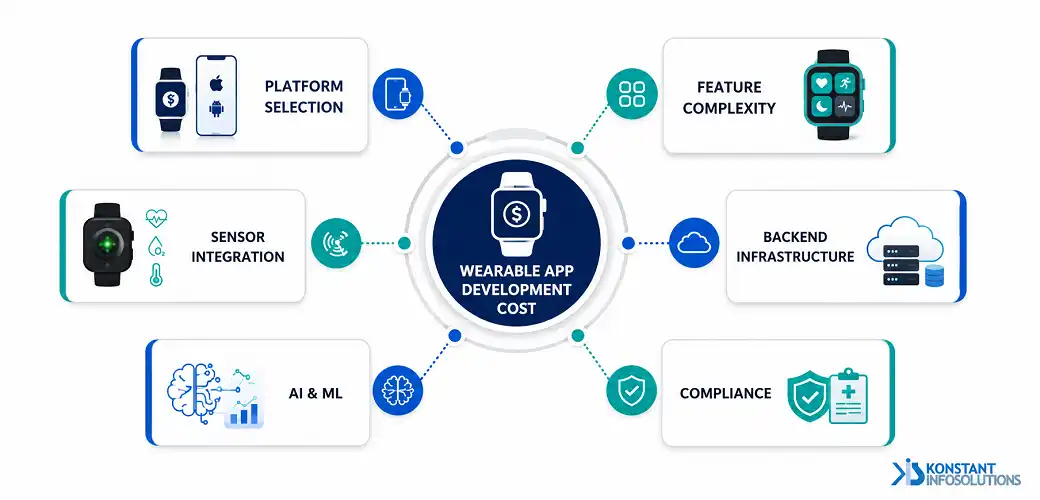
As already said, the cost of developing a mobile app for wearable devices in 2026 depends on several factors. Some of the most common factors are feature complexity, backend infrastructure, compliance requirements, sensor integration, AI capabilities, and more. While developing a basic wearable app will cost between $20,000 and $45,000, a complex application with functionalities and rigorous testing needs could go up to $300,000+.
As project size and complexity increases, infrastructure requirements as well as maintenance cost also rise. Carefully understanding cost affecting factors can help with careful budget planning and eliminate unexpected expenses.
Wearable Platform Selection
One of the most crucial factors that affect development costs is the choice of wearable platform. Each platform offers different device capabilities, integration options, development frameworks, and user demographics. Testing requirements, ecosystem integrations, platform-focused design approaches, and device compatibility directly impact the overall development budget. So, businesses must carefully define product goals and choose a target audience before picking a wearable platform.
| Platform | Typical Cost Range | Major Cost Driver |
| Apple Watch | $30,000–$130,000+ | HealthKit & iOS Integration |
| Wear OS | $25,000–$120,000+ | Multi-Device Compatibility |
| Fitbit | $15,000–$250,000+ | Fitness Analytics & Integrations |
| Garmin | $30,000–$150,000+ | Sports Tracking & GPS Features |
| Cross-Platform | $20,000–$150,000+ | Multi-Platform Support |
Apple Watch
Developing an Apple Watch app includes both, a companion iPhone app as well as a watchOS application. Moreover, integration with HealthKit offers advanced fitness and health functionality, but could increase development and testing efforts because of data synchronization, privacy controls, and platform-focused design standards.
Estimated Cost: $30,000–$130,000+
Wear OS
Wear OS app development demands compatibility with various device manufacturers and multiple screen sizes. UI optimization, additional testing, and device-specific management will increase overall development time.
Estimated Cost: $25,000–$120,000+
Fitbit
For wellness monitoring, activity management, fitness tracking, and sleep analysis solutions, Fitbit app development is commonly preferred. While Fitbit offers various development APIs and tools for simplified integrations, personalized coaching, third-party integrations, advanced analytics, and cloud synchronization may increase the development cost.
Estimated Cost: $15,000–$250,000+
Garmin
Garmin wearables are usually built for sports performance, health monitoring, fitness, and outdoor navigation use cases. Based on complexity of real-time data processing requirements, device integrations, custom dashboards, and support for Garmin’s specialized location-tracking, overall development cost may vary.
Estimated Cost: $30,000–$150,000+
Cross-Platform Development
For reducing overall development efforts and accelerating time-to-launch through shared development codebases, cross-platform wearable app development is the best choice. While this approach may reduce overall development costs compared to developing native wearable apps, additional efforts are still needed for platform-specific device integrations and features.
Estimated Cost: $20,000–$150,000+
Feature Complexity
The number of features included in wearable apps will have a direct impact on overall development costs. Simple functionalities including activity tracking, profile management, user authentication, and push notification require less development effort. On the other hand, advanced feature integration such as GPS tracking, real-time synchronization, health monitoring, and predictive analytics will significantly increase development costs and efforts.
Sensor Integration
As wearable devices often depend on sensors to analyze and collect real-time user data, this impacts the overall development costs. Common sensor integration includes accelerometers, sleep tracking sensors, blood oxygen sensors, gyroscopes, and GPS modules.
Basic sensor integration is usually straightforward, but advanced integration requires accurate data processing and compatibility testing across diverse devices. As the complexity of sensor integration increases, testing and development costs also increases.
Backend Infrastructure
With solid backend infrastructure, wearable devices can store, process, and synchronize user data in real-time across diverse platforms and devices. This includes databases, analytics platforms, APIs, cloud services, and user management systems.
Wearable apps that support large user bases, complex reporting capabilities, real-time synchronization, and healthcare data storage need more sophisticated backend infrastructure. As a result, the complexity of backend architecture plays a crucial role in deciding the overall development costs.
AI and Machine Learning
AI-driven wearable mobile apps support personalized recommendations, anomaly detection, predictive health insights, intelligent coaching, and activity recognition. These capabilities enhance overall user satisfaction and create more valuable user experiences.
However, AI integration often needs additional investments for machine learning models, infrastructure, data processing, training datasets, and ongoing optimization. As a result, AI features are considered among the most expensive components for wearable app development.
Regulatory Compliance Requirements
Particularly for wellness and healthcare applications, compliance requirements could significantly increase the overall development costs. Adhering to industry compliance and regulations such as GDPR, HIPAA, and various other protection standards require encrypted communication, privacy safeguards, and audit trails.
Fulfilling these requirements could often involve additional documentation, security reviews, development, and testing, which increases overall development budget and timelines.
What Factors Have the Biggest Impact on Wearable App Development Cost?The major factors that affect the wearable app development costs include feature complexity, backend infrastructure, regulatory compliance, platform selection, and AI integration capabilities. Wearable apps with real-time data synchronization, advanced healthcare integrations, health monitoring, and multiple wearable platform support usually costs more compared to basic wearable apps because of increased testing, security, development, and maintenance requirements. |
Wearable App Development Cost Breakdown by Development Stage
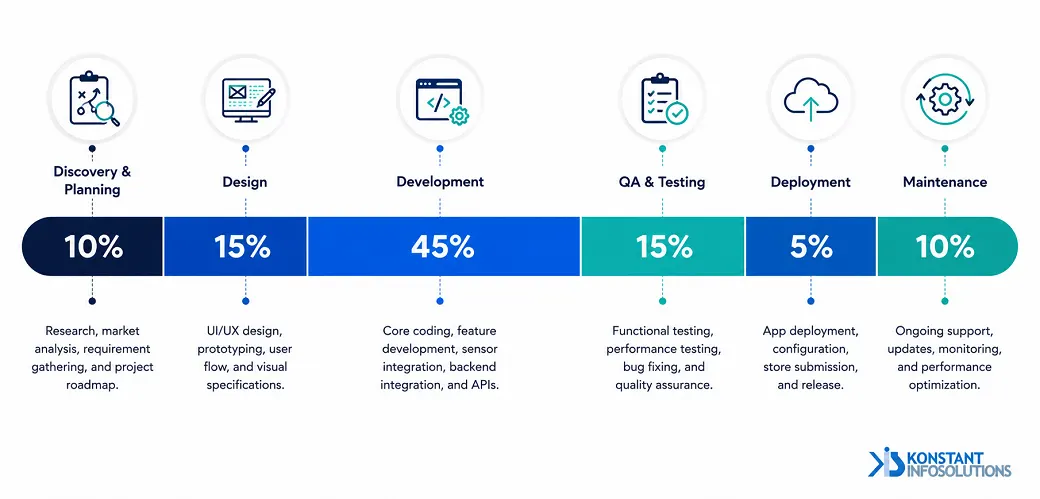
The total cost of developing a wearable app is also determined by overall development stages ranging from initial planning to post-launch support and maintenance. Having a clear understanding about how the budget is typically allocated can help in keeping projects under budget and eliminate unexpected costs later. Here is a tabular representation (for a $50,000 project) of how the overall budget is distributed:
| Development Stage | Percentage of Budget | Estimated Cost |
| Discovery & Planning | 10–15% | $5,000–$7,500 |
| UI/UX Design | 10–15% | $5,000–$7,500 |
| Development | 45–55% | $22,500–$27,500 |
| Testing & QA | 10–15% | $5,000–$7,500 |
| Deployment & Launch | 3–5% | $1,500–$2,500 |
| First-Year Maintenance | 15–25%* | $7,500–$12,500 |
*Maintenance is calculated separately from the initial development budget.
Discovery and Planning
The initial phase begins with thorough market research to lay a solid foundation of the entire project. Developers identify target users, evaluate market demand, and understand core business goals to create a successful development roadmap. You may have to invest about 10-15% of the overall development budget for successful planning.
UI/UX Design
As wearable devices have limited screen sizes, ensuring intuitive user experiences is essential. The UI/UX design cost amounts to about 10-15% of overall development budget. This phase is focused on crafting wireframes, navigations, platform-specific design guidelines, and user flows. With a well-designed user experience, businesses can improve user engagement.
Development
This stage is the most expensive and accounts for the largest expense ranging from 45-55% of overall budget. Development phase includes building intuitive frontend, strong backend architecture, connecting sensors, implementing strong security measures, and feature development.
Quality Assurance
Before deploying the app, it is important to run rigorous automated and manual tests to ensure the app performs well at the end user’s device. This includes performance testing, usability testing, functional testing, security validation, and device compatibility checks. Although this takes about 10-15% of overall expenses, it may help in identifying issues before launch.
Deployment and Launch
Once the app is tested completely, the deployment phase starts. This stage includes preparing the app for Google Play Store and Apple App Store release while ensuring it adheres to standards of marketplaces, configuring production environments, and validating launch readiness. Deployment takes a smaller portion of the overall budget, i.e., 3-5%.
Post-Launch Maintenance
Expenses don’t end after the app is deployed. To keep the app running smoothly at all times, it demands regular support and maintenance including bug fixing, OS updates, feature enhancements, and performance optimization. This covers about 15-25%* of overall development costs on an annual basis.
Planning a Wearable App Project?
Get a tailored cost estimate based on your goals, features, and target platforms.
Get a Free Cost EstimateCost of Popular Wearable App Features
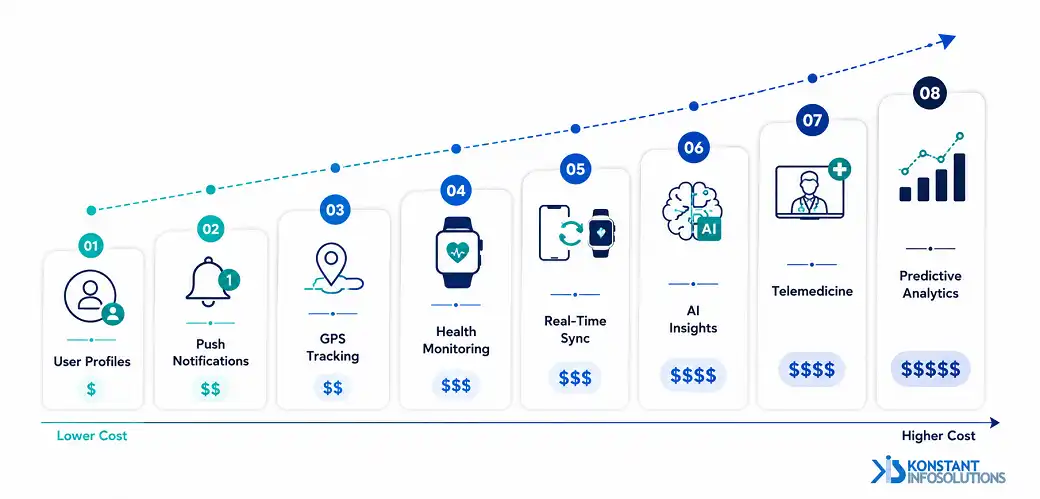
The number of features you will integrate within the app also play a significant role in determining the overall cost of wearable app development. Some basic features including pus notifications as well as user profile require minimal development efforts and cost less. On the other hand, integration of some advanced features such as predictive analytics, real-time health monitoring, and AI-driven insights could require complex integrations and will cost more.
| Feature | Development Complexity | Estimated Additional Cost |
| User Profiles | Low | $1,000–$3,000 |
| Push Notifications | Low | $1,000–$2,500 |
| GPS Tracking | Medium | $3,000–$8,000 |
| Health Monitoring | Medium | $5,000–$15,000 |
| Real-Time Sync | Medium | $4,000–$10,000 |
| AI Insights | High | $10,000–$30,000+ |
| Telemedicine Integration | High | $15,000–$40,000+ |
| Predictive Analytics | High | $12,000–$35,000+ |
Now we will look at each feature in detail:
User Profiles
To store user activity history, personalized preferences, and health metrics, wearable apps contain user profile features. This functionality within the app offers customized user experience and ensures seamless data synchronization. Overall cost ranges from $1,000 to $3,000.
Push Notifications
With in-device push notification, users can stay engaged through alerts, personalized recommendations, reminders, and achievements. Mostly favorable for medication reminders, activity tracking, and fitness goals, this feature adds around $1,000 to $2,500.
GPS Tracking
Integration of GPS tracking helps with distance measurement, location-based services, route mapping, and route navigation. These capabilities are especially useful for sports, workforce management, fitness, and outdoor adventure applications. The overall cost addition with GPS tracking integration is around $3,000 to $8,000.
Health Monitoring
To analyze data including ECG sensors, gyroscopes, heart rate, accelerometers, and temperature sensors, wearable devices leverage health monitoring features. These capabilities enable users to receive actionable and personalized health insights and could cost around $5,000 to $15,000.
Real-Time Sync
Real-time data synchronization ensures wearable data is regularly updated and exchanged between companion mobile apps, wearable devices, and cloud infrastructure. This ensures users get real-time updated information about their health metrics. The overall cost ranges from $4,000 to $10,000.
AI Insights
To provide predictive alerts, personalized recommendations, and wellness suggestions, wearable apps leverage AI-powered insights such as health metrics and user activity patterns. These features enhance user engagement and could cost between $10,000 to $30,000.
Telemedicine Integration
With telemedicine integration, wearable devices offer patient monitoring, EHR connectivity, virtual consultations, and appointment scheduling. Due to secure data transmissions, healthcare compliance requirements, and third-party integrations, cost ranges from $15,000 to $40,000.
Predictive Analytics
This feature uses historical as well as real-time data to forecast outcomes, identify trends, and support proactive decision-making. Common applications include recovery forecasting, health risk detection, and performance optimization. The typical cost addition is about $12,000 to $35,000 because of data modelling, ongoing optimization requests, and advanced algorithms.
Expert InsightThe biggest cost-saving strategy isn't choosing the cheapest development team. It's defining the right features from the start. A focused MVP often delivers better ROI than a feature-heavy product built without market validation. |
How to Reduce Wearable App Development Costs?
Developing a wearable app in 2026 doesn’t need to be expensive. With strategic planning and decisions, businesses can reduce development costs while maintaining performance, quality, and user experience.
Start With an MVP
Beginning with MVP development is considered to be one of the most effective ways to reduce wearable app development costs. Instead of creating a full-scale product integrated with every possible feature, start with core features only that solve a specific user problem. This will help validate the idea in the market and reduce the risk of unnecessary investments.
Use Cross-Platform Technologies
If you are planning to target multiple wearable platforms, investing in cross-platform app development services could be a profitable choice. This approach allows teams to reuse the same codebase and components to minimize development efforts while maintaining flawless user experience. However, you must evaluate if any functionality is platform-specific and requires native development.
Prioritize Essential Features
The choice of features has a direct impact on overall development cost. So, it is crucial to prioritize only the features that offer highest value to users and consider addition of non-essential features later on. For example, if you are developing a fitness wearable app, integrating health monitoring and activity tracking is crucial instead of adding AI-powered recommendations.
Reuse Existing APIs and Integrations
If you develop each and every feature from scratch, this will significantly increase the overall development budget. Instead, leverage existing cloud services, payment gateways, APIs, healthcare integrations, and analytics platforms to accelerate development cycles and launch your product quickly.
Partner With an Experienced Development Team
Hiring an experienced wearable app development company can help in reducing development risks and avoiding common mistakes. While choosing a reliable partner like Konstant Infosolutions, check for reviews from past clients, previous wearable projects they have delivered, communication transparency, development approach, and ratings on Clutch, GoodFirms, and more. This will ensure your project’s success and long-term growth.
Benefits of working with an experienced development include:
- Faster development cycles
- Reduced technical debt
- Better architecture
- Predictable budgets and timelines
- Improved quality assurance
Why Are Businesses Investing in Wearable Apps in 2026?
The wearable market is growing rapidly as more and more people are becoming increasingly dependent on connected devices for improving productivity, health monitoring, and accessing real-time information. Due to this increased demand, both large scale organizations as well as startups have already started investing in custom wearable app development services, to collect valuable information, offer personalized user experiences, and drive constant revenue.
| Business Driver | Impact on Adoption |
| Digital Health | High |
| Consumer Wearables | High |
| Real-Time Data Access | High |
| AI Personalization | Growing |
| Enterprise Applications | Growing |
Growth of Digital Health
The increase in digital health practices is one of the major drivers of accelerated wearable app adoption. Fitness trackers, smartwatches, and health-monitoring devices help users to track vital health metrics such as sleep quality, physical activity, heart rate, and physical activities. Moreover, healthcare providers have also started to leverage wearable capabilities for preventive care, remote patient management, and chronic disease management.
Increasing Consumer Adoption
Wearable devices are becoming an important aspect of user’s everyday lives. From making contactless payments and accessing smart notifications to tracking fitness, wearable devices offer personalized experiences as well as convenience. As device adoption is increasing, wearable apps are becoming a core way for businesses to interact with users.
Demand for Real-Time Data
As wearable devices continuously generate and collect real-time data, it helps users to make more informed decisions. From monitoring health conditions and managing workplace operations to tracking workout performance, instant insights allow businesses to deliver actionable information whenever needed.
AI-Powered Personalization
Integration of machine learning and artificial intelligence capabilities makes wearable apps more user-centric and intelligent. Organizations can analyze user behavior, health metrics, and daily activities to deliver more personalized recommendations and customized experiences. This level of personalization improves overall user satisfaction and long-term engagement.
Enterprise Use Cases
Wearable apps are now no longer limited to fitness and healthcare only. Global enterprises are increasingly investing in wearable applications for employee safety, logistics tracking, workforce management, field service operations, and industrial monitoring. These solutions also help in enhancing overall productivity, streamlining operational processes, and enhancing safety.
Conclusion
In the end, the cost of developing a wearable app in 2026 starts at $20,000 for a basic app and could go up to $300,000+ for more complex enterprise and healthcare solutions. The final investment will depend on feature complexity, backend infrastructure, security requirements, and AI capabilities.
Businesses thinking about developing wearable solutions for fitness, enterprise operations, healthcare, sports, and IoT ecosystems must evaluate their requirements before defining the development budget. While integration of some advanced features such as predictive analytics, AI-powered insights, real-time health monitoring, and telemedicine integration could increase overall development costs, they ensure long-term business growth and consistent revenue.
Instead of focusing solely on initial development costs, organizations must also consider maintenance costs and long-term ROI that wearable apps offer. With a well-crafted wearable application, businesses can unlock new revenue generation opportunities, strengthen competitive advantage, and enhance customer retention.
If you are thinking about developing a wearable app in 2026, check out our comprehensive wearable app development guide to get a clear understanding about development best practices and process. Also, you can learn more about our wearable app development services to know how our team can help in designing and developing scalable wearable applications.