How to Scale an AI MVP From Prototype to Production in 90 Days?


Learn how to scale an AI MVP to production in 90 days with the right architecture, cost controls, monitoring, and production-ready practices.
Key Takeaways:
- Scaling an AI MVP requires production-ready architecture, reliable infrastructure, and measurable performance.
- A 90-day roadmap can help teams move systematically from an MVP to a production-ready AI product.
- Before scaling, teams should assess whether the existing MVP can be optimized, refactored, or needs to be rebuilt.
- Production readiness depends on areas such as AI models, APIs, databases, security, monitoring, and deployment workflows.
- Choosing the right AI model and architecture can help control inference costs while maintaining performance.
- Techniques such as model routing, response caching, token optimization, and autoscaling can reduce unnecessary production costs.
- AI MVP scaling should include continuous monitoring, testing, observability, and performance optimization.
- Teams should establish clear production metrics and KPIs before increasing infrastructure or user capacity.
- Scaling decisions should consider user growth, system performance, technical debt, AI costs, and business requirements.
- A phased approach helps businesses reduce production risks while improving scalability, reliability, and user experience.
With the emergence of AI development tools, building an MVP for concept validation has become more reliable. However, turning the MVP into a production-ready system requires additional development and engineering. The AI-built MVP is feasible to test a product idea or AI feature, but it may still have weak security, limited testing, technical debt, or unreliable data pipelines that may not support actual business workloads.
Scaling an AI MVP to production requires a team of dedicated developers who can help evaluate AI models, secure the application, prepare cloud infrastructure, strengthen the architecture, improve data quality, automate testing, and establish cost controls as well as monitoring. The goal is to ensure that the speed that made the AI MVP valuable remains unaffected.
This guide explains detailed steps about how to successfully transform an AI-built MVP into a production-ready system through a 90-day roadmap. A well-structured process includes initial technical audit, controlled deployment, and post-launch validation.
Quick Answer: How Do You Scale an AI MVP to Production in 90 Days?
Scaling an AI-built MVP to production within 90 days requires a well-structured planning and process that includes architecture improvements, security, infrastructure, controlled deployment, technical auditing, AI and data validation, testing, and observability. The initial 30 days are focused on architecture and assessment, next 40 days on data, performance, AI, and security, while the final 20 days are about monitoring, production validation, infrastructure, and deployment.
Quick Answer: How Do You Scale an AI MVP to Production in 90 Days?
Scaling an AI-built MVP to production within 90 days requires a well-structured planning and process that includes architecture improvements, security, infrastructure, controlled deployment, technical auditing, AI and data validation, testing, and observability. The initial 30 days are focused on architecture and assessment, next 40 days on data, performance, AI, and security, while the final 20 days are about monitoring, production validation, infrastructure, and deployment.
AI MVP vs. Production Application: What Needs to Change?
An AI-built MVP helps validate a product concept along with demonstrating its core features and functionalities. On the other hand, a production-ready solution is built to support larger workloads, reliable AI behavior, real users, stronger security, and ongoing operations. The transformation from AI MVP development to production is focused on refactoring or rebuilding operational and technical areas of the MVP.
| Area | AI MVP | Production AI System |
| Architecture | Designed primarily for rapid validation and iteration | Modular, scalable architecture designed for production workloads |
| Code Quality | May contain shortcuts, prototypes, or technical debt | Reviewed, maintainable, documented, and production-tested code |
| AI Models | Selected mainly to demonstrate functionality | Evaluated for accuracy, reliability, latency, cost, and fallback behavior |
| Data | Limited datasets or manually managed data flows | Validated, consistent, governed, and automated production pipelines |
| Security | Basic authentication and access controls may be sufficient | Strong authentication, authorization, encryption, secrets management, and AI-specific controls |
| Testing | Limited functional or manual testing | Automated functional, integration, security, performance, and AI evaluation testing |
| Infrastructure | Development or basic cloud environment | Scalable production infrastructure with automated deployment and recovery mechanisms |
| Monitoring | Basic logs or limited visibility | Comprehensive logs, metrics, traces, alerts, AI observability, and performance monitoring |
| Cost Management | Costs may be estimated or monitored manually | Inference, infrastructure, storage, and third-party costs are continuously tracked and optimized |
| Compliance | Requirements may not be fully addressed during validation | Applicable privacy, regulatory, security, and industry requirements are incorporated into operations |
The key difference is that an MVP proves what can work, while a production-ready AI application must demonstrate that it can work reliably, securely, efficiently, and consistently at real-world scale.
The 90-Day Roadmap for Scaling an AI MVP to Production
A well-structured 90-day AI MVP scaling process starts with an in-depth assessment before the development teams start making major technical changes in the production environment. The first 30 days are for establishing what needs to be changed, what could be retained, and how the production-ready system will behave under real-world workloads. This will help build a solid foundation for the remaining production launch activities.

Days 1–15: Audit the MVP and Define Production Requirements
The initial 15 days are about getting a clear understanding about the current state of AI-built MVP before making any technical changes. Development teams work on AI-generated code reviews, technical debt identification, codebase audit, and data foundation and architecture examination that may impact the AI MVP production readiness. Moreover, it is also important to document measurable KPIs and production requirements.
Practical implementation points:
- Audit the Codebase: Review dependencies, test coverage, code quality, documentation, and AI-generated code for human validation.
- Assess Architecture and Data: Identify weak service dependencies, integration risks, bottlenecks, data-quality issues, and production components that don’t support existing workloads.
- Define Production Requirements: Document performance targets, security requirements, compliance needs, expected users, availability, integrations, and deployment requirements.
- Establish KPIs and Risks: Define metrics for reliability, usage, conversion, latency, AI output quality, and cost while resolving production risks.
Days 16–30: Rework the Architecture for Scale
The next step after MVP audit is to plan and establish an AI solution architecture capable of managing and handling production workloads. The objective here is not to overengineer the AI systems, but to eliminate architectural limitations that could make future scaling of AI application difficult. Teams must redesign the APIs, service boundaries, backend, databases, and integrations depending on workload requirements.
Implementation priorities:
- Strengthen Backend Architecture: Separate core workflow logic form background processing, AI services, and external dependencies whenever needed.
- Design Reliable APIs: Define clear authentication, versioning, timeout handling, API contracts, validation, and retry behavior.
- Optimize Database Architecture: Carefully review indexing, query performance, schemas, connection management, and storage requirements for production traffic load.
- Define Service Boundaries: Make sure to separate components if independent deployment or scaling offers an operational benefit instead of creating unnecessary complexity.
- Add Caching and Queues: Caching can be used for frequently requested data while queues can support internal asynchronous workloads such as notifications, long-running AI tasks, and document processing.
- Harden Integrations: Add proper fallback behavior, dependency controls, error handling, and monitoring for third-party AI models as well as APIs.
The final result should be a reliable production architecture for AI applications that can seamlessly handle operational workloads while remaining maintainable for future growth and development.
Days 31–50: Harden the AI and Data Layer
Once the application architecture is finalized, the next 20 days must be focused on making the data and AI layers capable enough for production. The development team should evaluate models under real-world workloads, validate freshness and quality of production data, and test how the AI model performs across different outputs. The goal at this phase is to make the AI model predictable instead of depending on prototype conditions.
Implementation priorities:
- Validate Data Pipelines: Check data quality, consistency, freshness, transformations, and failure handling across production pipelines.
- Evaluate Models: Measure relevance, consistency, accuracy, latency, and failure rates with representative edge cases and datasets.
- Test Prompts and RAG: Rigorously test retrieval quality, context handling, source or citation accuracy, prompt variations, and grounding if RAG is being used.
- Add Guardrails: Apply output validation, business rules, input validation, and content controls around model responses.
- Plan Fallbacks: Clearly define non-AI workflows or fallback models for service outages, model failures, or unacceptable outputs.
- Optimize Model Selection: Align the model’s capabilities with current business operations to balance, latency, AI inference costs, quality, and reliability.
Days 51–70: Strengthen Security, Testing and Performance
The next phase covers AI application security as well as system testing before moving the application into production. Secure authorization and authentication measures must be implemented at application level, while sensitive business data and information must be secured with appropriate protection throughout its lifecycle. AI-specific risks and threats can be resolved with quality assurance testing services as conventional security measures are not alone enough to identify and resolve risks that may arise because of AI and LLM workflows.
Implementation priorities:
- Secure Access: Verify authorization, secrets management, authentication, session controls, and least-privilege access.
- Protect Data: Rigorously test data handling, storage encryption, logging, and exposure of sensitive data.
- Test AI Security: Assess potential risks such as sensitive information disclosure, excessive agency, prompt injection, improper output handling, and unbounded consumption.
- Automate Testing: Build automated unit, integration, regression, and AI evaluation tests into the development pipeline.
- Test Real Workloads: Use performance and load testing, identify throughput, concurrency, latency, and resource limits.
- Test Edge Cases: Validate unexpected model outputs, timeouts, recovery scenarios, malformed inputs, third-party failures, and empty responses.
These activities help prepare a solid foundation for AI production readiness before moving the application to the final monitoring, infrastructure, and deployment phase.
Days 71–82: Prepare Infrastructure and Observability
The final infrastructure phase helps prepare the AI infrastructure required for the application to operate reliably in the production environment. Development teams must configure deployment environments, operational visibility, cloud resources, and CI/CD pipelines before the final launch as these capabilities become crucial when AI workloads scale.
Implementation priorities:
- Configure Cloud Infrastructure: Make sure to set up production storage, containers, compute, networking, and resource scaling.
- Automate Deployment: Establish CI/CD pipelines along with separate staging, production, and development environments.
- Implement Observability: Configure metrics, error monitoring, logs, traces, and alerts across infrastructure and application components.
- Add AI Observability: Track model output quality, usage, inference costs, latency, failures, and token consumption.
- Validate Recovery: Rigorously test health checks, recovery procedures, backups, and incident alerts before final launch.
Days 83–90: Deploy, Validate and Launch
The final eight days must be focused on a controlled AI application deployment instead of an immediate full-scale application release. The main objective is to evaluate and verify whether the production-ready solution is working and behaving as expected under real-world conditions while maintaining a clear rollback path.
Final-stage checklist:
- Validate Staging: Complete performance, user acceptance and security tests in the staging environment.
- Verify Production Configuration: Confirm environment secrets, APIs, scaling policies, variables, database connections, model settings, and monitoring.
- Run a Controlled Rollout: Initially, release to limited users or percentage of traffic before expanding functionalities and features.
- Perform Smoke Testing: Validate authentication, integrations, notifications, critical workflows, AI responses, payments and other core functionalities.
- Monitor the Launch: Watch out for latency, AI output quality, costs, errors, infrastructure health, and usage carefully after the deployment.
- Prepare Rollback: Make sure to maintain a tested rollback process for model, configuration, application, or database failures.
- Complete Post-Launch Validation: Validate production KPIs against the established targets established during Days 1-15 and also address critical issues before final rollout.
A structured launch can help turn the final stage of the transition journey into a successful validation process instead of a single deployment event.
A 90-day roadmap should be treated as a production-readiness framework, not a fixed delivery guarantee. The timeline works best when the MVP already has validated product requirements and a usable technical foundation. If the audit reveals major architectural weaknesses, unreliable data, or security gaps, teams should adjust the scope rather than rush an unfinished system into production. - Yogendra Gupta, Project Leader / Tech Lead Mobile/Cloud
What Technical Areas Must Be Production-Ready?
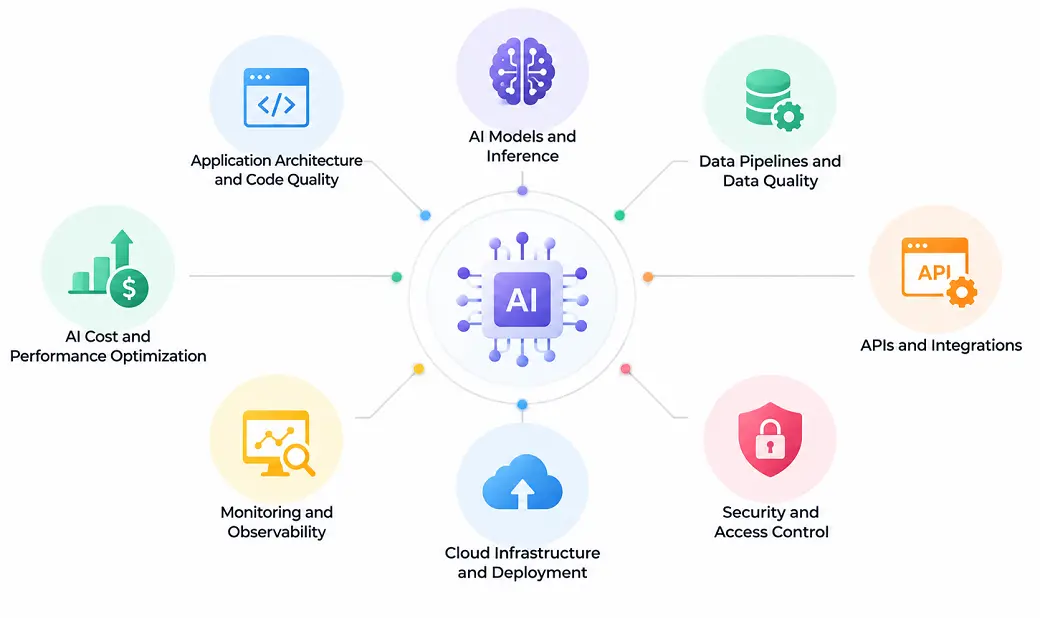 OWSAP’s Top 10 LLM applications highlight potential risks associated with sensitive information disclosure, excessive agency, prompt injection, improper data handling, and unbounded consumption. So, teams must rigorously test these risks as a crucial part of the security process.
Cloud Infrastructure and Deployment
The production environment should provide appropriate storage, containers, environment separation, compute, networking, and deployment automation. With CI/CD pipelines, teams can make production more consistent, while autoscaling can help align infrastructure capacity with changing user demands. This is crucial when existing AI workloads start to expand. According to IDC reports, global AI infrastructure investments are expected to reach $1.21 trillion by 2030.
Monitoring and Observability
Production monitoring must offer greater visibility into both AI as well as software layers. Metrics can track resource latency and usage, logs can capture application events, and distributed traces allow businesses to identify potential failures across services and workflows. Moreover, teams should regularly monitor output quality, data drift, costs, model performance, errors, and inference costs to identify production issues before they start affecting users.
AI Cost and Performance Optimization
AI solutions require continuous monitoring and optimization as traffic and user base grows. The development team can focus on controlling inference costs with model routing, token and context optimization, efficient request handling, appropriate model selection, and caching. Timely monitoring of inference latency and volume can also help identify and eliminate inefficient or expensive workflows. According to Gartner, the global AI inference spending is valued at around $23.3 billion as of 2026, highlighting the continuously growing importance of production inference economics.
Ready to Scale Your AI MVP?
Turn your AI prototype into a scalable, production-ready solution with the right technology and expertise.
Scale My AI MVPHow to Know Your AI MVP Is Ready for Production?
An AI-built MVP can be moved into production if the existing AI behavior, operational controls, core functionalities, and infrastructure have been tested and validated under real-world scenarios. For reference, use the checklist below as a production-readiness checkpoint. Every stage should have documented validation and defined acceptance criteria.
| Production Area | Production-Readiness Check |
| Product Requirements | Core use cases, user requirements, and production success criteria are clearly defined and validated. |
| Architecture | The architecture can support expected users, workloads, integrations, and future scaling requirements. |
| Code Quality | Code is reviewed, maintainable, documented, tested, and free from critical technical debt. |
| AI Evaluation | Model outputs are evaluated for accuracy, reliability, consistency, edge cases, and known failure scenarios. |
| Data | Data is accurate, consistent, accessible, properly structured, and handled according to defined requirements. |
| Security | Authentication, authorization, encryption, secrets management, and AI-specific security controls are implemented. |
| Testing | Functional, integration, performance, security, and AI-specific testing have been completed. |
| Infrastructure | Production infrastructure, deployment processes, backups, scaling, and recovery mechanisms are configured. |
| Monitoring | Application health, model performance, latency, errors, usage, and infrastructure metrics are continuously monitored. |
| Cost | AI inference, cloud infrastructure, storage, and third-party service costs are measured and controlled. |
| Compliance | Applicable privacy, regulatory, data protection, and industry-specific compliance requirements are addressed. |
When these areas have been validated, the MVP has a stronger foundation for becoming a production-ready AI application rather than simply a working prototype.
When Should You Scale an AI MVP and When Should You Rebuild It?
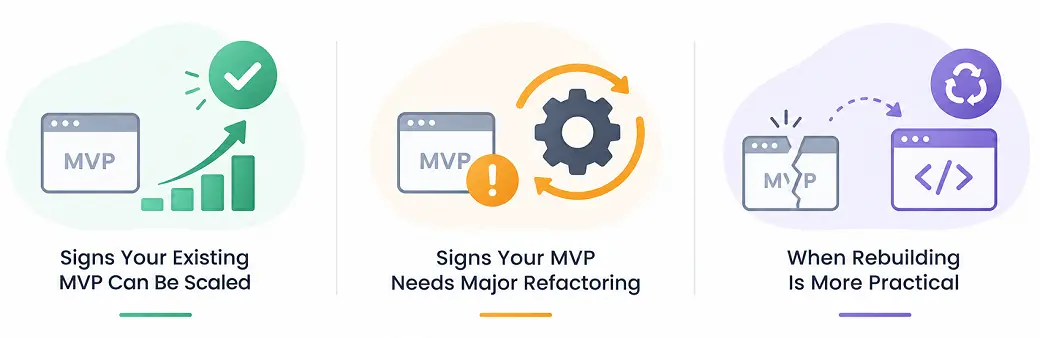
Not every AI-powered MVP development solution requires complete rebuild before moving to production stage, but not every prototype can be directly scaled either. The actual decision of rebuilding or refactoring depends on the quality of existing codebase, security, architecture, data foundation, and product assumptions. With a structured approach and assessment, it becomes easy to decide whether the MVP can be moved directly into scaling or needs rebuilding from scratch.
Signs Your Existing MVP Can Be Scaled
An AI-built MVP is practically suitable for scaling if the existing architecture is stable as well as technical debt is also manageable. The codebase must be understandable, maintainable, and testable, while product requirements should be properly validated. A strong data foundation is crucial because production-ready AI systems heavily rely on reliable and consistent data pipelines.
Signs Your MVP Needs Major Refactoring
Deeper refactoring is crucial if security problems are creating production risks or severe technical debt is slowing down the development. Performance bottlenecks, difficult-to-maintain AI-generated code, poor architecture, and fragile third-party integrations, can also affect efficient scaling. In such scenarios, AI MVP modernization services can help strengthen the foundation without the need for a complete rebuild.
When Rebuilding Is More Practical
Rebuilding the AI MVP from scratch is sensible only if the product assumptions or existing fundamental architecture are no longer valid. If the existing design doesn’t support business workloads, the AI approach has changed significantly, or the data model is unsuitable, moving to production directly may result in more complexity. A well-structured rebuilding approach can help set-up a solid foundation for successful production.
How Much Does It Cost to Take an AI MVP to Production?
Transitioning an AI MVP to production can cost around $30,000 to $150,000+, depending on AI complexity, security needs, expected scaling, technical condition, data requirements, and integrations. A basic or straightforward MVP will require limited production efforts, while a complex enterprise-grade MVP will need substantial infrastructure upgrades, security work, refactoring, and AI evaluation. Current AI development pricing also varies depending on the location of the company. For example, typical rates of hiring AI developers are around $30-$50/hour in India and $55-$100/hour in the United States.
Key Factors That Influence Production Scaling Costs
The quality of the existing AI-built MVP is one of the biggest factors that affects the final cost as current technical debt could result in more in-depth refactoring. Data requirements, security, team composition, location of AI mobile app development company, AI complexity, cloud infrastructure, third-party integrations, and compliance may also increase the overall production budget.
Typical Cost Components
The costs of scaling an AI-built MVP to production typically span AI model and inference, data pipelines, testing, ongoing maintenance, engineering and refactoring, cloud infrastructure, security, and monitoring. The following table represents indicative ranges for realistic budget planning.
| Production Scope | Approximate Cost |
| Basic MVP hardening and production deployment | $30,000–$50,000 |
| Moderate AI MVP scaling and optimization | $50,000–$100,000 |
| Complex AI application with advanced integrations | $100,000–$150,000+ |
| Enterprise-grade AI platform | $150,000+ |
These estimates are intended for budget planning, not as universal pricing benchmarks. The final AI development cost will depend on required AI capabilities, security standards, production workload, existing code that can be retained, infrastructure architecture, and integrations.
Ways to Control Production Costs
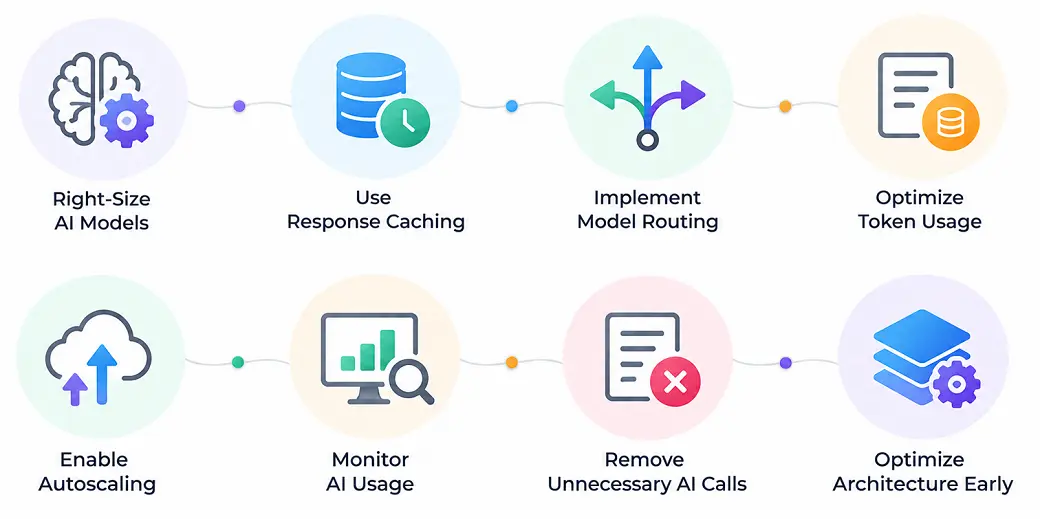
Enterprises can easily control AI production and recurring costs by optimizing ongoing infrastructure as well as development decisions. Some key approaches are:
- Right-Size AI Models: Match the model capabilities with the complexity of each workflow instead of using high-cost models for every single request.
- Use Response Caching: Frequent caching helps reduce unnecessary inference costs as well as repeated model calls.
- Implement Model Routing: Make sure to route simple workflows or tasks to low-cost models while reserving extensive models for complex tasks.
- Optimize Token Usage: Reduce unnecessary content, output length, and prompts to lower inference cost.
- Enable Autoscaling: Based on actual user demand, scale computing resources instead of always maintaining full or excessive capacity even during low-traffic periods.
- Monitor AI Usage: Regularly track token consumption, cost by feature, inference volume, and latency to identify and eliminate expensive workflows.
- Remove Unnecessary AI Calls: Carefully review workflows and eliminate the model calls that are not important for the final production-ready build.
- Optimize Architecture Early: Clearly address inefficient integrations, data flows, and infrastructure before traffic starts to increase and demands expensive rework.
Production cost optimization must be prioritized from initial architecture planning rather than after the application starts to gain significant traffic. Decisions about data flows, caching, scaling, model selection, infrastructure, and observability have a direct impact on recurring costs. - DD Agarwal, Solution Architect at Konstant Infosolutions
Should You Hire an AI Development Partner to Scale Your MVP?
Successfully scaling an AI-built MVP to production requires a team that brings expertise across software architecture, security, testing, AI engineering, cloud infrastructure, DevOps, and ongoing optimization. If the internal team has limited experience, working with an external AI development partner is suitable to identify technical production gaps and build a well-structured path for transformation.
When Does External AI Engineering Support Make Sense?
Outsourcing AI engineering support is suitable if the internal team has limited production or AI engineering expertise, delivery timeline is tight, or the solution requires complex security, scalability work, architecture, or data engineering. An experienced AI partner can also help reduce technical challenges and risks while transforming the AI MVP into a production-ready solution.
What to Look for in an AI Development Partner?
When comparing service providers, evaluate their experience with production application development, DevOps, automated testing, AI engineering, cloud infrastructure, security, and observability. An experienced development team focuses on clearly architecture, data pipelines, AI model evaluation, inference optimization, and post-launch maintenance rather than directly moving to the production stage.
Questions to Ask Before Hiring an AI Development Company
To hire an experienced AI development company, make sure to ask these questions:
How will you audit our existing MVP?
Understand their approach towards identifying security gaps, production risks, technical debt, and scalability issues.
How will you evaluate the AI layer?
Make sure to ask the team about output quality, guardrails, reliability, model performance, evaluation methods, and reliability.
What is your production-readiness process?
Evaluate how the development company manages testing, infrastructure, monitoring, architecture, security, and deployment before final launch.
How do you control AI inference costs?
Ask if the team prioritizes caching, token optimization, model selection, routing, and usage monitoring.
How do you handle security and monitoring?
Clarify how AI-specific risks, observability, incident responses, application security, logging, and alerts are handled.
What post-launch support is included?
Make sure to verify whether performance optimization, infrastructure management, ongoing maintenance, model updates, and production support are available.
Build a Production-Ready AI Solution
Get expert guidance to optimize your AI architecture, performance, costs, and deployment strategy.
Talk to AI ExpertsConclusion
AI MVP development is becoming increasingly popular as there are several AI foundation models, development frameworks, coding tools, and cloud platforms that reduce the time needed for validating an app idea in the market. But developing an AI prototype is just the initial phase. A digital solution that performs well and smoothly in an MVP environment may encounter scalability, data, cost, security, reliability, and performance challenges when launched in the market for real-world users.
Transitioning from AI MVP to production requires a proper shift from experimentation to engineering. The development company must strengthen the application architecture, improve data pipelines, automate testing, establish monitoring before launch, evaluate existing codebase, validate AI outputs, implement security controls, prepare the scalable infrastructure. Moreover, the team also has to verify whether the existing MVP needs complete refactoring or existing functionalities can be improved.
A well-structured 90-day roadmap can help prioritize major transformation activities without losing the project's core scope and objectives. In this guide, we have discussed everything needed for successfully scaling an AI-built MVP from prototype to production-ready solution, which technical areas need attention, tips for managing costs as the user base grows, what must be changed at each stage, and how to seamlessly assess production readiness.