AI Development Cost in 2026: The Complete Guide

Discover AI development costs in 2026, including pricing, cost factors, timelines, budgeting tips, hidden costs, and real-world examples.
Key Takeaways
- AI development costs in 2026 range from $30,000 for a basic solution to $1 million+ for an enterprise-grade platform.
- Data quality, AI model selection, and project complexity are major drivers that affect overall development costs.
- With pre-trained models and AI MVPs, businesses can validate their ideas to reduce upfront costs.
- Consider hidden development expenses such as compliance, model maintenance, cloud infrastructure, and integrations while evaluating overall development budget.
- Most AI projects take about 2 weeks to 12+ months for competition, depending on the technical complexity.
- Through a structured budgeting framework, businesses can plan realistic expenses and maximize long-term ROI.
Artificial intelligence technology is now no longer limited to enterprises only. Small-scale startups as well as SMEs are also investing in AI to enhance customer experiences, open new revenue opportunities, automate operational workflows, and uncover meaningful business insights. About 88% of businesses use AI within their operational workflows. However, there is a major question that every business asks before investing in AI projects: How much does AI development cost?
Well, the answer to this is not quite straightforward. Developing a simple AI app such as an AI chatbot will cost around $2,500, while a more complex enterprise-driven AI solution can go over $ 1 million. The difference is due to several factors, including project complexity, model selection, compliance requirements, type of solution, data readiness, and the level of customization needed.
To help you better understand how you can better plan your AI development budget, we have created this guide. You will also find answers about cost estimates based on solution types, hidden expenses to consider, budgeting frameworks, and best strategies to optimize overall development costs. So, whether you are building your first AI solution from scratch, or thinking about large-scale enterprise implementation, this guide will help you plan your budget more effectively and make informed decisions.
AI Development Cost at a Glance
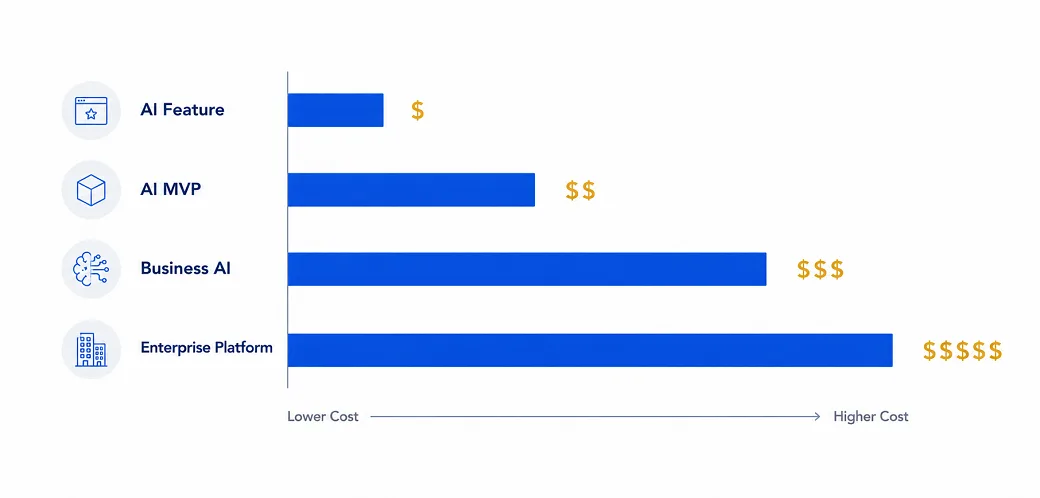
In simplest terms, the final cost of developing an AI solution is heavily influenced by various factors. The major cost drivers are project type and size.
AI Development Cost Overview
| Project Type | Estimated Cost | Timeline | Best For |
| AI Feature | $2,500-$15,000 | 2-6 weeks | Adding AI capabilities to an existing application |
| AI MVP | $15,000-$50,000 | 2-4 months | Startups validating an AI-powered product or feature |
| Business AI Solution | $50,000-$150,000 | 3-6 months | Automating business processes or improving customer experiences |
| Enterprise AI Platform | $150,000-$1,000,000+ | 6-12+ months | Large-scale AI initiatives requiring advanced customization, integrations, and enterprise security |
Note: This is an average AI development cost. The final estimate will depend on your project size and scope, business goals, expected outcomes, and targeted audience.
Average AI Development Cost by Project Complexity
Based on project size and complexity, AI projects fall under four different categories. Basic features such as content recommendations and chatbots will require less investment. AI MVPs are ideal for startups and early-stage projects to test and validate an idea in the market. Business centric AI applications offer more advanced integrations, capabilities, and automation. At last, enterprise-grade Ai platforms involve multiple integrations, large-scale deployments, custom AI models, and strict security.
Typical AI Development Timeline
The timeline of developing an AI solution varies based on several factors such as data quality, integration requirements, feature scope, and AI model complexity. A simple AI app can be built within a few weeks. On the other hand, a complex enterprise-grade solution will require about 6 to 12+ months because of model training, ongoing optimization, and extensive planning.
AI Development Cost Estimation Framework
Estimating the overall AI development cost is not guesswork. As every project is different, following a structured budgeting framework will help with better allocation of resources and decide what affects the overall development cost the most. Below is a three-step framework that will help you to create a solid budget for an AI project:
Define Your AI Project Scope
The very first step is to clearly define the core problem your AI solution will solve and what you want to achieve. Having a well-defined scope will reduce development time and improve budget accuracy.
Start by identifying:
- Primary business objective.
- Users who will interact with the AI solution.
- Core features of the first release.
- The systems or platforms the solution must integrate with.
- Industry-specific security or compliance.
Putting a strong focus on integrating core features during the planning phase will ensure quick launch while leaving room for feature enhancements in future.
Choose the Right AI Development Approach
The AI app development approach you will choose will affect both long-term maintenance as well as implementation.
| Development Approach | Best For | Relative Cost |
| AI APIs | Rapid deployment and standard AI capabilities | Low |
| Fine-Tuned Models | Industry-specific use cases requiring higher accuracy | Medium |
| Open-Source Models | Greater flexibility and reduced licensing costs | Medium |
| Custom AI Models | Highly specialized business requirements and proprietary solutions | High |
If you are planning to launch your solution quickly with lower upfront costs, AI APIs are an ideal option. Fine-tuned models can enhance system performance by adapting models, open-source models offer greater customization and deployment, and fully custom AI models work best for strict regulatory needs as well as proprietary datasets.
Estimate Infrastructure & Operational Costs
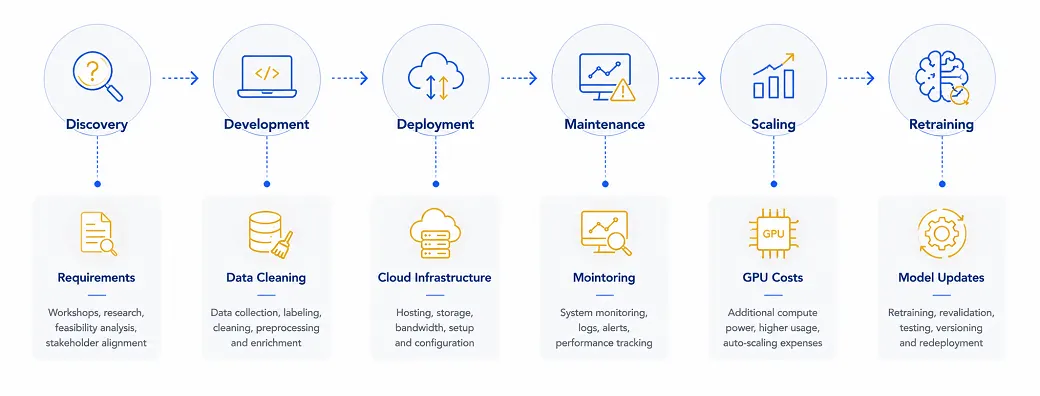
The initial development budget is just one part of the overall investment. You must also account for model hosting, monitoring, future scaling needs, cloud infrastructure, API usage, and maintenance.
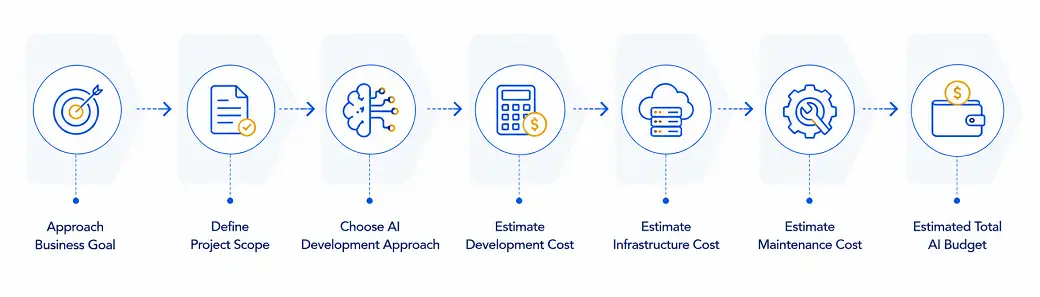
One practical way to estimate overall AI development cost is by considering each component separately:
Estimated AI Development Cost = “Planning & Discovery + Data Collection & Preparation + AI Model Development + Infrastructure & Cloud Services + Third-Party Integrations + Testing & Deployment + First-Year Maintenance”
Breaking the overall project into smaller cost components will offer a clear understanding for efficient investment allocation and help in reducing the chances of unexpected expenses during development.
Instead of putting all the focus on initial development costs, you must also evaluate the total cost of ownership which includes ongoing maintenance, optimization, infrastructure, and compliance. This will ensure a more accurate budget planning and will ensure long-term success as your solution evolves.
Key Factors That Influence AI Development Costs
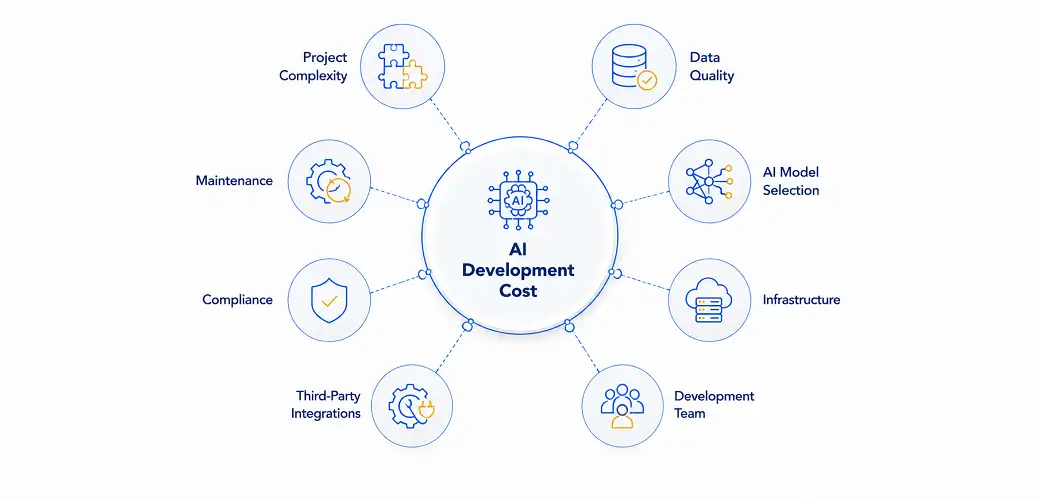
Before starting with an AI project, most businesses have one common question in mind:What actually affects the AI development costs?
The answer depends not only on the choice of AI model only. There are various other factors such as data quality, integrations, long-term maintenance, project scope, infrastructure, and security requirements, that play a crucial role in determining the final AI development cost. Having a clear understanding of these factors will help in drafting a more realistic development budget, avoid unexpected expenses during development, and prioritize the core features.
Cost Driver Impact
| Cost Factor | Impact on Budget | Why It Matters |
| Project Complexity | High | More features and custom workflows require additional development effort. |
| Data Quality & Availability | High | Poor-quality data increases preparation, cleaning, and labeling work. |
| AI Model Selection | High | Custom models require significantly more time and computing resources than pre-trained models. |
| Development Team & Expertise | Medium to High | Specialized AI expertise and larger teams increase overall development costs. |
| Infrastructure Requirements | Medium to High | Compute resources, cloud services, storage, and GPUs affect both development and operational expenses. |
| Third-Party Integrations | Medium | Integrating existing business systems requires additional engineering and testing. |
| Compliance, Security & Testing | Medium to High | Industry regulations and security controls increase implementation effort. |
| Maintenance & Continuous Improvement | Medium | AI solutions require ongoing monitoring, retraining, and performance optimization after launch. |
Project Complexity
For AI solutions, project size and complexity is considered as one the biggest factors that influence the overall AI development costs. Developing a basic document classifier or FAQ chatbots will require less effort compared to enterprise-grade platforms with customized workflows and real-time decision making features. When integrations, functionality, and user requirements increase, development time, efforts, testing, and infrastructure requirements will also increase. By defining a clear project scope from the beginning, you can prevent unnecessary costs later.
Data Quality & Availability
The accuracy of AI systems is only as accurate as the data they learn from. Through well-organized and structured datasets, you can quickly move into development time to reduce both implementation cost and time. If the data is inconsistent or incomplete, you may have to put additional efforts and time for collecting, cleaning, and labelling data before model training. For many AI projects, data preparation is considered as one of the most time-consuming phases of the development process.
AI Model Selection
The choice of the right AI model has a direct impact on long-term maintenance expenses as well as overall development costs. Based on your business needs and requirements, you may choose fully customized models, pre-trained models, or fine-tuned models. With pre-trained models, you can speed up overall development time as well as reduce development costs. Fine-tuned models are best to improve performance of domain-specific tasks, while building a custom model will require significant investment for computing resources and data training.
Expert Insights:
AI model development isn't usually the biggest cost driver. Data preparation, changing project requirements, and system integrations often account for a larger share of the overall budget. Defining the project scope and preparing quality data early can significantly reduce costs.
Development Team & Expertise
The location, size, and experience of an AI mobile app development company, is considered as one of the most crucial factors that affects the overall project expenses. For developing a custom AI application, you will need an experienced team of mobile app developers, UI/UX designers, project managers, machine learning engineers, data experts, and QA specialists. Advanced AI projects with computer vision, generative AI, and advanced machine learning capabilities will require highly specialized experts. All these factors will lead to increased AI development costs but will reduce technical errors and risks.
Infrastructure Requirements
Modern artificial intelligence solutions need more than just web hosting. Depending on the project, you will also need GPUs, networking, backup systems, computing resources, scalable storage, and monitoring tools for model training. Infrastructure expansion also continues to grow even after deployment as your user base grows. This makes solution scalability a crucial factor for estimating the overall AI development costs.
Third-Party Integrations
AI applications have to communicate with existing business systems such as ERP software, cloud computing services, analytics platforms, CRM platforms, payment gateways and communication tools. Every integration needs careful planning, development, testing, and continuous maintenance. The greater number of integrations you need, the more efforts you have to put to ensure secure data exchange, reliable performance, and compatibility with future needs.
Compliance, Security & Testing
Businesses that deal with sensitive user information or operate under regulated industries like finance or healthcare have to comply with various standards such as HIPAA or GDPR. Moreover, implementing role-based access controls, secure authentication, encryption, audit logging, and compliance testing can increase both ongoing maintenance responsibilities and development costs. Make sure to do comprehensive testing of your AI solution to identify edge cases, validate model accuracy, and ensure your solution performs best in real-world conditions.
Maintenance & Continuous Improvement
AI development doesn’t end once the app is deployed. As businesses expand over time and new data becomes available, you have to consider model retraining, monitoring, timely updates, and performance optimization to offer reliable and accurate responses. So, make sure to plan for post-launch maintenance from the beginning to keep expenses under control while ensuring your solution continues to deliver long-term business value. You can also reduce mobile app maintenance costs by outsourcing to a reliable partner.
AI Development Costs by Solution Type
The cost of developing an AI app is heavily affected by the type of solution you are planning to develop. AI applications such as AI chatbots use pre-trained data as well as models and can be launched quickly within a few weeks. On the other hand, computer vision systems or enterprise-grade AI solutions demand specialized expertise, extra development efforts as well as time, and larger infrastructure. The comparison table offers a quick overview about development cost of different types of AI solutions:
AI Development Cost Comparison by Solution Type
| AI Solution | Typical Cost | Timeline | Complexity |
| AI Chatbots | $10,000-$80,000 | 1-3 months | Low to Medium |
| AI Agents | $50,000-$250,000+ | 3-8 months | High |
| Generative AI Applications | $120,000-$350,000+ | 4-9 months | High |
| Computer Vision Systems | $30,000-$200,000 | 3-6 months | High |
| Predictive Analytics | $15,000-$100,000 | 1-3 months | Medium |
| Recommendation Engines | $40,000-$150,000 | 3-6 months | Medium to High |
| Natural Language Processing Solutions | $25,000-$80,000 | 2-5 months | Medium |
Note: These are just typical ballpark estimates. The actual AI development cost varies based on data availability, integration, ongoing maintenance, project scope, infrastructure requirements, and compliance needs.
AI Chatbots
Best for: Customer support, lead generation, internal help desks, and FAQ automation.
Typical Cost: $10,000-$80,000
Timeline: 1-3 months
For businesses thinking about implementing artificial intelligence within their business operations, AI chatbots are considered the most accessible starting point. Modern chatbots are integrated with natural language processing and large language models (LLMs) to easily interpret user inputs and deliver accurate responses. CRM feature integrations, analytics dashboards, multilingual support, custom knowledge bases, and advanced workflows may increase overall investments.
AI Agents
Best for: Process automation, task execution, research assistance, and workflow orchestration.
Typical Cost: $50,000-$250,000+
Timeline: 3-8 months
Compared to traditional chatbots, AI agents do not require human intervention to execute user-queries, automate operational workflows, make decisions, and communicate with external applications. Memory management, security requirements, enterprise integrations, reasoning capabilities, and ability to perform multiple actions are some of the major AI development cost drivers.
Generative AI Applications
Best for: AI copilots, content generation, document summarization, and knowledge assistants.
Typical Cost: $120,000-$350,000+
Timeline: 4-9 months
Gen AI solutions leverage foundation models for creating images, text, code, or other types of content based on user prompts. As these solutions often require prompt engineering, usage monitoring, retrieval-augmented generation (RAG), and vector databases, the infrastructure costs are typically higher. Moreover, businesses also have to account for API usage, model inference, and ongoing optimization, which may increase overall AI development costs.
Computer Vision Systems
Best for: Quality inspection, facial recognition, medical imaging, retail analytics, and object detection.
Typical Cost: $30,000-$200,000
Timeline: 3-6 months
Through computer vision, machines can analyze, understand, and interpret video streams or images. The overall project cost heavily depends on dataset size, model accuracy, image quality, annotation requirements, and deployment environment. Organizations without any pre-defined image dataset should also consider expenses for data labelling and collection, which covers a significant part of overall investment.
Predictive Analytics
Best for: Demand forecasting, fraud detection, predictive maintenance, customer churn analysis, and financial forecasting.
Typical Cost: $15,000-$100,000
Timeline: 1-3 months
Leveraging machine learning algorithms and historical business data, predictive analytics help organizations to forecast future demands and outcomes. The cost of development varies based on several factors such as model complexity, integration with business intelligence platforms, data quality, and reporting requirements. But with well-structured and clean data, you can easily reduce overall development time as well as implementation costs.
Recommendation Engines
Best for: eCommerce platforms, streaming services, online learning platforms, and digital marketplaces.
Typical Cost: $40,000-$150,000
Timeline: 3-6 months
These solutions help businesses analyze customer’s purchase behavior, browsing patterns, and shopping behavior to offer more personalized suggestions. Based on real-time personalization requirements, the need to handle heavy user traffic, volume of user data, and recommendation algorithm complexity, the final development costs may increase.
Natural Language Processing Solutions
Best for: Sentiment analysis, document classification, language translation, speech recognition, and text analytics.
Typical Cost: $25,000-$80,000
Timeline: 2-5 months
With NLP, AI systems can analyze, interpret, understand, and generate responses in a more human-like tone. The cost will depend on training data quality, integrations of third-party APIs, language support, and model customization. Most businesses leverage NLP with virtual assistants, intelligent document processing, chatbots, and search applications.
How to Reduce AI Development Costs Without Compromising Quality?
Reducing AI development cost doesn’t mean that you have to go with the cheapest option available. You can optimize and save on development costs by investing in the right AI technologies, planning for long-term scalability, and avoiding unnecessary expenses. Follow a strategic and well-defined development approach to control development expenses to develop a reliable AI solution that will drive long-term ROI and business value.
Start with an MVP
One of the best ways to optimize AI development cost is by developing and launching your solution with a Minimum Viable Product. Instead of developing a full-scale solution, focus on integrating one core feature that can solve one well-defined business problem to validate your idea. The cost of developing an MVP is significantly a lot less compared to developing a feature-rich AI app. For example, an AI customer chatbot can be initially designed to only automate common user queries before expanding capabilities for sentiment analysis, personalized recommendations, and multilingual support. This personalized approach helps businesses to validate performance, gather real-user feedback, and make informed decisions to minimize development risks.
Use Pre-Trained Models Where Appropriate
It is not always necessary to develop a custom model from scratch. Most businesses can leverage pre-trained models including BERT, Llama, or GPT to significantly reduce development time as well as implementation costs. Pre-trained models work fine with applications like content generation, language translation, chatbots, document summarization, and text classification. You should consider model development only if you need proprietary data processing, industry-specific performance, or highly specialized capabilities that pre-trained models cannot offer.
Prioritize High-Impact Features
Features that are not necessary or don’t offer immediate value to your business can be integrated later on. By prioritizing high-impact features and functionality, you can accelerate delivery timelines, reduce development costs, and prevent unnecessary scope expansion. Not every feature will drive equal business value. Before the development process starts, identify and prioritize core capabilities that support your primary business goals. Whether it’s increasing operational efficiency, generating new revenue, improving customer experience, or reducing manual work, focus on which features are required initially.
Build for Scalability from Day One
Optimizing AI mobile app development cost is not only limited to initial investments only. The AI solution you will develop should be scalable enough to scale with your growing business needs without the need of a complete rebuild from scratch. Make sure to choose scalable cloud infrastructure, flexible APIs, and modular architecture from the beginning. This ensures you can seamlessly add new AI capabilities, integrate additional business systems, and support higher user volumes as your business expands. While this approach will still require slightly more upfront expenses, it will reduce long-term re-development and maintenance costs.
Partner with an Experienced AI Development Company
One of the major reasons why most AI projects go over budget is poor implementation planning, not technical complexity. Businesses who underestimate data preparation, have unclear requirements as well as changing project scope, and undefined integration have to face higher development costs. By hiring an experienced AI development partner, you can identify common challenges early and create a solid implementation roadmap before beginning the development process. At Konstant, we follow an agile and planning-first approach to help businesses validate their AI project idea in the market, define realistic timelines, estimate overall development costs, and choose the best strategy that aligns with their business goals and long-term business plans. While hiring an AI development company, choose a team that can:
- Offer transparent cost estimation about data preparation, infrastructure, development, integrations, and maintenance.
- Provides post-launch monitoring, support, optimization, and continuous improvements.
- Can identify and suggest high-value AI use cases that align with your business goals.
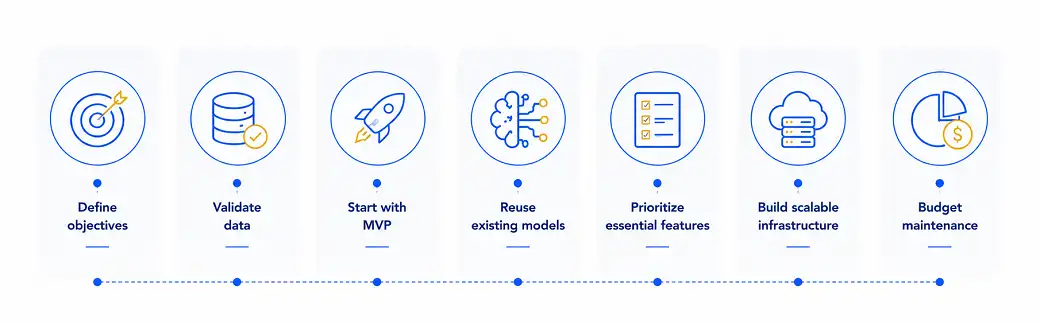
AI Cost Optimization Checklist
Before beginning with your AI project, make sure to check the following points to ensure the project stays under budget and deliver maximum value:
- Clearly define business objectives before choosing an AI solution.
- Validate data availability and quality during the planning phase only.
- Begin by developing an MVP to reduce initial expenses.
- Use open-source as well as pre-trained AI models whenever possible.
- Prioritize core features that will drive measurable results.
- Pick scalable and robust cloud infrastructure that will support future growth.
- Set-up budget for ongoing maintenance, monitoring, and model retraining.
- To prevent unnecessary feature expansion, make sure to review project scope regularly.
Real-World AI Development Cost Examples
Understanding the real AI development cost becomes quite easier when you explore real-life businesses who have successfully implemented AI in their operational workflows. While the exact cost of implementation is not disclosed by these companies, their solutions offer valuable insights about features, technologies, and engineering efforts involved in implementation. The examples below highlight some of the leading brands in the industry that use AI and what modern businesses have to expect while building similar solutions.
AI Customer Support Chatbot
H&M, a well-known Swedish multinational clothing retail company has enhanced the shopping experience for customers through AI-driven virtual shopping assistants. It helps customers discover products, get personalized shopping recommendations, and also answers common customer queries. The assistant is integrated with machine learning and natural language processing capabilities to interpret and understand user inputs, and then deliver relevant responses. This has helped the brand to reduce human intervention while improving overall shopping experience. Although the development cost of H&M’s AI assistant is not publicly disclosed, businesses planning to develop a similar platform have to invest significant amounts of money based on their unique project needs and business requirements.
Estimated Development Cost: $15,000-$60,000
Estimated Timeline: 2-4 months
Key Cost Drivers:
- Natural language processing capabilities
- Integration with CRM, and eCommerce platforms
- Product catalog size
- Multilingual support
- Personalization features
- Security and user authentication
AI Recommendation Engine
One of the most popular real-life examples is Netflix. The on-demand video streaming platform leverages AI-powered recommendation capabilities for analyzing user preferences, engagement patterns, viewing history, and search behavior to deliver personalized content suggestions. Its recommendation engine has become the company's core driver for increased user engagement and retention. Netflix’s recommendation capabilities have evolved over the years with continuous investments. However, businesses can also build similar recommendation engines similar to video streaming platforms like Netflix at a smaller scale by carefully focusing on specific business goals and selecting the right machine learning models.
Estimated Development Cost: $40,000-$150,000
Estimated Timeline: 3-6 months
Key Cost Drivers:
- Volume and quality of data
- Recommendation algorithm complexity
- Real-time personalization requirements
- Integration with existing platforms
- Infrastructure required to support growing user traffic
AI Document Processing Solution
Organizations working across finance, legal, healthcare, and insurance services are increasingly adopting AI-powered document processing applications to automate validation and extraction of information from contracts, claims, and invoices. Most popular examples include Microsoft Azure AI Document Intelligence and UiPath Document Understanding that show how AI saves from manual processing of business documents. Businesses planning to implement similar solutions typically leverage computer vision, optical character recognition (OCR), and machine learning to seamlessly process large-scale unstructured and structured data.
Estimated Development Cost: $35,000-$120,000
Estimated Timeline: 3-5 months
Key Cost Drivers:
- Number of document formats
- OCR accuracy requirements
- Workflow automation
- Regulatory compliance
- Integration with ERP or CRM platforms
Enterprise AI Assistant
Modern enterprise AI assistant solutions are transforming how employees complete everyday chores and access information. Industry giants such as Salesforce with Agentforce with Salesforce and Microsoft with Microsoft 365 Copilot demonstrate how AI assistants help retrieve enterprise knowledge, support decision-making using natural language interactions, summarize documents, and automate repetitive workflows. Developing the same kind of enterprise AI system demands more than just simply integrating a large language model. You also have to focus on implementing role-based access controls, ensuring reliable performance across departments, connecting multiple business systems, and maintaining data privacy.
Estimated Development Cost: $100,000-$500,000+
Estimated Timeline: 6-12 months
Key Cost Drivers:
- Number of system integrations
- Custom AI workflows
- Role-based access controls
- Data security and regulatory compliance
- Scalability across business functions
Real-World AI Development Cost Comparison
| AI Solution | Estimated Cost | Timeline | Primary Cost Drivers |
| AI Customer Support Chatbot | $15,000-$60,000 | 2-4 months | NLP capabilities, integrations, multilingual support |
| AI Recommendation Engine | $40,000-$150,000 | 3-6 months | Data quality, personalization, scalability |
| AI Document Processing Solution | $35,000-$120,000 | 3-5 months | OCR, workflow automation, compliance |
| Enterprise AI Assistant | $100,000-$500,000+ | 6-12 months | Enterprise integrations, security, custom AI workflows |
Conclusion
The cost of developing an AI solution starts from a few thousand dollars and can go over $1 million for building enterprise-grade solutions. However, the final cost will vary, depending on several factors such as data quality, infrastructure, compliance requirements, project complexity, AI model choice, integrations, and ongoing maintenance. As every project is different and has unique technical requirements, the cost of AI app development is not fixed.
Instead of focusing solely on the initial development budget, you must also evaluate total ownership costs and go with the approach that perfectly aligns with your objectives, scalability needs, and long-term growth strategy. Whether you are planning to develop a predictive analytics platform, an AI chatbot, or an enterprise-grade solution, following a well-defined approach will help maximize ROI.
If you want to develop an AI solution, start by clearly defining business goals, prioritize core features, and note down total investment including both development as well as ongoing maintenance expenses. A solid foundation built today will prepare your business to scale confidently in future.