React Native vs. React: Create a New App, Feature Update

How does it affect new React Native vs. React App Development? We'll read more about adopting React without rewrites and why trying new features is effortless?
What do Google Trends, NPM trends, GitHub, Statista say about React and React Native? If you’re planning to capitalize on the global mobile market, what is the first thing you’ll consider, going by the global popularity statistics? Mobile applications generated $188.9 billion US dollars in 2020-2021, making for a huge business opportunity.
Point of Contention: Library vs. Framework
Libraries are tools that are not mandatory to use but save development time. It is up to you to identify the correct tools that will cut the long story short.
- ‘React’ is the JavaScript library for building user interfaces.
- ‘Redux’ is the open-source JavaScript library for managing the application state.
- 'Three.js' is the JavaScript library to create and display 3D computer graphics.
- ‘Lodash’ is the JavaScript library to provide utility functions for common programming tasks.
- ‘jquery’ handles events and HTML document manipulation.
React Native and React are in a parent-child hierarchy. ReactJS is the JavaScript-based library, while React Native is the entire framework. ReactJS is the control center or the storehouse to operate React Native Framework.
Point of Contention: React vs. React Native
One important distinction between libraries like React and Frameworks like React Native or Ember.js or Angular.js is that React is concerned only with rendering the user interface and leaves many things up to each project to integrate.
React Native acts as a cowl scarf for React. Latter is just concerned with rendering the UI and leaves many things up for each project put together.
React Tech Stack: Tools to Build a React Application
This tool stack may sound like a mark but the debate over the superiority of frameworks or libraries is old and has many excellent arguments on both sides. React's openness has allowed projects to scale up incrementally, leaving for rapid innovation from the community on various other parts of the stack. This React tech stack helps manage the complex ecosystem of cross-platform projects.
- Application Code – React, Redux, React Router
- Build Tools - Webpack, Uglify, npm/yarn, Babel, babel-preset-env
- Testing Tools - ESLint, Enzyme, Mocha/Jest
When we compare React with other frameworks and libraries, it is hefty to create a website, GitHub repository called ToDoMVC that offers the same to-do list application implemented using a handful of popular JavaScript libraries and frameworks. This ToDoMVC has now become the de-facto place to evaluate and compare tools. Now, it is more capable, Hacker news Progressive Web Apps (HNPWA) launched as ToDoMVC's successor. HNPWA focuses on app-like behaviour with responsive designs, mobile performance, and offline capability.
See also: Swift vs React Native
Statistics Summary (2021)
| ReactJS | React Native |
| Ranked 1st by StackOverFlow in 2021 | Ranked 6th by StackOverFlow in 2021 |
| Ranked 4th in most loved and dreaded category | Ranked 9th in the most loved and dreaded categories |
| Ranked 2nd in the satisfaction and 1st in usage and awareness categories, respectively | Ranked 3rd in the satisfaction and 1 in usage and awareness categories. |
| React is the most popular JavaScript project after the Vue library | React Native is the 2nd most popular JavaScript project after the Vue library. |
Cross-Platform Mobile Frameworks Used By Software Developers (2019 To 2021)
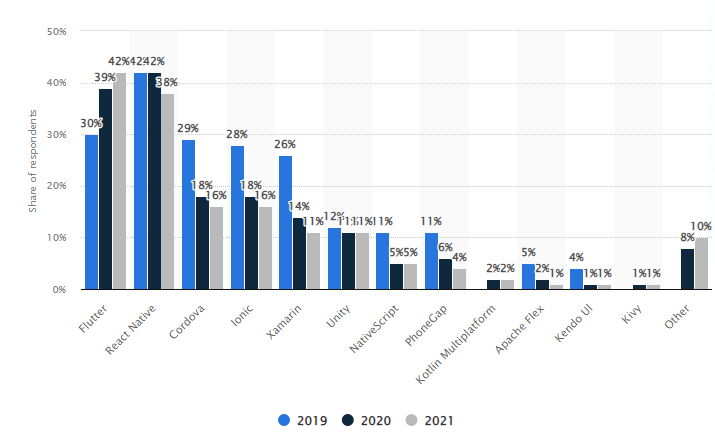
(Source)
React is a JavaScript library to build declarative, efficient, and flexible user interfaces. React has been designated for gradual adoption. You can use React as a <script> tag from a CDN, or as a React package on NPM.
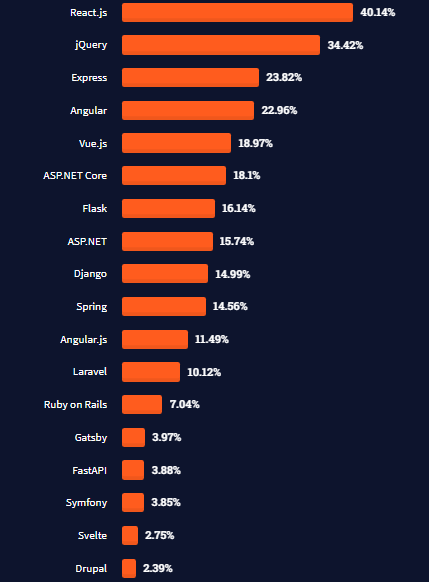
Popular Web Frameworks in 2021
You might have done extensive development work in some of these common web frameworks and libraries over the past year, and some which you would want to work in over the next year.
(Source)
JavaScript Feature and Tool Update
| Project | Use Case |
|---|---|
| Babel | It transforms source code |
| Yarn | It improves CocoaPods for JS |
| TypeScript | It transforms source code |
| NPM | It is a CocoaPods for JS |
| ESLint | It is a Static code linter |
| prettier | It is a Code formatter |
| TSLint | It is a Static code linter |
| Jest | It is a Test runner |
| Metro Bundler | It is a code bundler for React Native |
| Storybooks | It is a prototyping environment |
| DangerJS | It is used for code review automation |
| Husky | It simplifies Git Hooks |
What’s in ReactJS?
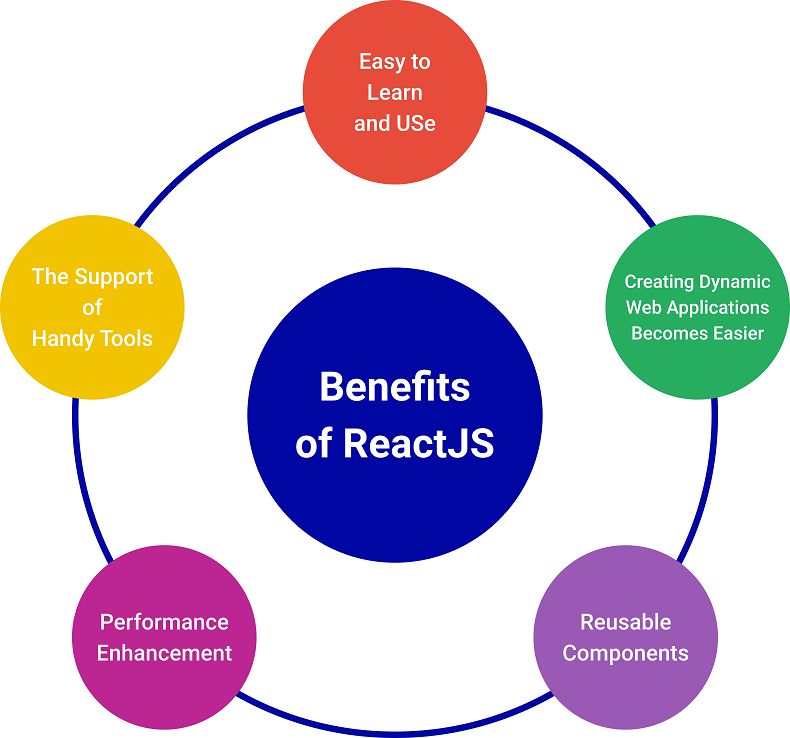
- React manages functional components with less boilerplate code
- If React is JavaScript’s library to create interactive and effective user interfaces, it propels tools to weave and fix mobile app’s properties/features.
- React (if not React Native), can scale too many files and components. It uses third-party libraries from npm.
- It detects common mistakes
- It promotes live editing cascading style sheets and JavaScript in development.
- React is preferred for optimized apps.
- The declarative user interface framework for Android and iOS platforms assists in using native UI controls and making efficient use of the native platform. It makes it easier to debug.
- It lets you develop encapsulated components that make managing states in complex UI's easier.
- It initiates live reloading without rebuilding the native app.
- It lets you reuse the code across iOS, Android, and other platforms.
Adjectives defining ReactJS are: Declarative, component-based, and Learn once - write anywhere, simple and stateful component, component using external plugins, component-based rendering mechanism, best Server-Side Rendering (SSR) and has massive SEO support.
Cons of ReactJS
- Library support
- Complex Navigation
- Increased Cost and Time Overhead
When to use it?
- When you want to develop a website/web app
- When you want to build a fast and stable user interface for the website
Who is using Reactjs?
| Netflix | Newyork Times | Yahoo Mail |
What’s in React Native?
React uses the virtual DOM with code conversion from JSX to HTML. If the same concept is used in apps, JSX has to be used, and code is converted into Java and Objective C. Latter is the concept behind React Native. Also developing code once and using it on multiple platforms eases the development task, saves time and effort, and simplifies the code writing process. Code is written in one place and is convertible into HTML, Java, or Objective-C. It is how React Native works.
Adjectives defining React Native are: Learn once – write anywhere, UI Focussed, Cost-effective, Native Modules;
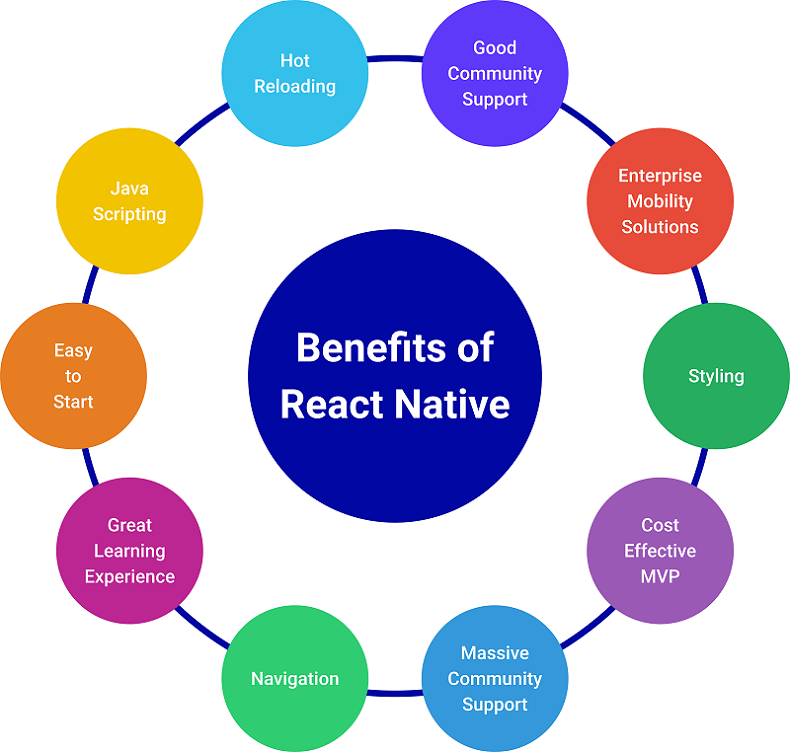
Cons of React Native
- Chaotic Abstraction Layer
- Compatibility Issues
- Patenting and Licensing
- Limited Native Libraries
When to Use React Native?
- When you want to build a mobile app/cross-platform mobile app
- When you want to save time (It allows you to use pre-built components and reusable code for various platforms)
Who is Using React Native?
| Shopify | Skype | Words with friends | Artsy | |
| Facebook Ads Manager | Tableau | Bloomberg | Call of Duty Companion App | Tencent QQ |
| Facebook Analytics | Flipkart | Foreca | adidas GLITCH | |
| Mercari | Tesla | Wix.com | Baidu Mobile | |
| oculus | Nerdwallet | Uber Eats | Salesforce | CBS Sports Franchise Football |
| Coinbase | Discord | Walmart | LendMN | Chop |
| Delivery.com | F8 | Gyroscope | Huiseoul | JD |
| SoundCloud Pulse | Townske | Vogue | whym | Shine |
| Bloomberg | Airbnb | Discord |
Differences: React Native vs. React (JS)
Both complement each other, so there is hardly a comparison. But still, we'll discuss why both terms seem confusing. ReactJS is optimal for creating applications with high functionality and complex calculations. React Native offers a native feeling to your mobile applications.
| Differences | ReactJS | React Native |
|---|---|---|
| Type and SetUp | JavaScript Library | JavaScript Framework |
| Written in | JavaScript | JavaScript, Java, C++, Objective-C, Objective-C++, Python |
| Platform | Web Platform | Android, macOS, Android TV, tvOS, iOS, Web, Windows, UWP, and VR |
| Used For | Developing Web Platform | Developing Mobile Platform |
| Scripting | It supports HTML5 and CSS | It does not support CSS |
| Animation and Gestures | It uses Animation using CSS | It uses Animation using Animation API |
| DOM and Styling | It makes use of React DOM and CSS for styling | Uses native API’s and StyleSheet for Styling |
| Navigation | It makes use of React Router for navigating web pages. | Uses built-in Navigator library |
| Platform Specificity | Single-Platform (web) | Cross-platform (mobile) |
| Developer Tools | Reactide, React Cosmos, React Sight, Storybook, CodeSandbox, React Developers Tools, Evergreen, Bit | Nuclide, Bit, Expo, React, dev tools, Vim Editor, Sublime Text, Jest, and Reduxsauce; |
| Designing | Renders HTML in UI | Makes use of JSX for rendering UI |
| Security | Higher Security Standards | Lower Security Standards |
| Database | It makes use of API for integrating databases. | Uses Realm |
| Server-side rendering | Allows server-side rendering | It does not render on the server. |
| Components | Uses code components | Uses React Native components |
| Learning Curve | It is easier | It is easy if you already know ReactJS |
| Performance | It fares well than React Native | It is good |
| Storage | It makes use of local storage | It makes use of asynchronous storage |
Conclusive: Key Takeaways for React Native and ReactJS Developers in 2022
Although React Native is a great way to build your website, you should use it only when you plan to build both web and app versions or if you already have an app in React Native and plan to launch a web version. Choose React if you want to create a website. Our React developers often refer to ToDoMVC and HNPWA to know what it takes to write websites or web apps in any modern library or framework. Hire React Native developers for web/mobile app development!