IoT in Agriculture: Technology Use Cases for Smart Farming

Learn how IoT in agriculture is transforming the future of crop production, management, and distribution to fight off food scarcity.
In most parts of the world, agriculture is the primary source of livelihood and the backbone of the countries. Rapid climate change, water scarcity, outdated agricultural practices, and overuse of chemical fertilization have led to low production and decreasing capital gain for farmers.
However, things have enormously changed thanks to technological advancements. Farmers can fight off all adversities and boost their capital gain with IoT in agriculture. It’s safe to say that smart farming techniques have brought a much-needed revolution in the agriculture industry. Numerous brands have taken the initiative to launch their farming apps using reliable IoT app development services.
In this article, we’ll discuss how farming in IoT helps mitigate food shortages, prevent crop failures, and provide required information through IoT sensors. You will also learn about industrial IoT applications in agriculture. How are agricultural brands innovating new farming techniques?
IoT in Agriculture: Statistics and Facts
- IoT is the leading tech innovation in agriculture, and drones are one of the most popular tools in agritech.
- Statistics suggest the world will have approximately 32.1 billion IoT devices in 2030, with 8 billion IoT consumer devices in China alone. (Statista)
- New stats show that the market value for smart farming worldwide will reach $33 billion by 2027. (Statista)
- IoT spending surpassed the $1 trillion mark in 2023 and is growing year over year. (Exploding Topics)
- The global IoT market size in precision farming is expected to reach $47.2 billion by 2034, at a CAGR of 20.20% during the forecast period of 2025-2034. (us)
What Is the IoT in Agriculture?
- Enhance farm productivity,
- Address traditional agricultural challenges,
- Increase crop quality and quantity,
- Make farmlands (indoor and outdoor) intelligent,
- Boost profitability for farmers,
- Monitor soil condition, crop health, water requirement, climate conditions, etc.
Key Components of Smart Farming
Farmers implement IoT technology in the agriculture sector using software and hardware components. Being an agricultural brand, you can hire an IoT app development company to develop an innovative agriculture app and connect it with IoT-based hardware devices.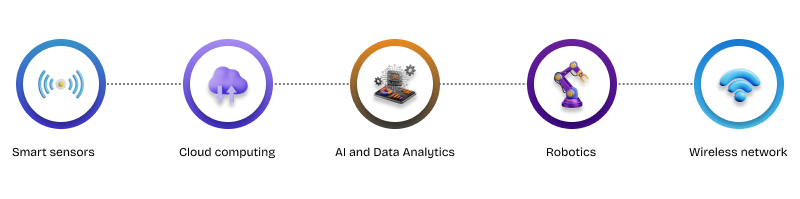 Smart sensors:
These IoT-based devices collect data, such as moisture, nutrients, temperature, early signs of diseases, etc., from the physical environment.
Cloud computing:
It helps store, process, and analyze the data that sensors have collected.
AI and Data Analytics:
Artificial intelligence and advanced data analytics help farmers analyze input and make informed decisions.
Robotics:
Automated systems, like drones and machinery, help farmers conduct all manual tasks, even in rough weather at odd hours.
Wireless network:
The 24x7 wireless network helps farmers get real-time updates on their crop health, monitor inventory, supervise distribution, and more.
Smart sensors:
These IoT-based devices collect data, such as moisture, nutrients, temperature, early signs of diseases, etc., from the physical environment.
Cloud computing:
It helps store, process, and analyze the data that sensors have collected.
AI and Data Analytics:
Artificial intelligence and advanced data analytics help farmers analyze input and make informed decisions.
Robotics:
Automated systems, like drones and machinery, help farmers conduct all manual tasks, even in rough weather at odd hours.
Wireless network:
The 24x7 wireless network helps farmers get real-time updates on their crop health, monitor inventory, supervise distribution, and more.
What Are the Benefits of IoT in Agriculture?
The Internet of Things in agriculture provides numerous advantages to farmers. It allows farmers to use ample amounts of resources at the right time. So they can configure problems when they arise or prevent them from happening. We will now look at the most common benefits of the Internet of Things in agriculture.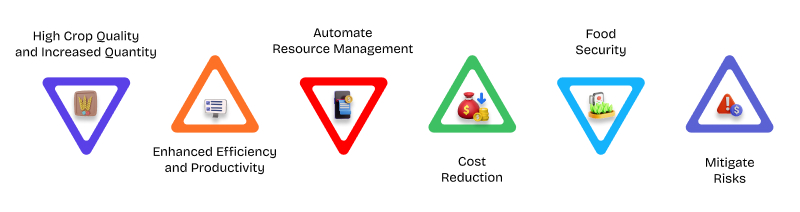
High Crop Quality and Increased Quantity
Farmers can improve production processes, control diseases, and take necessary actions in time by utilizing information analyzed by IoT devices. The high quality of crops helps them sell fast in the market and increase farmers' income.Enhanced Efficiency and Productivity
Remote crop and livestock monitoring enables farmers to create new opportunities to eliminate risks, increase crop yields, and maximize livestock output. They can make better decisions and respond to sudden fluctuations in weather, temperature, humidity, etc.Automate Resource Management
IoT devices used in smart farming equip farmers with real-time resource analysis. They can use the analyzed data to protect their crop and seeds. The real-time analysis also helps utilize livestock waste, fertilizers, seeds, etc. in a better way.Cost Reduction
IoT devices play a vital role in agriculture by preventing crop diseases, tracking crop health for high yields, promoting sustainable farming practices, and more. These advanced farming practices help farmers save money on crop production, management, and distribution.Maintain Food Security
IoT in agriculture can help fulfill the demand for high-quality food for the increasing global population. Farmers can optimize fertilizers, seeds, chemicals, etc., usage and ensure effective use of water, fuel, and electricity. It will encourage healthy crop production and accurate waste management.Mitigate Risks
Farmers can mitigate labor requirements and avoid untrained professionals. The new technology enables them to analyze customer demand, resolve any possible issue efficiently, and control yield production based on collected data. We will now discuss the real-world applications where IoT has transformed farming with real-time data, automated processes, and resource optimization.
Read more to learn how digitalization can boost your farming business. |
Most Popular IoT Use Cases for Smart Farming
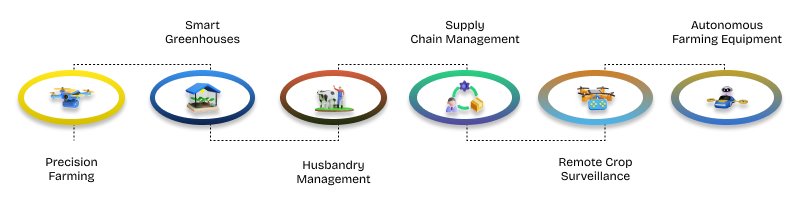
Precision Farming
It is one of the most transformative IoT trends in agriculture, capturing significant attention worldwide. The intelligent farming technique uses smart sensors, GPS, field mapping, and other tools. It results in:- Seamless crop management,
- Examining soil fertility,
- Improving production,
- Efficient resource management, etc.
Smart Greenhouses
Smart greenhouses ensure farmers get control over plantations, fertilization, and irrigation. IoT devices with smart sensors allow farmers to:- Monitor plant nutrient levels,
- Assess soil fertility,
- Check moisture levels,
- Record temperature, etc.
Supply Chain Management
IoT with blockchain technology enhances supply chain management for farmers. They can:- Control the flow of agricultural goods from the production site to consumer markets,
- Ensure transparent, safe, and error-free distribution,
- Track goods remotely,
- Confirm seamless crop management,
- Utilize predictive maintenance,
- Analyze real-time data collection, etc.
Husbandry Management
Having livestock healthy and content has become easier thanks to new tech innovations. Now, farmers can leverage IoT devices to:- Monitor animal health,
- Track their behavior,
- Know their whereabouts on grazing lands,
- Analyze their eating habits,
- Separate weak animals from strong ones based on data, etc.
Autonomous Farming Equipment
Robotics in farming has helped farmers improve productivity. Autonomous drones, tractors, and harvesters are new sensations in the farming industry. They assist in:- Reducing emissions significantly,
- Planting seeds rapidly over a large area,
- Minimizing operational expenses,
- Faster targeted spraying,
- Aerial distribution of seeds and pesticides, etc.
Remote Crop Surveillance
What if you could watch over your crop field from wherever you are at any time? It’s possible with IoT-based systems. Farmers and growers don't require to go out on harsh sunny days or in heavy rain to examine their crops. Using IoT devices, they can:- Inspect and analyze crops,
- Leverage drones to conduct effective crop monitoring,
- View real-time data via camera recording,
- Supervise livestock and manage resources effortlessly, etc.
What Are the Challenges in Smart Farming?

Data Management and Privacy
Smart farming deals with sensitive data regularly. They require to analyze this and keep the information for future inspection. Therefore, companies make sure to block unauthorized access or take steps to keep devices safe from hackers. Some farmers are not tech-savvy, making a significant issue regarding operating IoT devices.Scalability
Even if farmers bear the high initial cost and implement the IoT in agricultural lands, it will still create challenges in the future. Farmers will need to accommodate future demands as the changes occur and demand increases. It will require them to purchase additional devices, upgrade existing ones, and integrate evolving technologies.Interoperability and Implementation Cost
Installing IoT devices like drones, sensors, machinery, and other automated equipment can be expensive for small-scale farmers. In addition, integrating new technologies into existing systems is another challenge farmers face. Streamlining farm operations and data management without seamless interoperability and integration is challenging, and that too, at an affordable rate.Wireless Connectivity in Remote Areas
Many rural and remote areas face significant network issues, limiting the growth of smart farming. The lack of a stable connection prevents proper data storage and analysis processes, rendering the infrastructure useless and limiting the adoption possibilities of smart agriculture. Despite ongoing challenges, top agritech companies are working towards providing sustainable solutions. Let’s see how they are revolutionizing the agriculture sector using IoT.Real-life Examples of Smart Farming
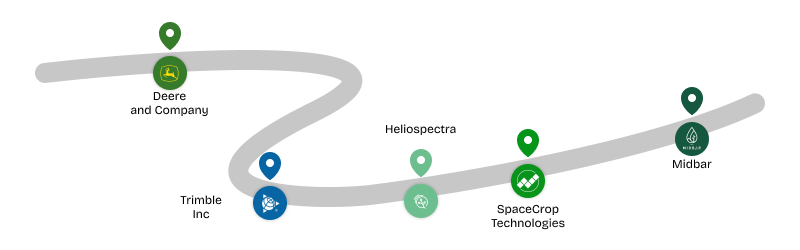
1. Deere and Company: Revolutionizing Precision Farming
This agriculture manufacturing company brings pioneering changes by implementing AI and IoT in manufacturing farm machines. Their new era of products leverages farmers to conduct remote monitoring, remote diagnosis, and predictive maintenance—bringing automation and sustainability to life. John Deere’s manure sensing system is the perfect example of automation. Farmers can detect soil health, fertilizer requirement, nitrate concentration in soil, extract data from previous crops, and more to yield healthier crops. It enables farmers to save costs and maximize efficiency.2. Trimble Inc.: Driving Sustainability in Smart Agriculture
Trimble provides the opportunity to streamline workflow with seamless connectivity and accuracy using modern farming technology. The company offers hardware, software, and agricultural services and promotes sustainable growth. Recently, the AGCO-Trimble joint venture has come forward to accelerate smart farming development. Trimble is making significant investments in areas like GPS-based guidance & steering, water management, positioning, flow control, and other precision agriculture segments.3. Heliospectra: Smart LED Lighting for Indoor Farming
Heliospectra is known for its smart lighting solutions for indoor farming and greenhouse cultivation. The company offers helioCARE services that provide farmers with energy-saving and customized light planning, sensor installations, food and cultivation training, etc. The new Spectrum Design Tool and Dynamic Zoning enable growers to optimize crop growth to gain high-quality yield and achieve operational efficiency. New MITRA multi-channel systems seamlessly integrate with Heliospectra’s HelioCORE software, enhancing light management for greenhouses and indoor farming.4. SpaceCrop Technologies: Sustainable Smart Farm Management
SpaceCrop is a new-age agricultural solution provider. It helps farmers adapt to climate change and increase food security with advanced farming solutions. Their smart farming services include smart irrigation, advanced farm management, and weather forecasting systems. The company leverages satellite data and artificial intelligence to make data-driven decisions and optimize resources for high yield and profitability. Recently, they partnered with the Davao Region Cacao Industry Development Council to implement a satellite monitoring system for 10 cacao farms in the Davao region.5. Midbar: Precision-control Indoor Farming
Midbar introduced an innovative approach to indoor farming requiring less water and utilizing aeroponics to grow crops faster. They use technologies like precision-controlled aeroponics, nozzle-less mist circulation, nano-climate control, and more. The company claims to build the world’s first inflatable farm, AirFarm. It allows people to cultivate indoor farming and eliminates the need for building strong steel structures. They have taken farming to the next level by investing in projects such as polar research and space agriculture, crop diversification, etc. Several agricultural companies are investing in the Internet of Things in manufacturing. The research and development in IoT technology has reached a new level.How Much Does an IoT-based Agricultural Solution Cost?
The Future of IoT in Agriculture
- At the Gongal 10th SKAUST-K AgriTech Mela, farmers, scientists, and agricultural experts gathered to discuss new farming practices and cutting-edge agricultural technologies.
- Government eMarketplace (GeM) has launched 170 new seed categories to simplify access to high-quality agricultural and horticultural seeds.
- At the Food and Agriculture Organization of the United Nations (FAO) meeting in China, twenty-two countries in the region identified twenty distinct Special Agricultural Products (SAPs) to ensure food security and healthy diets.
- Kioti showed off its new RX7340 tractor with Daedong’s precision technology. It demonstrates autonomously managing farm tasks using AI, soil analysis and prescriptions, growth and past diagnosis, and the changes in conventional harvesting methods.
- Solinftec recently released an advanced field management system, The Docking Station. It is solar-powered, autonomous, and integrated with the Solix platform.
- Monarch Tractor raised $133 million in Series C funding. It is considered the largest-ever funding raised in agricultural robotics.
- Robotics Plus released a new autonomous and hybrid vehicle, Prospr, for vineyards and orchards at the 2025 Unified Wine & Grape Symposium. This vehicle can effectively reduce fuel consumption, increase efficiency in the field, and automate intelligent spraying.
Final Thoughts
Eager to learn more about IoT-based farming apps? Talk to our experts or request a quote. |